Marking three years in office, President Bola Tinubu moves away from heavy-handed mandates to untangle decades-old community and commercial legal deadlocks.
By Abiodun Oladunjoye is the Director of Information and Public Relations in the State House
While President Bola Ahmed Tinubu’s first three years in office are heavily defined by structural financial adjustments—including the removal of fuel subsidies, exchange rate unification, and the introduction of the Nigerian Education Loan Fund (NELFUND)—a less celebrated but equally impactful pillar of his governance is taking center stage: proactive conflict resolution.
According to an analytical review by the Director of Information and Public Relations at the State House, Abiodun Oladunjoye, the administration has systematically prioritized institutional dialogue and regional reconciliation to untangle deep-seated security, political, and commercial bottlenecks that had stalled national development for decades.
A prime example of this strategy is the resolution of the protracted Ogoni crisis in the Niger Delta, an environmental and political impasse that suspended regional oil exploration in the 1990s. Operating through the Office of the National Security Adviser (ONSA), the administration engaged community representatives, traditional rulers, and the Nigerian National Petroleum Company Limited (NNPCL) to rebuild broken trust.
The historic submission of the report of the Presidential Committee on Ogoni Consultations, chaired by Professor Don Baridam, on September 25, 2025, effectively paved the way for an equitable framework to resume oil exploration.
To cement this reconciliation, President Tinubu hosted the Ogoni delegation at the State House and bestowed posthumous national honors on key figures of the struggle, including Ken Saro-Wiwa.
The administration extended this reconcisatory approach to the oil sector by resolving the long-standing Malabu Oil (OPL 245) dispute.
According to the Attorney-General of the Federation and Minister of Justice, Lateef Fagbemi, SAN, settling this legal battle eliminates the political uncertainty clouding one of Nigeria’s most lucrative asset blocks, a move projected to boost national oil production capacity by approximately 150,000 barrels per day.
Similarly, the Ministry of Aviation and Aerospace Development, led by Festus Keyamo, SAN, intervened on April 30, 2026, to end a bitter, 20-year concession dispute between the Federal Government and Bi-Courtney Aviation Services Limited over the operations of the Murtala Muhammed Airport Terminal Two (MMA2) in Lagos.
The administration has also applied this strategy of diplomatic negotiation to ethno-religious flashpoints.
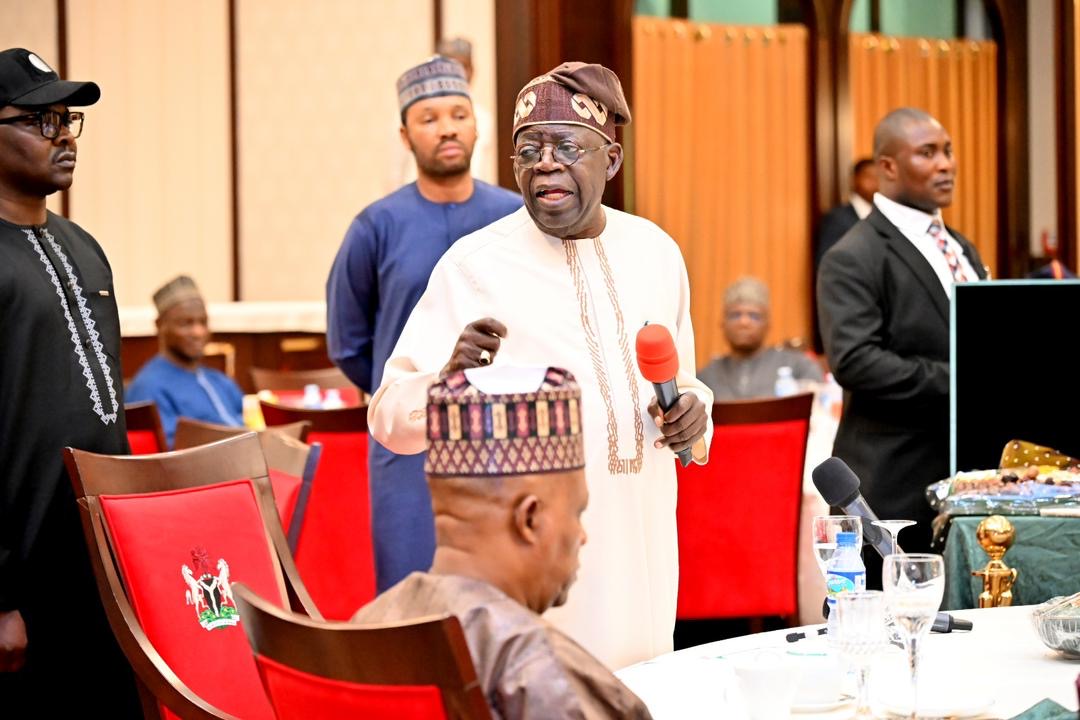
On April 29, 2026, President Tinubu hosted a 32-member delegation of Plateau State stakeholders at the Presidential Villa in Abuja. Led by Governor Caleb Mutfwang, the broad-spectrum meeting brought together former governors, traditional rulers, religious leaders, and youth organizations. Rather than enforcing top-down military or political mandates, the President tasked the local leaders with reviewing historical government White Papers to co-create sustainable, community-backed recommendations for peace.
Visit GMTNewsng for more news stories.