Discover how Baporo Prison in Burkina Faso is redefining justice through agricultural rehabilitation, inmate reintegration and productive work that could inspire prison reforms across Africa.
How Burkina Faso’s Agricultural Model Is Redefining Justice
Across much of the world, prisons are designed to punish. Tall walls, locked gates and overcrowded cells often define correctional systems, leaving inmates to count the days until their release. Yet one important question remains: Should prisons merely punish, or should they also prepare people for a better life after incarceration?
The Baporo Prison model in Burkina Faso offers a compelling answer. While no correctional system is beyond criticism or improvement, Baporo Prison demonstrates that justice can embrace accountability without abandoning rehabilitation.
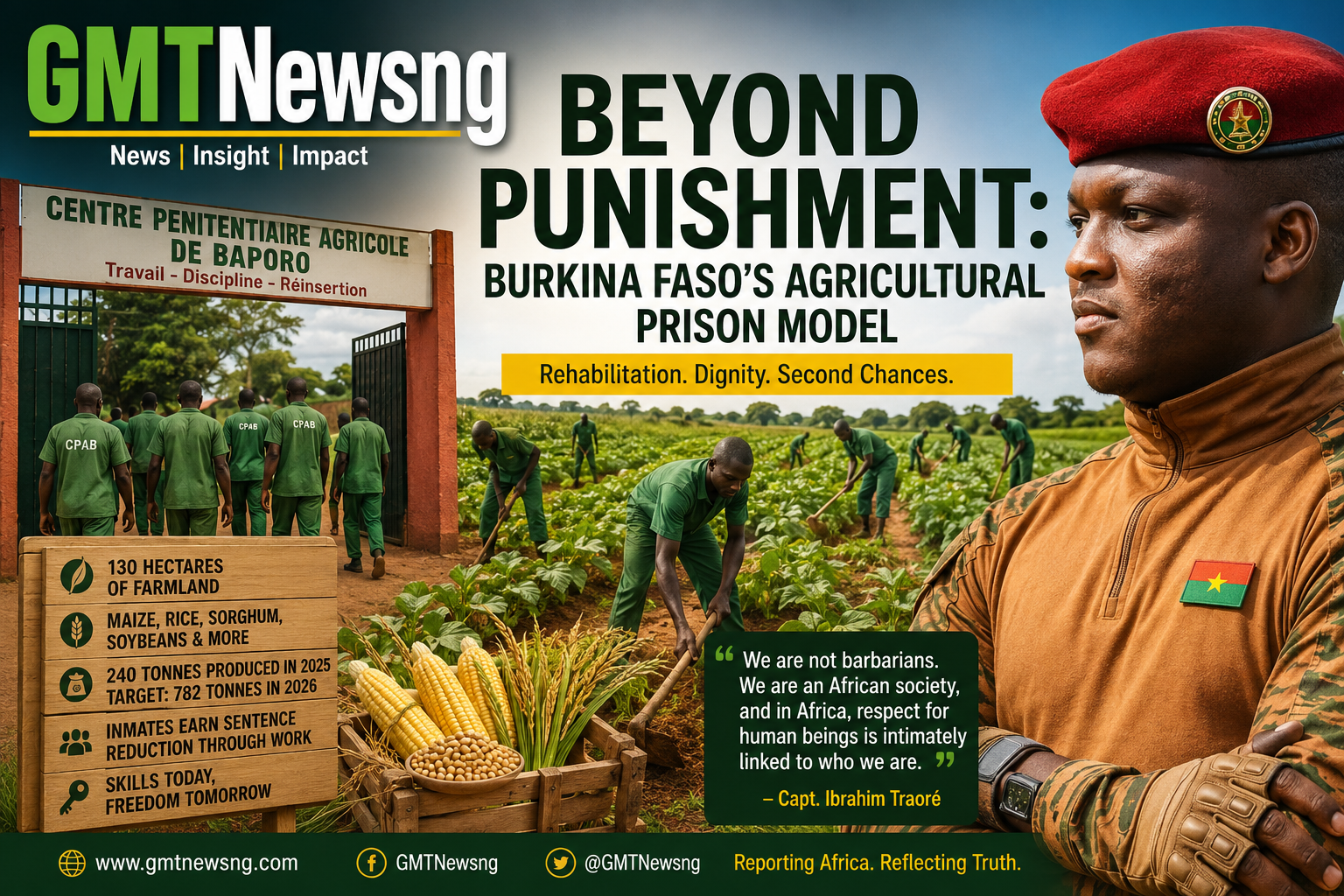
Established in 1986 during the administration of the late revolutionary leader Thomas Sankara, Baporo Prison was envisioned as an agricultural penitentiary where productive work would become part of an inmate’s journey toward reform. Nearly four decades later, the facility has regained international attention under President Captain Ibrahim Traoré, whose administration has strengthened legally recognised work-based rehabilitation for eligible prisoners.
Baporo Prison and the Philosophy of Rehabilitation
Unlike many conventional prisons where idleness often fuels frustration and hopelessness, Baporo Prison encourages eligible inmates to cultivate maize, rice, sorghum, soybeans and other crops on expansive farmland. The work is not simply about food production; it is about rebuilding discipline, responsibility and self-worth.
Recent legal reforms in Burkina Faso permit eligible inmates who participate in approved public-interest work to earn reductions in their prison sentences under specified legal conditions. The underlying principle is straightforward: where rehabilitation is genuine, society should recognise and encourage it.
This philosophy reflects an important truth. Most prisoners will eventually return to their communities. The real question is whether they return with resentment and few prospects, or with practical skills, renewed confidence and a stronger commitment to lawful living.
In this respect, Baporo Prison offers a model worthy of serious reflection.
From Thomas Sankara to Ibrahim Traoré
The history of Baporo Prison illustrates the enduring relevance of Thomas Sankara’s vision for self-reliance and productive public institutions. Although Burkina Faso has changed significantly since 1986, the idea that correctional facilities should contribute to national development has remained remarkably resilient.
During his visit to Baporo Prison, Captain Ibrahim Traoré stated:
“We are not barbarians. We are an African society, and in Africa, respect for human beings is intimately linked to who we are. No matter what situation a person is in, they must have a minimum of respect.”
Regardless of differing political opinions about Burkina Faso’s current leadership, this principle deserves recognition. Respect for human dignity should remain central to every justice system.
The United Nations Standard Minimum Rules for the Treatment of Prisoners, widely known as the Mandela Rules, similarly emphasise that imprisonment itself constitutes the punishment. Correctional institutions should therefore prepare inmates for successful reintegration into society rather than deepen cycles of despair.
Why Agricultural Prisons Matter
The significance of Baporo Prison extends beyond correctional policy.
Burkina Faso continues to face economic pressures, food insecurity and security challenges. Productive agricultural programmes help transform correctional facilities into places that contribute to national food production while equipping inmates with employable skills.
The reported growth in agricultural output at Baporo Prison demonstrates the potential of structured rehabilitation. More importantly, it reminds us that prison labour, when governed by law, proper safeguards and respect for human dignity, can become an instrument of restoration rather than exploitation.
This distinction matters.
A correctional programme should never sacrifice prisoners’ rights. Transparency, legal oversight and voluntary participation under established legal frameworks remain essential. These safeguards strengthen public confidence and ensure that rehabilitation never becomes coercion.
Lessons Africa Can Learn from Baporo Prison
Many African countries struggle with overcrowded prisons, limited correctional budgets and high rates of repeat offending. Simply locking people away without addressing the causes of criminal behaviour rarely produces safer societies.
Baporo Prison suggests an alternative approach.
Vocational training, agricultural production and structured work can coexist with lawful punishment. Such programmes help inmates acquire skills that may reduce dependence on crime after release while enabling correctional institutions to contribute positively to national development.
No country should copy another’s system without adapting it to local laws and circumstances. Yet successful ideas deserve careful study, regardless of where they originate.
If properly regulated, similar agricultural rehabilitation centres could complement correctional reforms across Africa while respecting constitutional protections and internationally recognised human rights standards.
Justice Beyond Punishment
Ultimately, the greatest achievement of Baporo Prison may not be measured by hectares cultivated or tonnes of harvested crops. Its true value lies in its reminder that justice is strongest when it balances accountability with hope.
A prison sentence necessarily restricts liberty, but it should not extinguish the possibility of personal transformation. Communities benefit when former inmates return with practical skills, renewed purpose and a genuine opportunity to rebuild their lives.
The conversation sparked by Baporo Prison is therefore much larger than Burkina Faso. It challenges policymakers across Africa to rethink what correctional institutions should accomplish.
The true measure of a prison is not how many people it can confine, but how many lives it can help restore. If Baporo Prison continues to demonstrate that productive work, dignity and accountability can coexist within a lawful correctional system, it may ultimately harvest something far more valuable than crops—it may help cultivate a new vision of justice for Africa and the wider world.
Visit GMTNewsng for more news stories.