UNN researchers urge stronger action against PHC absenteeism in Enugu, identifying transport support, workplace cooperation and community monitoring as key solutions.
The Health Policy Research Group (HPRG) of the University of Nigeria, Nsukka (UNN), has called for stronger government action to tackle **PHC absenteeism** and improve accountability in primary healthcare facilities across Enugu State.
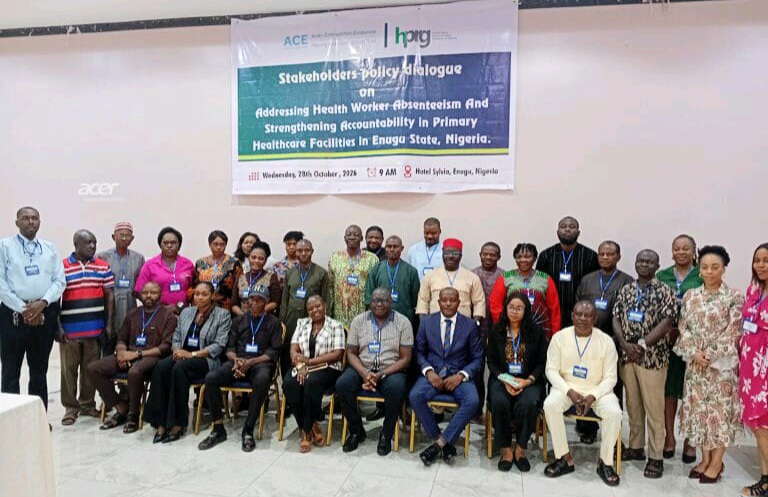
The group’s Coordinator, Prof. Obinna Onwujekwe, made the call on Thursday during a stakeholders’ policy dialogue on addressing health workers’ absenteeism and strengthening accountability in primary healthcare facilities in the state.
The News Agency of Nigeria (NAN) reports that the dialogue brought together representatives of the Enugu State Ministry of Health, the State Primary Healthcare Development Agency, the National Health Insurance Authority, community stakeholders and the media.
Onwujekwe said the engagement was organised to present research findings and discuss practical measures for reducing absenteeism among healthcare workers.
He identified transportation difficulties, inadequate workplace support and limited community involvement as major factors contributing to the problem.
PHC Absenteeism
According to him, the research identified three interventions that could improve workers’ attendance and service delivery: transportation support, stronger workplace support systems and community participation in monitoring healthcare facilities.
“One of the findings is that providing transportation support to health workers, especially those serving in remote communities, will encourage them to report to work regularly.
“We also discovered that providing support systems within health facilities, where colleagues support one another, can improve attendance.
“Community involvement is equally important because when communities participate in monitoring healthcare services, it helps to strengthen accountability,” he said.
The coordinator said combining the interventions could significantly reduce **PHC absenteeism** and improve healthcare delivery.
He explained that the dialogue was intended to translate research evidence into practical government policies and programmes.
“Our expectation is that government and other policymakers will take renewed action to ensure that these interventions are implemented across the state,” he said.
Onwujekwe expressed optimism that implementing the recommendations would help ensure that residents visiting primary healthcare facilities would find health workers available to attend to them.
He described the research as complementary to the state government’s efforts to expand healthcare infrastructure, stressing that newly constructed health centres must also have personnel available to provide services.
He acknowledged the introduction of a clock-in system by the state government to monitor workers’ attendance, but maintained that tackling **PHC absenteeism** required several complementary strategies beyond attendance monitoring.
Presenting the research findings, HPRG Research Associate, Dr Pamela Ogbozor, said the intervention was implemented between August 2025 and January 2026 in four primary healthcare facilities in Nsukka and Igbo-Etiti, covering Enugu North and Nkanu West.
She said eight other facilities served as control locations where the interventions were not introduced.
Ogbozor reported that 100 per cent of health workers in the intervention facilities regularly completed attendance registers, compared with 90 per cent in the control facilities.
She added that 15.4 per cent of workers in the intervention facilities left before the end of their shifts, compared with 48 per cent in the control locations.
She identified absenteeism as including failure to report for duty, arriving late and leaving before the end of scheduled shifts.
The researcher warned that the practice could expose patients to serious complications and even death, while placing additional workloads on the few workers available.
Representing the Independent Corrupt Practices and Other Related Offences Commission (ICPC), Mr Stephen Obi described absenteeism and ghost workers as serious challenges.
“Absenteeism and ghost workers go together and to the commission, it is a serious challenge,” he said.
Obi said the dialogue had provided useful information which he would take back to the commission.
Also speaking, Mr Alex Ugwu, Chairman of the Ward Development Committee at Hilltop Health Centre, Ngwo, welcomed the intervention, saying it would help identify service gaps and improve healthcare delivery.
HPRG is partnering with the SOAS Anti-Corruption Evidence (ACE) research consortium in the United Kingdom to investigate and reduce corruption in health and public service delivery.
Visit GMTNewsng for more on PHC Absenteeism and other news stories.
PHC absenteeism, Enugu healthcare, UNN, Health Policy Research Group, Primary Healthcare Centres, Health workers, Enugu State Government
#PHCAbsenteeism #EnuguHealthcare #UNN #PrimaryHealthcare #HealthAccountability