UNICEF has commended Governor Peter Mbah for consistently allocating over 33 per cent of Enugu State’s budget to education, while seeking stronger collaboration in child health and human development.
ENUGU — The United Nations Children’s Fund (UNICEF) has commended the Enugu State Government for consistently allocating more than 33 per cent of its budget to education, describing the investment as a commitment to the future of children.
UNICEF also expressed readiness to strengthen its partnership with the state government in education, child nutrition, healthcare and other areas of human development.
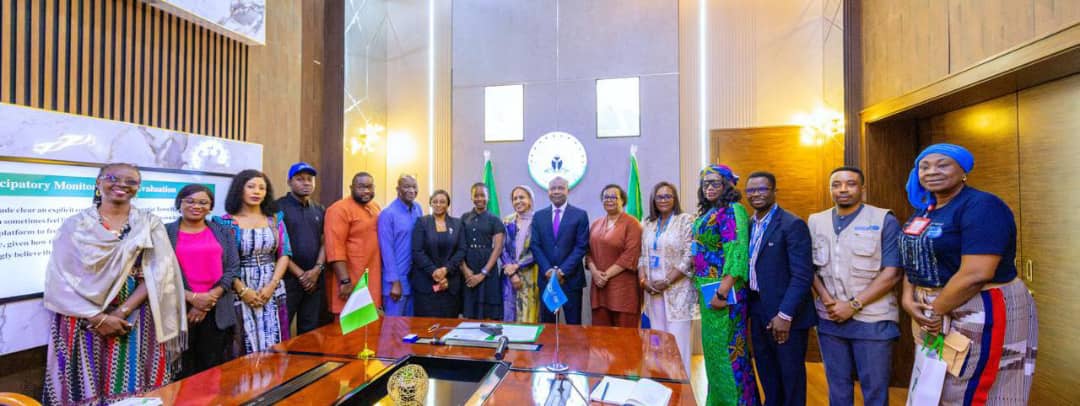
The UNICEF Nigeria Country Representative, Ms. Wafaa Saeed, made the remarks on Tuesday when she led a delegation of the organisation on a courtesy visit to Governor Peter Mbah at the Government House, Enugu.
Saeed praised the state government’s sustained investment in education, noting that its allocation of approximately one-third of the annual budget to the sector exceeded the 15 to 20 per cent benchmark UNICEF advocates for governments.
“We appreciate what Enugu State has done. Almost one-third of the state’s budget is devoted to education, far and above the United Nations recommendation. It actually shows that ‘tomorrow is here’,” she said.

She described the investment as a strategic commitment to the future of Enugu’s children and said it provided an opportunity for UNICEF to deepen its engagement with the state.
According to her, the organisation was ready to contribute its global experience, technical expertise and knowledge to strengthen existing programmes and support new initiatives.
Saeed also highlighted child nutrition and other social development programmes as areas where the partnership could be expanded, stressing the importance of ensuring that interventions were sustainable.
She said Enugu’s approach to investing in children and human development could offer valuable lessons for other parts of Africa.
Responding, Mbah said his administration was interested in a practical partnership that would enable the state to benefit from UNICEF’s international experience in designing and implementing social-sector programmes.
The governor said collaboration with the organisation would help the state avoid unnecessary trial and error while improving the effectiveness of its interventions.
“Such partnership will help my state avoid trial and error because of UNICEF’s experience and expertise. We look forward to that experience,” he said.
Mbah reaffirmed that human development remained central to his administration’s development agenda, stressing that economic growth must go hand in hand with investments in social services.
He explained that the government’s investments in education, healthcare and other essential services were intended to prevent future poverty and address social challenges before they became more difficult and expensive to manage.
“Human development is essential to us, and as much as we want to grow our economy, we do so without undermining human development. Social services are as important, if not more important, than the economic sector,” he said.
On education, the governor said the state had developed a 10-year education plan to equip children with the knowledge and skills required to thrive in the modern economy.
He noted that changing global demands required a departure from traditional teaching methods, adding that the state was adopting approaches that would better prepare children for future employment and productivity.
“The world of today is different from the world of 40 years ago, and to use the same methods and tools of 40 years ago to teach children of today will be a mismatch,” Mbah said.
He also highlighted the importance of early childhood development, explaining that the state was integrating health screening and nutritional assessments into its school admission process.
According to him, children undergo screening before admission into kindergarten to identify medical and nutritional needs that require attention.
The governor further explained that the state’s Smart Green Schools were deliberately located in rural communities to reduce disparities in access to quality education between urban and rural areas.
He said the government was using measurable indicators and data to assess the impact of its education reforms, noting that some indicators showed Enugu performing above the national average.
However, he maintained that the reported progress would not make the government complacent, as it remained committed to continuous improvement and adapting its education policies to local needs.
“We have measurable indicators, and data from organisations like yours help us to assess what we are doing. And we can say that we have indicators higher than the national average, but that will not make us complacent,” he said.
On healthcare, Mbah acknowledged UNICEF’s interventions in some local government areas, particularly those aimed at reducing maternal and infant mortality.
He identified rural healthcare delivery as a priority of his administration, noting that the government was constructing Type-2 Primary Healthcare Centres across the state’s 260 wards.
The governor said the facilities were being equipped with solar power systems to ensure reliable electricity, adding that UNICEF had supported the installation of solar systems in some healthcare centres.
He also identified the renovation of rehabilitation and child-care facilities as another area where UNICEF’s technical assistance would be valuable.
Mbah expressed interest in expanding the partnership beyond existing projects, particularly through the adoption of international best practices and technical expertise in healthcare, education and child welfare.
Welcoming the UNICEF delegation, the governor described Enugu as a historic and cosmopolitan city with considerable potential for tourism and development.
He recalled the discovery of coal in the area in 1909, which contributed to Enugu’s emergence as an important administrative and commercial centre and its subsequent role as the capital of the former Eastern Region.
Mbah expressed optimism that the engagement would lead to stronger cooperation between UNICEF and the state government, particularly in scaling up existing programmes and ensuring their sustainability.
The visit is expected to provide a platform for further discussions on education, child nutrition, healthcare and other human development initiatives in Enugu State.
Visit GMTNewsng for more news stories.