Nigeria has issued a strong warning on transnational threats as Vice-President Kashim Shettima urges global cooperation against terrorism, cyberattacks and organised crime at the 81st UN General Assembly.
Nigeria has warned that even powerful national defences cannot fully protect countries from terrorism, organised crime, cyberattacks and other security threats that operate across international borders.
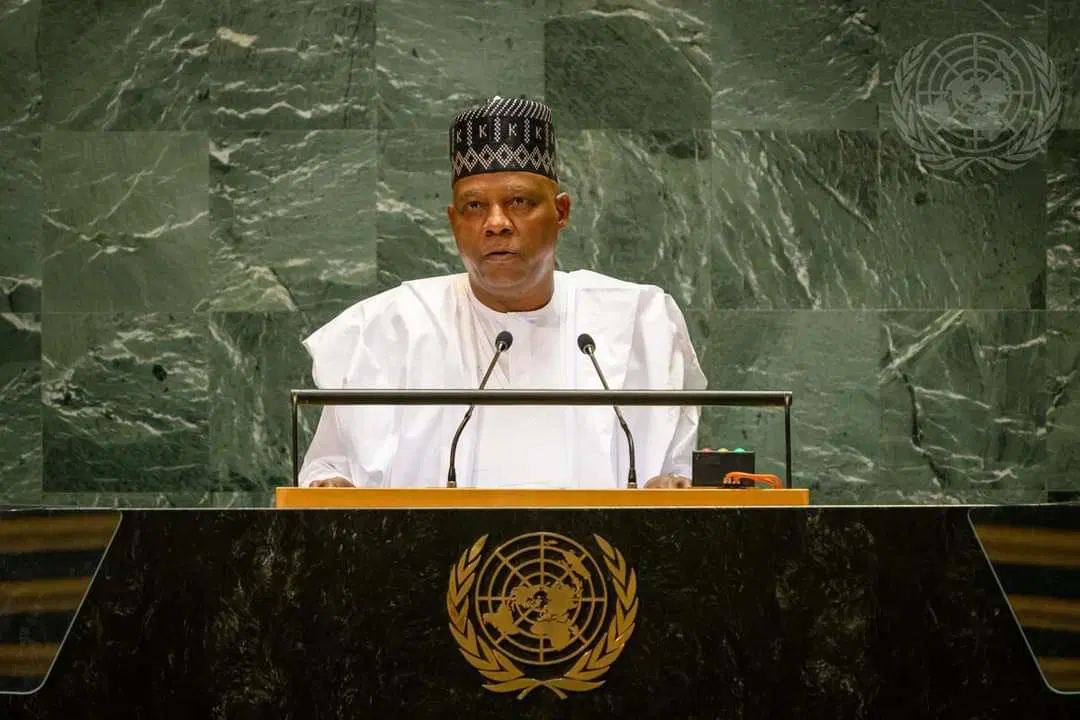
Vice-President Kashim Shettima gave the warning on Thursday, September 24, while delivering President Bola Ahmed Tinubu’s national statement at the 81st United Nations General Assembly in New York.
Shettima said modern security threats exploit gaps between national responses, making international cooperation, intelligence sharing and coordinated action essential to confronting them.
“Nigeria’s prolonged struggle against Boko Haram, ISWAP, and other armed groups has taught us that military victories require enduring foundations in education, economic opportunity, accountable governance, and communities whose rights and dignity are protected,” Tinubu said in the statement delivered by Shettima.
The President further called for countries to exchange intelligence, strengthen institutional capacity, disrupt the financing of violence and prevent weapons from crossing borders.
He said terrorism, organised crime, cyberattacks and illicit finance continued to exploit weaknesses in national security responses, reinforcing the need for collective action.
Nigeria maintained that military operations remain necessary in confronting violent extremist groups but cannot, on their own, guarantee lasting peace.
Tinubu linked sustainable security to education, economic opportunity, accountable governance and the protection of human rights, arguing that development cannot take root where violence continues to destroy livelihoods.
“Development cannot take root while violence repeatedly uproots livelihoods, and peace cannot endure while injustice and exclusion replenish the ranks of those who threaten it,” the President said.
Shettima’s presentation of the statement came against the backdrop of Nigeria’s prolonged counter-insurgency operations against Boko Haram, ISWAP and other armed groups in the North-East.
Nigeria also pointed to insecurity in the Sahel as evidence that instability in one country can have consequences for neighbouring states, including displacement, disruption of regional integration and threats to democratic governance.
The President reaffirmed Nigeria’s commitment to regional security through the Economic Community of West African States (ECOWAS), the African Union and partnerships in the Gulf of Guinea.
He said Nigeria continued to support mediation, democratic governance, counter-terrorism and maritime security initiatives while contributing personnel and resources to international peace operations.
Nigeria’s peacekeeping engagements cited in the address included Liberia, Sierra Leone, Darfur, Mali and The Gambia.
Tinubu also warned against treating conflicts in distant countries as problems that would have no consequences for other parts of the world.
He said conflicts could disrupt trade, increase humanitarian pressures, drive displacement, strengthen extremist networks and create wider economic and security shocks.
Nigeria consequently urged world leaders to renew their commitment to dialogue, mutual respect, collective responsibility and international law.
Tinubu reaffirmed Nigeria’s support for the peaceful settlement of disputes under the United Nations Charter, while calling for urgent diplomatic attention to Sudan and other conflict-affected countries.
He urged parties to conflicts to protect civilians, facilitate humanitarian access and uphold international humanitarian and human rights law.
The President also argued that military victories alone could not secure lasting peace, calling for greater investment in peacebuilding, mediation, institution-building and conflict prevention.
“We place our faith in diplomacy because military victories alone cannot secure lasting peace,” he said.
Beyond security, Nigeria used the 81st UN General Assembly to renew its call for reform of the United Nations Security Council.
Tinubu said the world in 2026 should not remain governed by a distribution of power established in 1945 and called for at least two permanent African seats on the Security Council, with the rights and responsibilities of permanent membership, including veto power for as long as the veto exists. Nigeria also called for five non-permanent African seats.
The 81st UN General Debate is being held from September 22 to 28 under the theme, “Restoring trust, managing transformation: A United Nations that delivers for all.”
Nigeria’s address therefore combined calls for stronger international security cooperation with demands for greater African representation in global decision-making and renewed emphasis on diplomacy, development and multilateral action.
Visit GMTNewsng for more news stories.