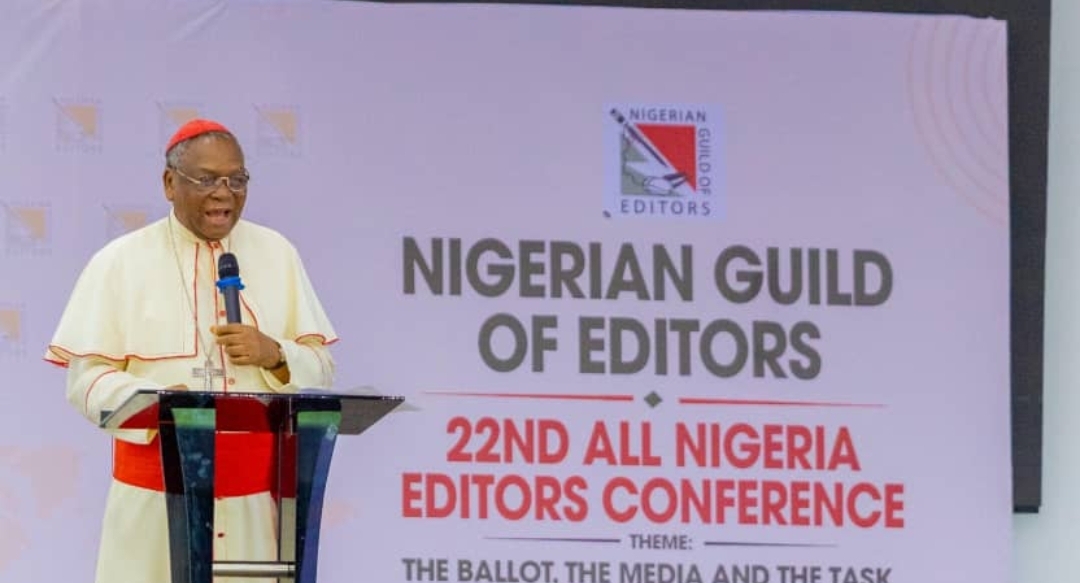
Voters must be protected from intimidation and misinformation ahead of the 2027 elections, Cardinal John Onaiyekan and Obi of Onitsha Alfred Achebe have warned at the 22nd All Nigeria Editors Conference in Enugu.
Former Catholic Archbishop of Abuja, John Cardinal Onaiyekan, and the Obi of Onitsha, Igwe Nnaemeka Alfred Achebe, have warned against the intimidation of voters ahead of the 2027 general elections, stressing the need to protect the integrity of the electoral process.
They spoke separately on Thursday at the 22nd All Nigeria Editors Conference (ANEC), organised by the Nigerian Guild of Editors (NGE) in Enugu.
The conference, which held from September 24 to 25 at The Dome, International Conference Centre, Enugu, was themed, “The Ballot, The Media and the Task of Keeping Democracy Alive,” with a sub-theme on detecting and debunking AI-generated disinformation before, during and after elections. More than 500 editors and other stakeholders were expected to participate.
Onaiyekan, who delivered the keynote address, said Nigerians must remain at the centre of governance and that elections should reflect the genuine wishes of citizens.
He expressed concern over the quality of elections in the country and called on political actors and electoral institutions to work towards free, fair and credible elections.
The cleric said security agencies had a responsibility to provide a safe environment for voters rather than create an atmosphere of fear around polling centres.
“When security agents with their paraphernalia of force are all over the place, with sirens blaring everywhere, people are intimidated and many are even afraid to come out to vote,” he said.
Onaiyekan also advocated reforms to strengthen the Independent National Electoral Commission (INEC), improve electoral justice and ensure that election petitions are resolved within reasonable time.
He proposed greater independence in the appointment of electoral commissioners and the establishment of specialised tribunals for election-related cases. He also called for mechanisms that would enable citizens to challenge election results where their votes were directly at stake.
The former archbishop further urged politicians to accept electoral outcomes in good faith, arguing that courts should primarily resolve disputes arising from elections rather than become the institutions that determine who wins elections.
His position on the role of the judiciary was also reflected in wider discussions at the conference, where speakers raised concerns about the growing role of courts in determining electoral outcomes after voting has taken place.
Igwe Alfred Achebe, who chaired the conference, said democracy could not be sustained without deliberate efforts by citizens and institutions to protect democratic processes.
He said the media had a critical responsibility to provide voters with accurate and credible information, particularly as artificial intelligence makes it easier to create and distribute convincing false audio, video and images.
“The ballot is the citizen’s voice. The media is a mirror by which the citizen sees the world clearly enough to know what to say with that voice,” Achebe said.
He warned that AI-generated misinformation could undermine the credibility of elections if fabricated content was not detected and debunked before, during and after voting.
“Today, falsehood can be manufactured by machines and disseminated with a persuasiveness that mimics truth so precisely that even trained eyes can struggle,” he said.
Achebe therefore urged editors and journalists to strengthen fact-checking and verification systems ahead of the 2027 elections.
Also speaking through the Resident Electoral Commissioner in Enugu State, Dr Chukwuemeka Chukwu, INEC Chairman, Prof. Joash Amupitan, called on media organisations to strengthen their capacity to identify and counter AI-driven disinformation.
Amupitan said electoral technology must remain subject to human auditing and legal verification to safeguard the credibility of election processes.
He urged news organisations to establish dedicated fact-checking desks and incorporate digital verification tools, deepfake detection systems and forensic image analysis into their newsroom operations.
“Fortify your newsrooms against AI-driven disinformation, prioritise verification over speed, and stand as an unyielding fortress of truth,” he said.
The INEC chairman said the commission was preparing for the logistical demands of the 2027 elections, noting that more than 176,000 polling units would require extensive personnel and operational coordination.
In August, Amupitan disclosed that INEC planned to deploy approximately 1.4 million ad hoc personnel across more than 176,000 polling units for the 2027 general elections.
He said the scale of the exercise made cooperation among INEC, the media, security agencies, political parties, civil society and voters essential to the conduct of a transparent election.
The discussions at the Enugu conference placed voter protection, credible information, electoral accountability and technological verification at the centre of preparations for the 2027 general elections.
Visit GMTNewsng for more news stories.