NNOM: Only three women have received the Nigerian National Order of Merit (NNOM) since 1979. GMTNewsng examines the historical, institutional and academic factors behind the gender disparity.
More than four decades after the Nigerian National Order of Merit (NNOM) was established to celebrate the nation’s most outstanding intellectuals, only three women have been inducted into its prestigious roll of laureates.
The statistic has reignited conversations about gender representation in Nigeria’s academic and research community, with experts pointing to decades of structural barriers rather than shortcomings in the award’s merit-based selection process.
The NNOM, instituted in 1979, is widely regarded as Nigeria’s highest recognition for intellectual and academic excellence. Unlike national honours that acknowledge public service or political leadership, the NNOM is reserved for individuals whose lifetime contributions have significantly advanced knowledge, research and national development.
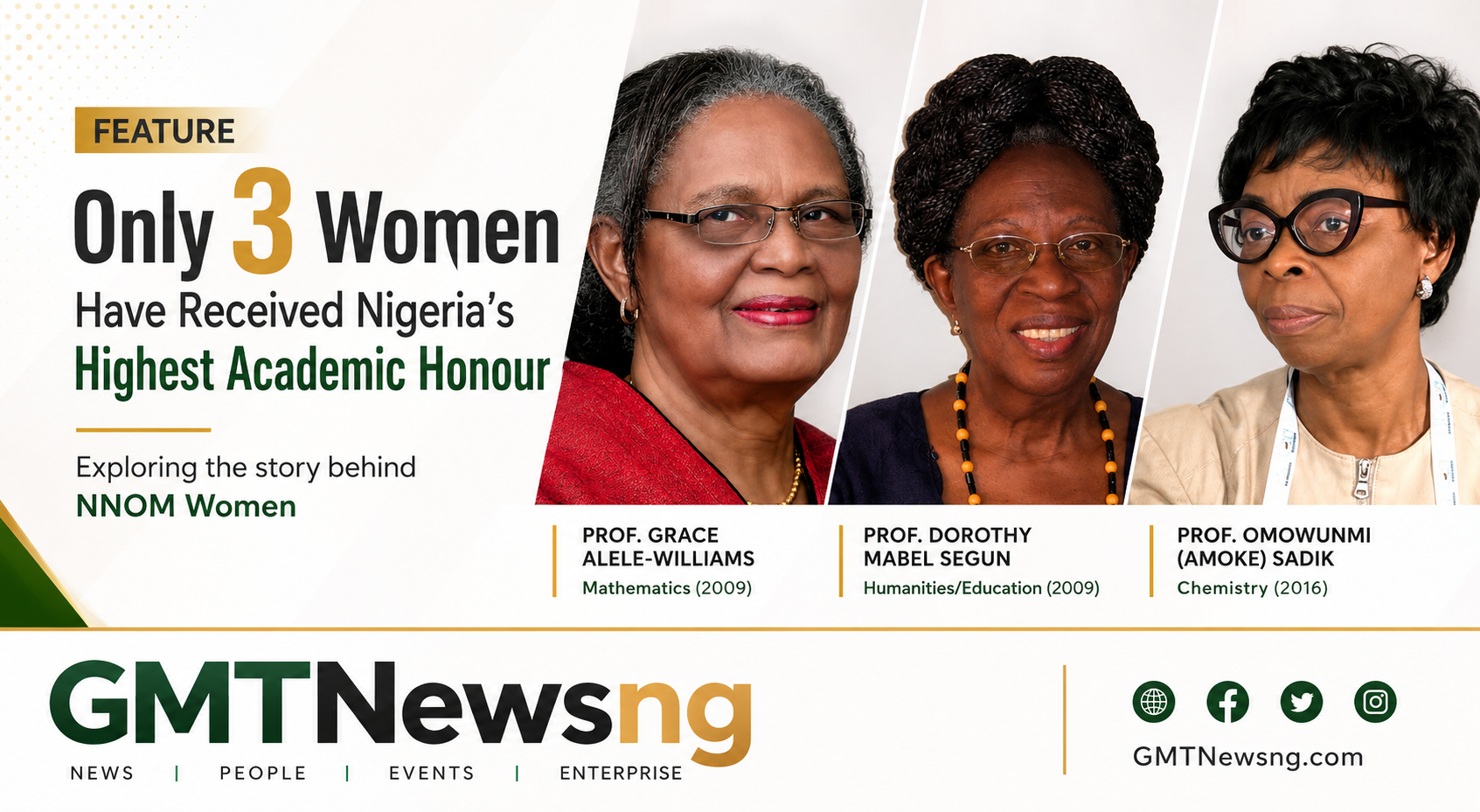
Since the first laureates were named, only Professor Grace Alele-Williams, Professor Dorothy Mabel Segun, and Professor Omowunmi (Amoke) Sadik have received the honour.
Professor Alele-Williams and Professor Segun were both honoured in 2009, making it the only year in NNOM history when two women received the award simultaneously. Professor Sadik became the third female laureate in 2016, and no other woman has joined the list since then.
Historical Barriers Limited the Pool of Candidates
Analysts say the low number of female NNOM laureates reflects Nigeria’s educational history.
Many of the early recipients of the award belonged to generations that pursued higher education between the 1940s and 1960s—a period when university education was far less accessible to Nigerian women, especially in science, engineering and medicine.
As a result, the number of women who could build the decades-long academic careers required for consideration remained comparatively small.
Lifetime Achievement Requirement
Another factor is the nature of the award itself.
The NNOM is not conferred for a single outstanding publication or discovery. Instead, it recognises a lifetime of exceptional scholarship, research and innovation, often spanning several decades.
Because women entered Nigerian academia in larger numbers only in more recent decades, relatively fewer have accumulated the extensive body of work traditionally associated with NNOM recognition.
Challenges Within Academia
Gender disparities in Nigeria’s higher education sector also contribute to the imbalance.
Although female enrolment in universities has increased significantly, women remain underrepresented among full professors, principal investigators, research leaders and vice-chancellors.
Experts have attributed this to factors including unequal access to research funding, slower career progression, limited mentorship opportunities and career interruptions associated with family responsibilities.
These challenges can reduce the visibility and impact of women’s scholarly contributions over time.
The Nomination Process Matters
Unlike some honours that rely solely on government selection, the NNOM depends on a rigorous nomination process.
Outstanding scholars must be nominated and their achievements subjected to extensive evaluation.
Observers note that women may receive fewer nominations or have less access to influential academic networks that champion deserving candidates, potentially affecting representation without any explicit gender bias in the selection criteria.
Merit Remains the Guiding Principle
The Nigerian National Merit Award Secretariat maintains that the honour is based strictly on excellence.
Indeed, the award has occasionally not been presented in years when no nominee met its exacting standards.
There is no evidence that the NNOM’s rules discriminate against women. Rather, analysts argue that historical inequalities in education and research opportunities have produced unequal outcomes under a gender-neutral system.
Signs of Progress
Despite the disparity, experts believe the outlook is improving.
More Nigerian women are earning doctoral degrees, leading research projects, securing international grants and occupying senior academic positions than ever before.
The achievements of Professors Alele-Williams, Segun and Sadik have also inspired younger generations of female scholars across science, medicine, engineering, education and the humanities.
As more women attain distinguished academic careers and receive strong institutional nominations, analysts expect the gender gap among NNOM laureates to narrow in the coming years.
For now, however, the fact remains that in over 45 years of the Nigerian National Order of Merit, only three women have attained what many regard as the country’s highest intellectual honour.
The Three Female NNOM Laureates
- Professor Grace Alele-Williams – Mathematics (2009)
- Professor Dorothy Mabel Segun – Humanities/Education (2009)
- Professor Omowunmi (Amoke) Sadik – Chemistry (2016)
Nigerian National Order of Merit, NNOM, Women in Academia, Grace Alele-Williams, Dorothy Mabel Segun, Omowunmi Sadik, Nigerian Scholars, Higher Education, Gender Equality, Research
Visit GMTNewsng for more news stories.