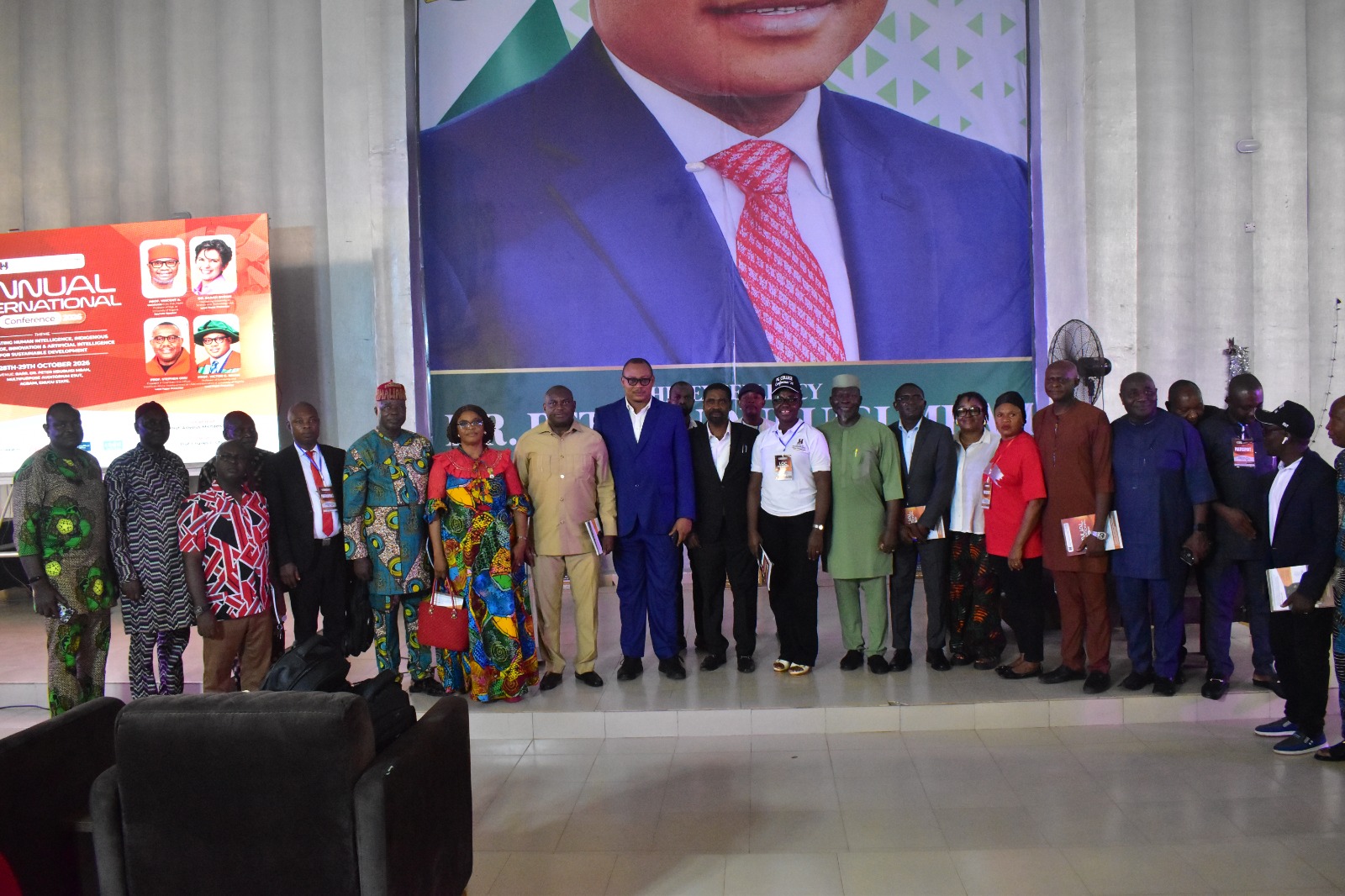
ESUT Conference
ESUT Conference challenges researchers to combine artificial intelligence, indigenous knowledge and professional expertise to address Nigeria’s development challenges
By Maxwell Menkiti Ngene PhD.
The 2026 ESUT conference has challenged researchers to combine artificial intelligence (AI) with human intelligence, indigenous knowledge and professional expertise to address Nigeria’s development challenges.
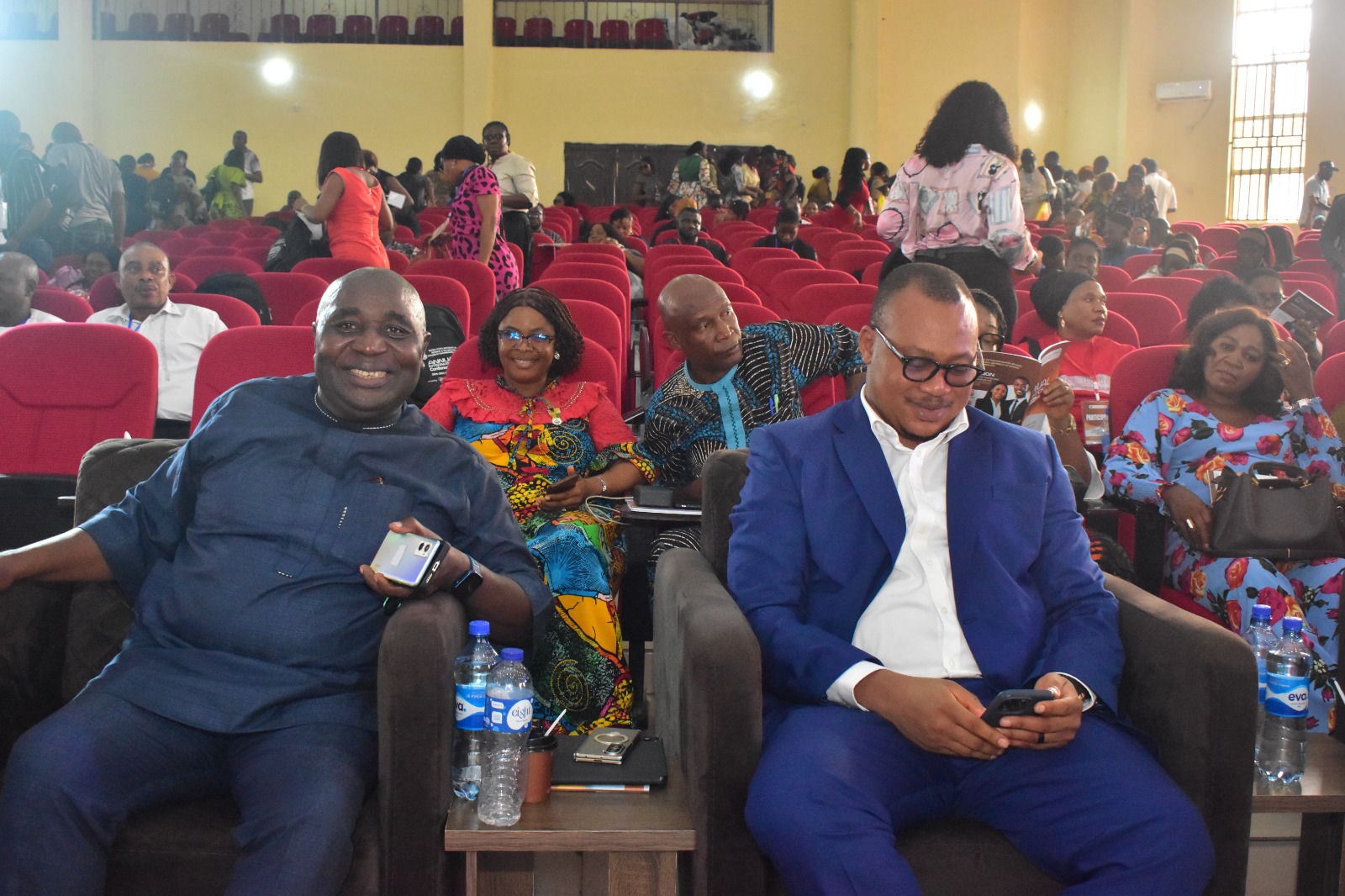
The international conference of the Enugu State University of Science and Technology (ESUT), held at the Peter Mbah Multipurpose Auditorium, Enugu, brought together academics, researchers and postgraduate students to examine how emerging technologies and local knowledge can advance sustainable development.
The ESUT conference was themed “Integrating Human Intelligence, Indigenous Knowledge, Innovation and Artificial Intelligence for Sustainable Development.”
It was the first international conference since the institution’s School of Postgraduate Studies transitioned to the College of Postgraduate Studies.
The Provost, Prof. Charles C. Chime, said the theme was designed to connect research with community needs while exploring opportunities presented by AI and innovation. He commended the participating researchers and postgraduate students and acknowledged the support of the Vice-Chancellor, Prof. Aloysius-Michaels Okolie.
Nnam Advocates Human-Centred AI
In the lead paper, “Geospatial Innovation for Sustainable Development: The Art of Spatial Analysis for Integrating Artificial Intelligence, Indigenous Knowledge, and Remote Sensing toward Achieving the Sustainable Development Goals,” Prof. Victor Chukwuemeka Nnam of the University of Nigeria, Enugu Campus, argued that technology alone could not guarantee meaningful development.
Nnam, a Professor of Surveying and Geoinformatics, said effective development decisions required the integration of satellite data, AI, indigenous knowledge, community experience and professional judgement.
“The challenge is not a lack of satellites or technology. The real challenge is building institutions that allow satellite evidence, indigenous knowledge, community experience, and professional expertise to speak to one another,” he said.
A Fellow of the Nigerian Institution of Surveyors and former Enugu State Commissioner for Lands and Urban Development, Nnam cited gaps in geospatial information as a constraint on monitoring progress towards the United Nations Sustainable Development Goals (SDGs).
He also referenced Nigeria’s 2025 Sustainable Development Report ranking of 147th out of 167 countries, with a score of 54.7 out of 100, to highlight the importance of reliable data in identifying development needs and evaluating interventions.
ESUT Conference: Four Pillars for Sustainable Development
Nnam proposed a Human-Centred Geospatial Framework built around four pillars: human intelligence, indigenous knowledge, innovation and artificial intelligence.
He explained that AI and satellite imagery could identify geographical patterns and monitor environmental changes, but interpreting the findings required local knowledge and professional judgement.
For instance, satellite imagery might identify buildings and physical features without establishing customary ownership, cultural significance or the historical context of a location.

“An AI output that has not passed through community validation and professional adjudication is not a finding, but a hypothesis. If no human being can honestly sign for an output, the pipeline is not yet finished,” he cautioned.
He warned that excluding community knowledge from automated decision-making could lead to errors in land administration, development planning and other areas affecting livelihoods.
Applying Geospatial Research to Local Challenges
Using examples from southeastern Nigeria at the ESUT conference, Nnam demonstrated how geospatial analysis could support erosion monitoring, land administration, agriculture and environmental management.
In Anambra State, he showed how different statistical approaches could produce varying interpretations of the distribution of gully erosion sites. For Enugu State, he compared conventional regression analysis with geographically weighted regression to illustrate how relationships between variables may differ across locations.
He also warned that land registration systems relying exclusively on satellite imagery could overlook undocumented customary claims, making community consultation and proper adjudication essential. ESUT Conference
Nnam identified five areas where geospatial technology and indigenous knowledge could contribute to sustainable development: land administration, erosion surveillance, food security, conflict prevention and coastal vulnerability assessment.
In agriculture, he presented an analysis in which incorporating the Igbo agricultural calendar into vegetation and rainfall analysis, alongside a one-month rainfall lag, increased the reported correlation coefficient from 0.706 to 0.871. He said the example illustrated how indigenous knowledge could improve the interpretation of environmental data, although such findings must be assessed in the context of the underlying data and methodology.
He also advocated participatory mapping of pastoralist routes and farming areas to help identify potential conflict points and support preventive interventions.
On coastal vulnerability, he referenced his 2026 study published in Scientific Reports, which used satellite imagery, deep learning and statistical modelling to examine shoreline changes in the Niger Delta.
Researchers Urged to Uphold Accountability
Nnam urged postgraduate students and researchers to be transparent about their methods, state the limitations of their findings, respect communities whose knowledge informs their work and take responsibility for their conclusions.
“We are not here to train technicians who simply make maps, but professionals who must determine, with evidence and accountability, what those maps are allowed to mean,” he said.
He maintained that the value of research lay not merely in producing maps and technical reports, but in generating credible evidence capable of informing decisions and improving lives.
The ESUT conference highlighted the role of postgraduate education in preparing researchers to apply technology and evidence to Nigeria’s development challenges.
Its central message was that sustainable development requires more than advanced technology. It also depends on reliable research, effective institutions, respect for indigenous knowledge, responsible innovation and human accountability.
ESUT conference, artificial intelligence, indigenous knowledge, sustainable development, ESUT Enugu, Victor Nnam, postgraduate research, geospatial technology
Visit GMTNewsng for more on Enugu Conference and other news stories.
#ESUTConference #ArtificialIntelligence #IndigenousKnowledge #SustainableDevelopment #ResearchAndInnovation