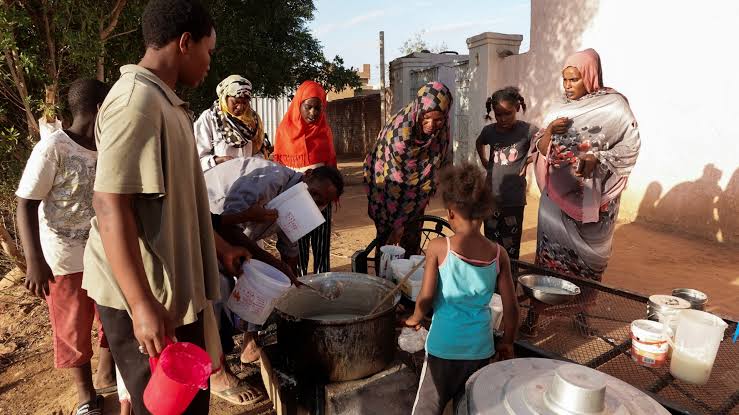
Food crisis in Sudan is worsening, with millions surviving on one meal daily as NGOs warn of a looming humanitarian disaster and risk of regional spread.
Khartoum, Sudan – The food crisis in Sudan has reached alarming levels, with millions of people now surviving on just one meal a day, according to a coalition of humanitarian organisations.
The report, released by Action Against Hunger, CARE International, International Rescue Committee, Mercy Corps, and Norwegian Refugee Council, warns that the situation is deteriorating rapidly and could spread beyond the country’s borders.
The worsening food crisis is driven by the ongoing conflict between the Sudanese army and the paramilitary Rapid Support Forces, which enters its third year this week.
According to the report, the hardest-hit regions, including North Darfur and South Kordofan, are witnessing extreme hunger, with many families unable to access more than a single meal per day.
In some cases, households are skipping meals entirely, resorting to eating leaves and animal feed in a desperate bid to survive.
The crisis has displaced millions and triggered one of the world’s most severe humanitarian emergencies, with an estimated 28.9 million people – about 61.7 per cent of the population – facing acute food insecurity under the 2026 Humanitarian Needs and Response Plan.
Despite mounting evidence, the Sudanese government has denied the existence of famine, while the Rapid Support Forces have rejected responsibility for conditions in areas under their control.
The United Nations has also reported widespread atrocities and ethnically driven violence linked to the conflict.
In November, global hunger monitors confirmed famine conditions in key areas, including al-Fashir and Kadugli. Subsequent findings by the Integrated Food Security Phase Classification indicated that famine thresholds for acute malnutrition had been exceeded in locations such as Um Baru and Kernoi.
The report highlights how the conflict has devastated agricultural systems, disrupted food supply chains, and led to the deliberate destruction of farms and markets.
Humanitarian response efforts are also under strain, as communal kitchens struggle to meet growing demand while donor funding cuts limit aid delivery.
Women and girls are among the most affected, facing heightened risks of violence when accessing food or water. Female-headed households, the report noted, are three times more likely to experience food insecurity than their male counterparts.
Aid agencies warn that without urgent intervention, the food crisis could escalate further, deepening human suffering and increasing the risk of regional instability.
Visit GMTNewsng for more news stories.