The dominance of political platforms over values threatens Nigeria’s democracy, raising fears of one-party rule and potential authoritarianism.
By Chijioke Ogbodo | GMTNews Analysis
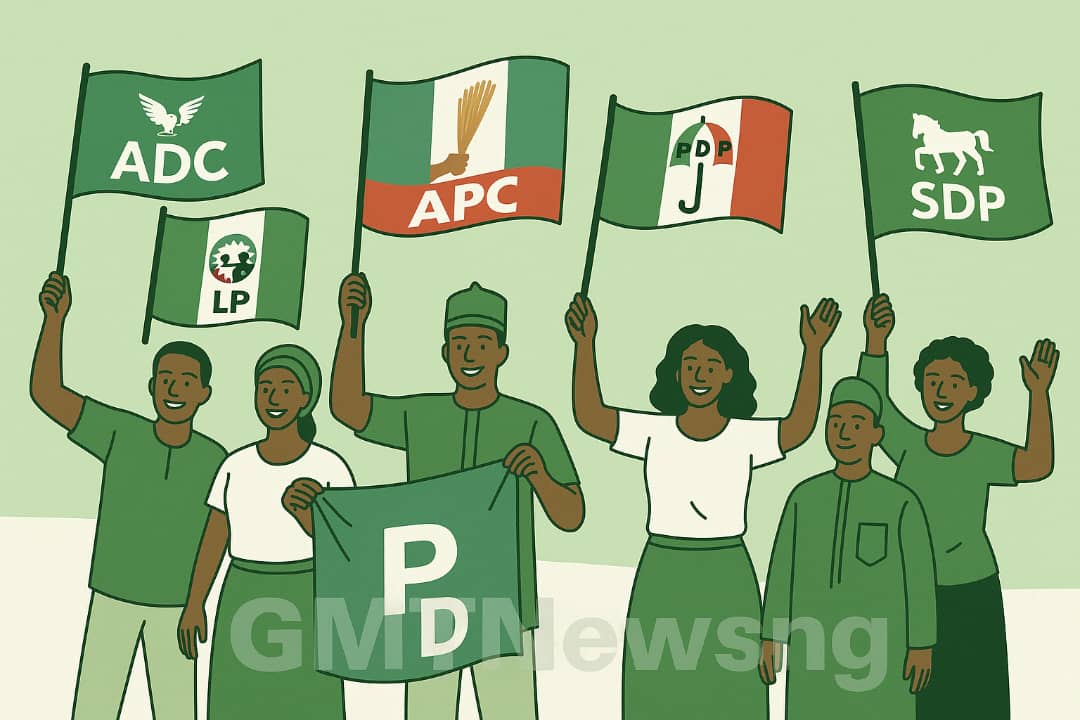
Nigeria’s democratic journey has consistently revolved around political parties as the sole gateways to electoral success. In the current political climate, it has become almost impossible for credible individuals to attain leadership positions without aligning themselves with one of the dominant political parties. This reality has forced aspirants, regardless of ideology or values, to seek platforms that guarantee them a chance to contest elections.
However, the increasing obsession with political platforms over principles has eroded the essence of democracy. Ideally, political parties are supposed to have clear manifestos that serve as their guiding philosophy and policy direction—these manifestos should be the driving force behind why individuals choose to join or support them. In Nigeria, however, these manifestos are often treated as mere formalities, with little influence on party ideology or governance.
This trend has created a troubling scenario where the masses focus more on the party than the quality of leadership being offered. Many aspirants, driven by political expediency, switch allegiances to join the party most likely to secure them a seat at the table of power. The implication is that party loyalty has become more important than competence, integrity, or a genuine commitment to service.
Unfortunately, this practice has taken root so deeply that Nigerians now appear to accept it as normal. The ongoing wave of defections to ruling parties ahead of every major election is increasingly seen as a necessary survival tactic. Yet, this normalization of opportunistic politics comes at a great cost to Nigeria’s democracy and governance standards.
More disturbingly, the dominance of one party poses an existential threat to democracy itself. In countries where one political party amasses unchecked power, history has shown that presidents can gradually transform into life presidents under the guise of popular mandate. Nigeria, with its fragile democratic institutions, can not afford to tread this dangerous path.
The reality today is that the ruling party enjoys an overwhelming majority in both the Senate and the House of Representatives. This absolute dominance of the National Assembly effectively weakens checks and balances, which are fundamental to any healthy political system where constructive criticism and diverse opinions help shape better governance. Without a vibrant opposition to question policies, scrutinize budgets, and hold the executive accountable, democracy risks degenerating into unchecked rule, where decisions are made without meaningful debate or dissent.
If this trend continues unchecked, Nigeria risks democratic implosion. A lack of robust opposition not only stifles accountability but also creates an environment where dissent is muted, and alternative voices are silenced. Citizens could wake up one day to find themselves in a de facto one-party state, where elections become ceremonial rather than competitive.
The pursuit of political expediency, while understandable in the short term, is dangerous in the long run. Leaders who ascend to power on the strength of party dominance rather than popular legitimacy are less likely to prioritize the needs of the people. Governance becomes about sustaining power instead of serving citizens.
The focus, therefore, must shift back to good governance and strong institutions rather than blind allegiance to political parties. Nigeria needs leaders who can rise above partisan considerations and commit to accountability, transparency, and service delivery. A strong democracy is built on credible governance, not on the dominance of a single political structure.
To safeguard Nigeria’s democratic future, citizens must begin to interrogate the character, competence, and vision of aspirants, irrespective of their party affiliations. True democracy thrives when the electorate prioritizes quality leadership over political expediency. Civil society, the media, and opinion leaders also have a duty to amplify this message.
Nigeria stands at a crossroads. The choice is between consolidating a vibrant, competitive democracy or allowing political expediency to drive the country toward one-party rule and potential authoritarianism. For the sake of the nation’s future, Nigerians must demand governance rooted in accountability, transparency, and inclusiveness – values that transcend party lines and place national interest above political convenience. But can citizens and political actors truly return to a politics driven by manifestos and ideas rather than opportunistic platforms? GMTNewsng
Chijioke Ogbodo is the Managing Partner of GMTNewsng. He writes ✍️ from Enugu.