There seems to be a ding-dong over the appointment of who succeeds the outgoing Chief Judge of Enugu State, Hon. Justice Precilla Ngozi Emehelu.
Ordinarily, there wouldn’t have been any challenges to who succeeds Chief Justice Emehelu, had it been that she toed the path prescribed by the existing Laws in the state. Rather she is alleged to have decided to abandon due process in order to recommend someone who is adjudged by majority of lawyers as incompetent and not qualified for the position, so he could cover her ugly tracks.
This, she is said to be doing on the false premise that there is no law regarding Chief Judge’s succession in Enugu State. One wonders the basis upon which she assumed the position of the State’s head of the judiciary if there were no laws, and with what laws are other functions in state based on?
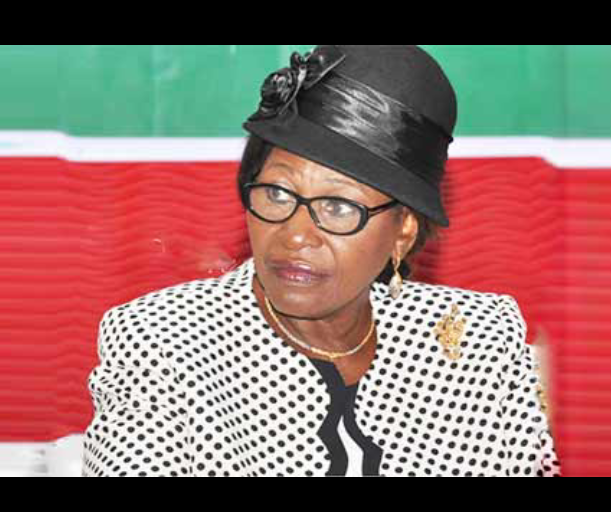 Justice N. P Emehelu
Barring extension of her tenure, Justice Emehelu would retire from Enugu State judicial service on September 7, 2021.
GMTNews can reliably confirm that in 2020, Hon. Justice A. Ozoemena of Enugu State High Court petitioned the National Judicial Council, NJC, complaining that he was called to Bar before Justices Anthony Onovo and Onuorah who incidentally were sworn in before him in 1998 when they were appointed Judges of the Enugu State High Court.
The NJC had, following the petition by Justice Ozoemena who was number 4 in the hierarchy, reordered the seniority list of Judges in the State and swapped the positions of Hon. Justices A. O. Onovo and A. R. Ozoemena as numbers 2 and 4 respectively in the hierarchy of Judges of the State High Court.
As a result of this development, Justice Onovo not pleased by the directive of the NJC, promptly wrote to the NJC citing the existing laws of the State at the time of their appointment which made the Council direct that the hierarchy chart should revert to status quo.
Our correspondent reliably gathered that the directive was not acted upon by the Enugu state Chief Judge, Justice Emehelu just to pave the way for Justice Ozoemena to again petition the NJC insisting on seniority according to year of call to Bar.
Everybody knows, as it is a common knowledge that the NJC has made a policy decision on the matter of seniority of Judges.
The decision is that for any State that has a law, the law would apply but for the States that have no law, seniority would be according to year of call to Bar.
This may have informed the position taken by Justice Ozoemena that the 1991 Laws of Anambra State have no application in Enugu State. Decree No. 2 of 1991 and the High Court Law of Anambra State 1991 was applicable in Enugu State as at the time of their appointment as Judges in 1998.
It is important to note that Enugu State made its own Laws in 2004 which was the same as the Laws of Anambra State 1991. Since Decree No. 4 made the laws applicable in the old Anambra State at the time the new State was created applicable in the new State then those applicable laws in Enugu State would be the Revised Laws of Anambra State, 1991. The 3rd recital to the Revised Laws of Enugu State, 2004 stated that:
“In consequence, the existing Laws on 27th August 1991 in Anambra State shall continue in force in Enugu State with necessary modifications thereto.”
By the 2004 Revised Laws of Enugu State in the 4th recital:
“The existing Laws of Anambra State on August 27, 1991 are contained in the Revised Laws of Anambra State 1991 which Laws came into force on 26th August 1991.”
It is an obvious affirmative answer to whether there was any law applicable to Enugu State from its creation in 1991 until 2004 when the Revised Laws of Enugu state was made. Section 8 (3) of the High Court Law, Cap 66 Revised Laws of Anambra State, 1991 stated as follows:
“For avoidance of doubt, where on the same day, two or more persons are appointed to the office of a judge they SHALL have precedence in the order in which they took their oath of office.”
Meanwhile, as in the case of seniority, it seems to be clear from the provision that the order of seniority of judges of Enugu State who were appointed and sworn-in on the same day is according to the order in which they took oath of office and not according to year of call to Bar.
If this interpretation is correct as it seems, then there is no basis for the dispute over seniority of Judges of the High Court of Enugu State.
For avoidance of doubt and to further strengthen the fact on succession in the judicial service, it is important to note that in 1998 eleven (11) Judges were appointed and sworn in and the order of their swearing in as Honourable Judges of the State High Court, set out their seniority which has never been in dispute until recently, after 22 years.
It is also noteworthy to state that during the appointment of the incumbent Enugu State Chief Judge, it was the second (2nd) most senior Judge, Hon. Justice A. O. Onovo that was recommended as an alternate candidate by the Enugu State Judicial Service Commission, JSC, and appeared before the National Judicial Council’s Committee for interview as Chief Judge.
It is a consternation that since the 2nd in command to the Chief Judge, Hon. Justice Pricilla Emehelu, who have been the Administrative Judge for Enugu Judicial Division of the High Court among other number 2 responsibilities, would now be shoved aside because of an inordinate ambition over the appointment of a new Chief Judge for the State.
GMTNews can reliably inform that on November 3, 1998, eleven (11) Honourable Justices were appointment and sworn-in in the following order:
- Hon. Justice B. E. Agbatah (Rtd.)
- Hon. Justice N. P Emehelu (FCI, Arb) current Chief Judge
- Hon. Justice F. C. Obieze (Rtd.)
- Hon. Justice K. N. Ude (Rtd )
- Hon. Justice R. Obiageli Nwodo JCA (Late)
- Hon. Justice E. C. Ahanonu (Late.)
- Hon. Justice S. C. Nnaji (Rtd.)
- Hon. Justice A. O. Onovo
- Hon. Justice R. N. Onuorah
- Hon. Justice G. O. Anibueze (Late), and
- Hon. Justice A. R. Ozoemena
Oath was administered to the above, one after another.
The judiciary is a disciplined professional entity that should be devoid of meddlesomeness.
In Enugu State, ascendance to certain critical appointive or elective positions (professional or not), sometimes are made possible as a result of solidarity and support from certain “constituencies” which is evidently lacking for someone who is favoured by the existing Laws in this case.
From available records, it is evidently clear in this matter that the outgoing Chief Judge of Enugu State is in support of subverting the law on the appointment of a successor to replace her in the state as she retires. This should not be allowed to happen.
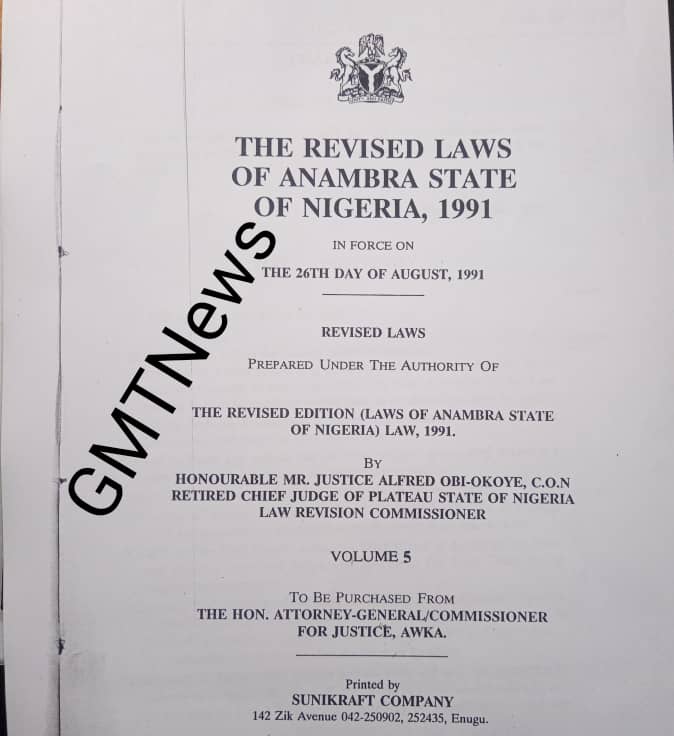
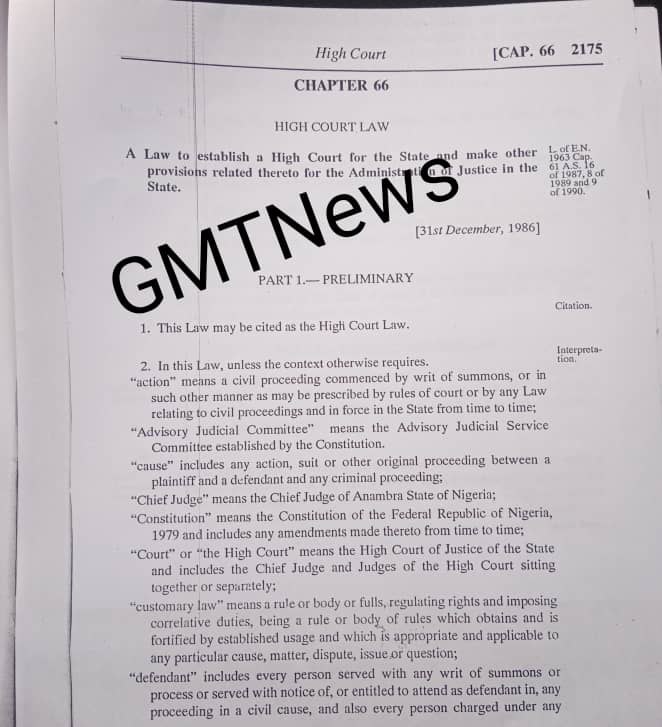
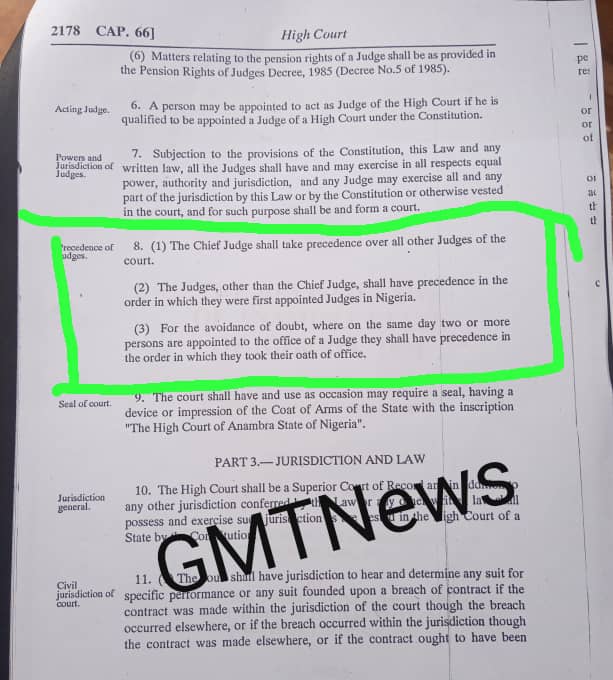 Extract from the Law