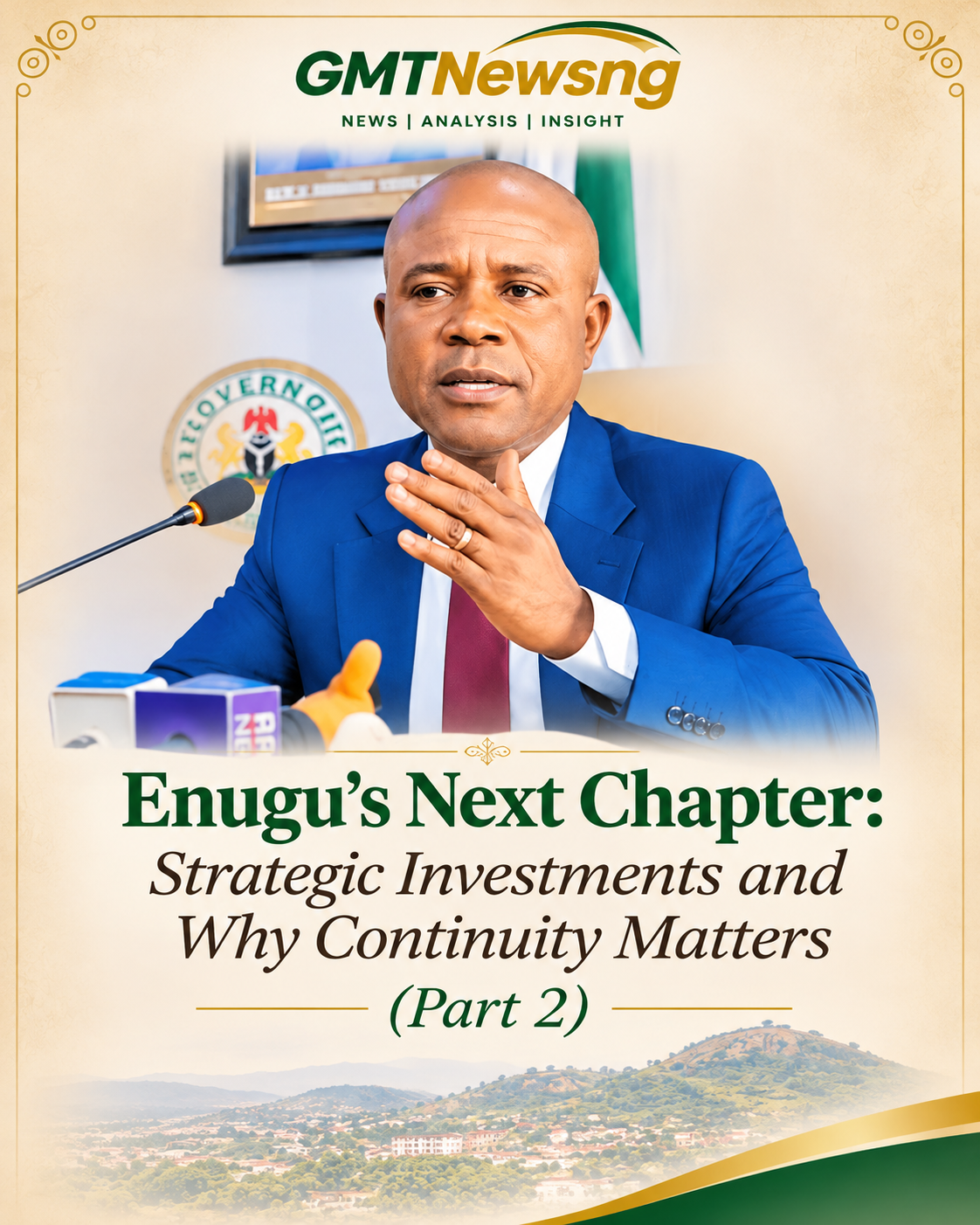
Enugu’s Next Chapter: Strategic Investments and Why Continuity Matters (Part 2)
From healthcare and industrial assets to security and scientific infrastructure, Enugu’s emerging development ecosystem strengthens the case for consolidating progress ahead of 2027. Continuity…
● By Chijioke Ogbodo
Beyond infrastructure: Building an economic ecosystem
In Part 1 of this feature, the focus was on the foundations of Enugu’s development ambitions: infrastructure, education, healthcare, agriculture, energy and the opportunities they create for economic growth.
But a state’s transformation also depends on what it does with its strategic assets, how effectively it attracts investment and whether its institutions can support a more productive economy. Continuity in implementing these interconnected priorities is therefore an important consideration.
Enugu’s development programme includes initiatives that extend beyond conventional road construction and public infrastructure. These include the revival of important commercial assets, investment in specialist healthcare, hospitality and tourism, industrial development, security technology and scientific capacity.
Their importance lies not only in their individual contributions, but also in how they could reinforce one another.
Enugu International Hospital: Advanced healthcare and regional relevance
The development of Enugu International Hospital represents an important step towards strengthening the state’s healthcare capacity.
The 300-bed specialist hospital is intended to expand access to advanced medical services and improve the availability of specialised treatment within Enugu.
For residents, the significance is straightforward: access to advanced healthcare closer to home could reduce the need for costly journeys to other states or countries in search of specialised treatment.
The implications extend beyond patients.
A modern specialist hospital can attract medical professionals, create employment for healthcare workers and support businesses involved in medical equipment, pharmaceuticals, hospitality and other services.
It could also strengthen Enugu’s position as a regional healthcare destination, serving patients from neighbouring states and potentially beyond Nigeria.
The wider economic benefit is considerable. Medical institutions can contribute to a growing healthcare ecosystem in which professional expertise, research, training and specialised services generate both social and commercial value.
For Enugu, the hospital represents an opportunity to combine improved healthcare access with economic activity and professional development.
Its long-term impact will depend on sustained investment in equipment, staffing, medical services and institutional capacity.
Reviving Enugu’s hospitality and tourism assets
Enugu’s historic Hotel Presidential and the development of Landmark Nike Lake Hotel and Resort offer opportunities to strengthen the state’s hospitality industry and reclaim a more prominent position in Nigeria’s tourism and conference economy.
Hotel Presidential carries considerable historical significance in Enugu’s commercial and social life. Its restoration offers the prospect of returning an important hospitality asset to productive use while supporting the city’s broader economic revival.
Landmark Nike Lake Hotel and Resort, meanwhile, adds to the state’s potential to attract visitors, conferences, business meetings and leisure tourism.
The economic value of these establishments extends beyond accommodation.
Hotels and resorts generate demand for food suppliers, transport operators, event planners, construction and maintenance services, entertainment businesses and other local enterprises.
They can also support employment across hospitality and tourism-related occupations.
For Enugu, a stronger hospitality sector could complement aviation, commerce, cultural tourism and investment promotion.
The opportunity is to make the state more attractive not only for occasional visits, but also for conferences, professional gatherings, business engagements and longer stays.
When properly developed and sustained, hospitality assets can become important contributors to the service economy.
NigerGas and EUPPL: Turning dormant assets into productive enterprises
The revival of public assets such as NigerGas and Enugu United Palm Products Limited (EUPPL) is another important dimension of Enugu’s economic development agenda.
The significance of these enterprises lies in their potential to move from underutilised or dormant facilities towards productive commercial activity.
NigerGas has relevance to both healthcare and industry through its medical oxygen and industrial gas capabilities.
Reliable medical oxygen is essential to hospitals and other healthcare facilities, while industrial gases can support manufacturing and related commercial activities.
A functioning gas enterprise could therefore strengthen local supply chains, create employment and support businesses that depend on these products.
EUPPL offers a different but equally important opportunity.
The palm produce industry has the potential to connect agricultural communities with processing, manufacturing and commercial markets.
Revitalising the enterprise could create opportunities for farmers, suppliers, processors, transport operators and other businesses involved in the agricultural value chain.
The broader principle is that public assets should contribute meaningfully to the economy rather than remain liabilities or neglected infrastructure.
Their revival could strengthen local production, create employment, attract private-sector participation and contribute to the state’s revenue base.
For Enugu, the challenge is to ensure that such enterprises become commercially viable, professionally managed and capable of sustaining their operations over time.
Security infrastructure and investor confidence
Economic development requires an environment in which people can live, work, travel and conduct business with confidence.
Enugu’s Command and Control Centre represents an important investment in the state’s security infrastructure.
Supported by surveillance technology and coordinated security operations, the centre can strengthen the capacity of security agencies to monitor threats, respond to incidents and improve coordination.
Its importance goes beyond crime prevention.
Businesses are more likely to invest and expand where their employees, facilities, goods and commercial operations can be protected.
A secure environment also supports transportation, tourism, hospitality, public events and ordinary economic activity.
The Command and Control Centre therefore contributes to a wider development objective: creating conditions in which citizens and businesses can operate with greater confidence.
Security infrastructure is most valuable when it is supported by effective personnel, reliable technology, institutional coordination and respect for citizens’ rights.
The long-term objective is a state where safety becomes an enduring foundation for social and economic progress.
GOUNI’s forensic facility and the value of scientific capacity
The Centre for DNA Forensics and Criminal Investigations at Godfrey Okoye University introduces another dimension to Enugu’s development story: the importance of scientific and specialised institutional capacity.
Forensic science has become increasingly important to criminal investigation, evidence analysis and the administration of justice.
Facilities capable of supporting DNA-related analysis, forensic research and professional training can strengthen the relationship between scientific knowledge and public institutions.
The potential benefits extend to law enforcement, legal practitioners, researchers, universities and students pursuing specialised scientific careers.
Such a facility could also contribute to professional training and the development of expertise that remains relevant beyond Enugu.
The wider significance is that development should not be measured exclusively through roads, buildings and physical infrastructure.
A modern state also needs institutions capable of applying science, technology and specialised knowledge to public challenges.
Enugu’s investment in such capabilities could strengthen its educational and research ecosystem while contributing to Nigeria’s broader forensic and scientific capacity.
Security and the restoration of economic normalcy
The importance of security becomes even clearer when considered against the disruption Enugu experienced before and during the early period of the Mbah administration.
The sit-at-home restrictions that affected the South-East imposed significant costs on traders, workers, students, businesses and households.
For many people, Mondays became a day of lost income, interrupted education and uncertainty.
A market trader who could not open her shop lost opportunities to earn. A small business faced reduced operating hours and diminished customer activity. Families had to adjust their routines around a disruption that affected ordinary life.
The restoration of normal Monday activity was therefore a major development in the state’s recovery.
Markets, schools, businesses and workplaces could resume more predictable operations. Traders regained opportunities to sell, workers could plan their schedules and students could participate more consistently in learning.
The significance of this change goes beyond the immediate security dimension.
Economic confidence depends on the ability of people to work, travel, trade and plan their lives without persistent disruption.
Restoring normal activity helped create conditions in which Enugu’s wider development programme could proceed with greater confidence.
Security, infrastructure and economic growth are inseparable. A state cannot fully realise its commercial potential when fear or uncertainty routinely prevents its citizens from participating in economic life.
The unfinished agenda and the importance of consolidation
The scale of Enugu’s development ambitions means that important work remains.
Infrastructure must be completed and maintained. Schools need effective teaching, equipment and operational support. Healthcare facilities require staffing and dependable services. Agricultural enterprises need markets, finance and processing capacity. Industrial development requires energy, skilled workers and investment.
The strategic projects discussed in this article also need sustained attention to ensure that their anticipated benefits become lasting realities.
This is where the question of continuity becomes particularly important.
A development programme built around interconnected investments requires time to mature. The economic value of a school, hospital, road, industrial facility or transport system often becomes more visible as the surrounding infrastructure and institutions develop.
A second term offers the opportunity to complete unfinished projects, strengthen implementation, improve operational performance and extend the benefits of development to more communities.
It also provides an opportunity to move beyond the initial establishment of infrastructure towards deeper economic outcomes: more productive businesses, stronger public services, better employment opportunities and improved household welfare.
The argument for continuity is therefore not simply about retaining political leadership.
It is about preserving the coherence of a development programme while giving its investments the opportunity to deliver their full potential.
Enugu’s political tradition and the choice ahead
Enugu’s political history provides an important context for the 2027 governorship election.
Since Nigeria returned to civilian democratic rule in 1999, the state has developed an unwritten understanding around the rotation of the governorship among its three senatorial districts.
Dr Chimaroke Nnamani of Enugu East served from 1999 to 2007. Sullivan Chime of Enugu West followed from 2007 to 2015, while Ifeanyi Ugwuanyi of Enugu North governed from 2015 to 2023.
Each completed two consecutive four-year terms, marking the first time since 1999 that all three districts had produced a governor who completed two terms.
Peter Mbah’s victory in 2023 returned the governorship to Enugu East.
The rotational understanding remains a political convention rather than a constitutional requirement. Its continued relevance depends on the political choices and confidence of the people of Enugu.
But the 2027 election presents a question that goes beyond the historical arrangement.
The state’s political tradition provides a framework for representation and accommodation. Its development trajectory raises a different consideration: what leadership can best sustain the progress already underway?
The electorate must ultimately weigh political expectations alongside governance, performance, development priorities and the opportunities ahead.
Why Peter Mbah deserves a second term
The case for Peter Mbah’s re-election rests on the scale and interconnected nature of the development programme his administration has initiated.
Across education, healthcare, roads, aviation, agriculture, energy, tourism, industrial assets and security, the administration has pursued a broad repositioning of Enugu’s economy and public services.
These are not isolated ambitions.
Better roads support farmers and businesses. Modern schools prepare young people for emerging industries. Healthcare infrastructure strengthens human capital. Aviation and hospitality improve commercial accessibility. Industrial assets can create employment and local value. Security infrastructure supports confidence and economic activity.
The benefits of these investments are expected to accumulate over time.
That is why continuity deserves serious consideration.
A second term would give the administration an opportunity to complete unfinished work, strengthen existing investments and translate infrastructure into more sustainable economic and social outcomes.
It would also allow Enugu to build upon the institutional experience, development priorities and partnerships already established.
Changing leadership is a legitimate democratic choice. Yet continuity can be equally valuable when a state is pursuing a long-term programme whose success depends on consistency, implementation and the completion of interconnected projects.
For Enugu, the question is whether the development direction already established should be given the opportunity to mature.
The argument for Mbah’s re-election is ultimately an argument for consolidation: completing what has been started, strengthening what has been established and extending the benefits of development to more people.
Choosing Enugu’s Future
Enugu is entering a consequential period in its political and economic history.
Its development ambitions are increasingly directed towards a more diversified economy, stronger public services, improved infrastructure, modern education, better healthcare and wider opportunities for enterprise.
The challenge is to ensure that these ambitions translate into measurable improvements in the lives of citizens.
As the 2027 governorship election approaches, the people of Enugu will have an opportunity to consider the direction in which their state is moving and the leadership required to sustain its transformation.
The first term of Peter Mbah’s administration has established a development framework across several critical sectors. The next phase should focus on consolidating that framework, completing outstanding projects and ensuring that the benefits of investment reach more communities. Continuity is the is the channel.
For a state seeking to strengthen its economic position and expand opportunities for its people, continuity offers a compelling path.
Enugu’s next chapter should be about turning the foundations of today into the prosperity of tomorrow. A second term for Peter Mbah offers the opportunity to pursue that task with greater consistency, experience and purpose.
Visit GMTNewsng for more on Enugu’s Strategic Investments: Why Continuity Matters, Continuity and other news stories.
#Continuity #EnuguDevelopment #PeterMbah #Enugu2027 #EnuguState #StrategicInvestments #GMTNewsng
● Continuity ● Continuity ● Continuity ● Continuity ● Continuity ● Continuity ● Continuity ● Continuity