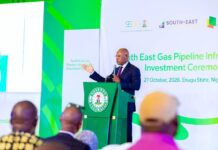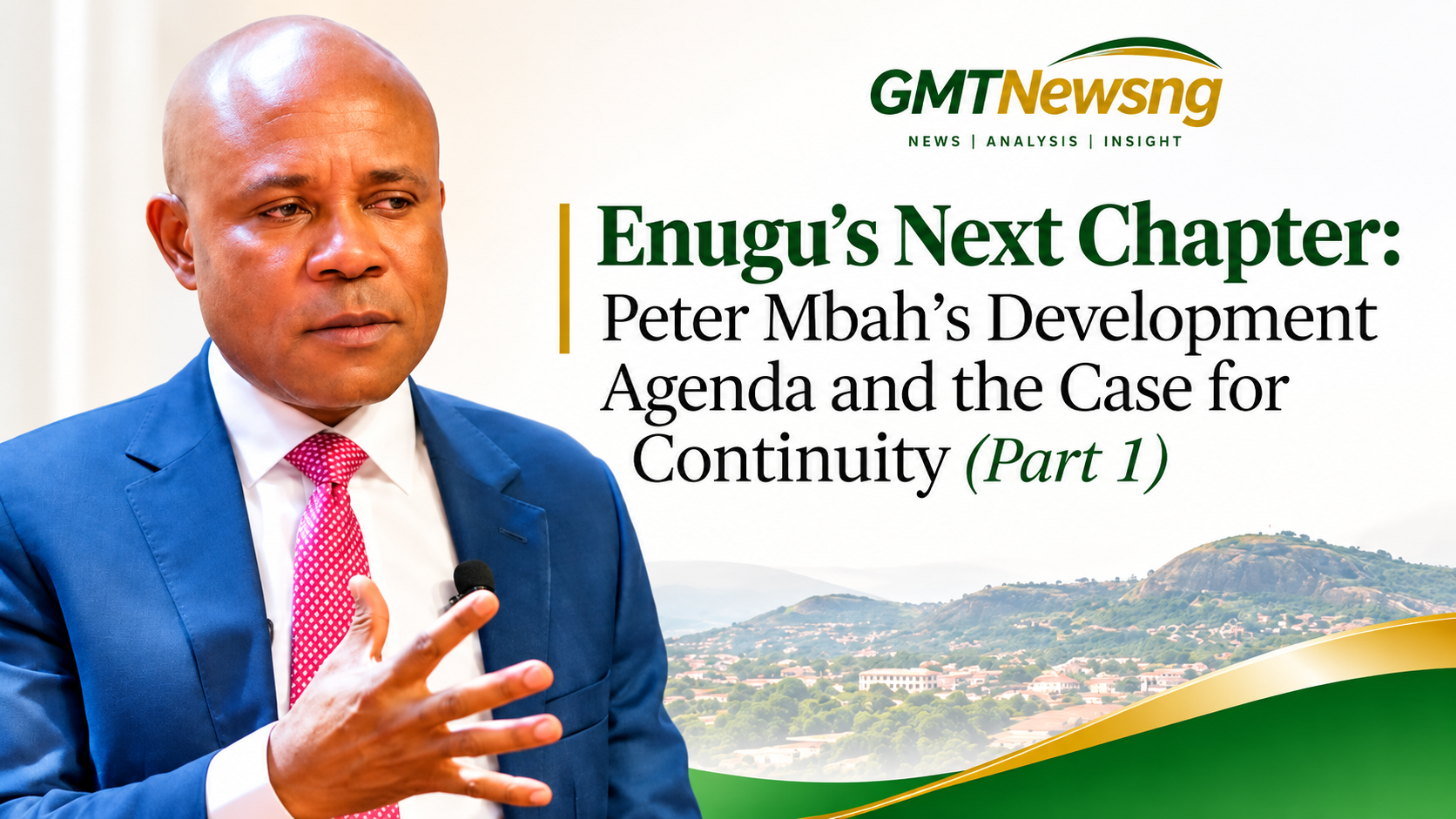
Development Agenda: From infrastructure and human capital to economic transformation, Enugu’s development ambitions have reached a stage where continuity could determine how far the state advances.
By Chijioke Ogbodo
A defining moment for Enugu
As Enugu State approaches the 2027 governorship election, its political conversation is increasingly shaped by a question with implications beyond the next electoral cycle: what kind of development trajectory should the state pursue, and what leadership can best sustain it?
Since assuming office in May 2023, Governor Peter Ndubuisi Mbah has pursued an ambitious programme aimed at repositioning Enugu as a more competitive economic, commercial and investment destination.
The programme spans infrastructure, education, healthcare, agriculture, energy, transportation, tourism and industrial development. Its distinguishing feature is the relationship between these priorities. Roads are expected to connect markets and communities; schools are intended to prepare a future workforce; healthcare investments strengthen human capital; and improved connectivity and energy infrastructure can support business expansion.
This is an attempt to address development as an interconnected challenge rather than a collection of unrelated projects.
For Enugu, the importance of this approach lies in its potential to create conditions for sustained economic growth, wider employment opportunities and improved living standards.
An economic ambition beyond conventional growth
Mbah’s development vision includes an ambitious target of expanding Enugu’s economy from an estimated US$4.4 billion to at least US$30 billion within eight years, with the long-term objective of positioning the state among Nigeria’s leading economies.
The target is demanding. But its significance lies in the scale of economic transformation it seeks to encourage.
Achieving such growth requires more than government expenditure or the construction of public infrastructure. It depends on an economy capable of supporting productive businesses, attracting investment, developing skilled workers and creating value across multiple sectors.
For Enugu, this means strengthening traditional economic activities while expanding into industries and services that can generate greater productivity and employment.
The state’s development prospects will ultimately depend on whether its investments create an environment where entrepreneurs can establish businesses, farmers can access markets, manufacturers can operate competitively and young people can find meaningful economic opportunities.
This broader ambition provides the context for understanding the administration’s development programme.
Infrastructure as an economic connector in Enugu’s development agenda
Road infrastructure is among the most visible aspects of Enugu’s ongoing development efforts. Its importance, however, extends well beyond the physical construction of highways and streets.
For farmers, roads influence how quickly produce reaches markets and how much value is lost during transportation. For traders, they affect the cost of moving goods. For businesses, reliable connectivity improves access to customers, suppliers and workers.
Road construction and rehabilitation across the state are therefore important to both urban development and rural economic activity.
The administration’s investment in public transportation, including buses and terminals, complements this effort by improving mobility and supporting a more organised transport system.
The wider objective is to make movement across Enugu easier and more productive.
Infrastructure becomes transformative when it changes the economic possibilities available to people. A road that connects a farming community to a market, a school to surrounding villages or a business district to transport networks can generate benefits far beyond its immediate location.
The challenge is to ensure that these investments are completed, maintained and integrated into the wider development system.
Reconnecting Enugu to wider opportunities
A state’s economic prospects depend partly on how effectively it connects with the rest of the country and the international economy.
Enugu’s renewed aviation ambitions are therefore significant.
The state’s air connectivity has expanded considerably since 2023, with incoming flights reportedly increasing from about two daily to more than fifteen. Enugu Air and the administration’s wider aviation strategy are intended to strengthen connections with other Nigerian cities and international markets.
Improved air access can influence investment decisions, business travel, tourism, professional networks and diaspora engagement.
For investors and entrepreneurs, accessibility matters. A state that is easier to reach is better positioned to attract commercial partnerships, conferences, business meetings and new economic activity.
Enugu’s ambition to regain a stronger regional commercial identity consequently depends in part on its ability to connect people, capital and opportunities.
Aviation’s economic value is amplified when it works alongside better roads, hospitality facilities, business infrastructure and a competitive local economy.
Education and the future workforce
Among the most consequential elements of the Mbah administration’s programme is its investment in education.
The development of 268 Smart Green Schools, designed to serve every electoral ward in the state, represents a major commitment to modernising educational infrastructure and broadening access to learning opportunities.
The initiative addresses a longstanding challenge: the unequal distribution of educational facilities and resources between urban and rural communities.
A child’s prospects should not be determined by where they happen to be born or attend school.
…Chijioke Ogbodo examines Peter Mbah’s development agenda in Enugu, from education and healthcare to infrastructure, agriculture and economic growth.
The changing global economy makes this investment particularly important. Artificial intelligence, automation, digital technology and advanced manufacturing are reshaping industries and redefining the skills required for employment.
In Enugu’s development agenda, tomorrow’s workforce will need more than conventional classroom knowledge. Digital literacy, technological competence, critical thinking and adaptability will increasingly determine professional and entrepreneurial opportunities.
Modern school infrastructure can provide a foundation for preparing young people for this changing environment.
A student in a rural community should have the opportunity to become an engineer, software developer, entrepreneur, agricultural technologist or healthcare professional without being disadvantaged by the location of their school.
The long-term value of the Smart Green Schools programme will therefore be measured not simply by the number of facilities delivered, but by the quality of education, the skills acquired and the opportunities opened to students.
Healthcare and the strength of human capital
The administration’s plan to establish 260 Type-2 Primary Healthcare Centres follows a similar development philosophy: bringing essential services closer to communities.
For rural families, access to a functioning healthcare facility can make a substantial difference. Pregnant women, children, elderly residents and people requiring routine medical attention should not face unreasonable distances or costs to obtain care.
Primary healthcare infrastructure can improve access, support early intervention and reduce the burden of preventable illness on households.
Its importance also extends to the economy.
A healthier population is better able to work, learn and participate in productive activity. Families facing fewer barriers to healthcare are better positioned to devote their resources to education, enterprise and other needs.
The development of healthcare facilities, recruitment of medical personnel and improvement of medical services form part of a broader effort to strengthen public welfare.
As with education, however, the lasting value of healthcare investment depends on staffing, equipment, maintenance and the quality of services provided.
The objective is to make healthcare more accessible, dependable and responsive to the needs of residents.
Agriculture and the promise of value addition
Enugu’s economic transformation cannot be complete without a stronger agricultural sector.
The state possesses fertile land, experienced farmers and communities with longstanding agricultural traditions. Yet agricultural productivity and profitability can be constrained by limited access to equipment, storage, processing facilities, finance and reliable markets.
The opportunity lies in moving beyond the production of raw commodities towards a more commercially integrated agricultural economy.
Cassava offers a useful example. When processed locally into products serving food and other industries, its value extends beyond the farmer.
Processing creates opportunities for machinery operators, technicians, transporters, packaging businesses, distributors and retailers.
Similar opportunities exist across other agricultural products.
The broader objective is to create rural economies in which farming supports a network of productive enterprises rather than remaining largely dependent on the sale of raw produce.
Agricultural industrialisation could strengthen rural incomes, create employment and retain more economic value within Enugu.
Realising this potential will require dependable markets, infrastructure, financing, technology and effective links between farmers and processors.
Energy and the industrial opportunity
Reliable electricity is essential to the competitiveness of businesses and industries.
Small enterprises operating with expensive alternative power face increased costs. Manufacturers require dependable electricity to sustain production. Agricultural processors need energy to operate machinery, preserve products and expand capacity.
Enugu’s energy and industrial ambitions must therefore be understood as part of its broader economic strategy.
Improved energy infrastructure can support manufacturing, attract investment, strengthen agricultural processing and make business operations more efficient.
The relationship between energy, transportation, education and skills is especially important. Infrastructure attracts investment more effectively when businesses can access reliable power and a capable workforce.
For Enugu to establish a stronger industrial base, these foundations must advance together.
The administration’s ambition is to create conditions in which productive enterprises can grow, employ more people and contribute to a more diversified economy.
Tourism and the service economy in the development agenda
Enugu’s historical, cultural and commercial significance provides opportunities for tourism and hospitality development.
The economic potential of this sector extends well beyond hotels and visitor attractions.
Hospitality generates demand for transportation, food supplies, construction, maintenance, entertainment and other local services. Tourism can therefore create opportunities for small businesses, artisans, suppliers and workers across multiple sectors.
Investment in hospitality assets and tourism destinations can also strengthen Enugu’s attractiveness as a location for business meetings, conferences, cultural events and leisure travel.
For a state seeking to expand its economic base, tourism offers a valuable complement to agriculture, manufacturing, aviation and commerce.
The objective is to create a service economy in which investment generates opportunities that reach beyond major establishments into communities and households.
A development agenda that needs time
The breadth of Enugu’s development ambitions raises an important consideration: major economic transformation rarely happens within a single four-year term.
Schools require sustained investment in teaching quality, equipment and maintenance. Healthcare facilities need staffing and operational resources. Roads and transport systems must be completed, maintained and extended. Agricultural industrialisation requires stronger processing capacity and market access. Manufacturing depends on energy, skills and investor confidence.
The first phase of a development programme (development agenda) often involves establishing infrastructure and putting systems in place. The subsequent phase must focus on operational effectiveness, completion, expansion and measurable economic outcomes.
That is why the question of continuity is becoming increasingly relevant to Enugu’s political future.
The issue is not simply whether a government should remain in office. It is whether a development direction already established across several interconnected sectors should be given the opportunity to mature.
The implications of that question—and the strategic investments that could shape Enugu’s next phase—form the subject of Part 2.
Part 2 examines Enugu’s strategic projects, the restoration of economic normalcy, and why the case for Peter Mbah’s re-election increasingly centres on consolidation.
Peter Mbah’s Development Agenda and Enugu’s Case for Continuity (Part 1)
Visit GMTNewsng for more on Development Agenda and other news stories.
Ogbodo is Managing Partner at GMT News Nigeria (GMTNewsng.com). You can contact him via chijioke@gmtnewsng.com
Part 2 examines Enugu’s strategic projects, the restoration of economic normalcy, and why the case for Peter Mbah’s re-election increasingly centres on consolidation. Stay tuned. Development Agenda