Enugu State Governor Peter Mbah has explained why his administration chose to build new Smart Green Schools rather than renovate existing facilities, citing the need for a fundamental education reform focused on digital skills, experiential learning and equal access to quality education.
Governor Peter Mbah has explained why his administration opted to construct new Smart Green Schools across Enugu State instead of concentrating on renovating existing school buildings, saying the state needed a fundamental transformation of its education system.
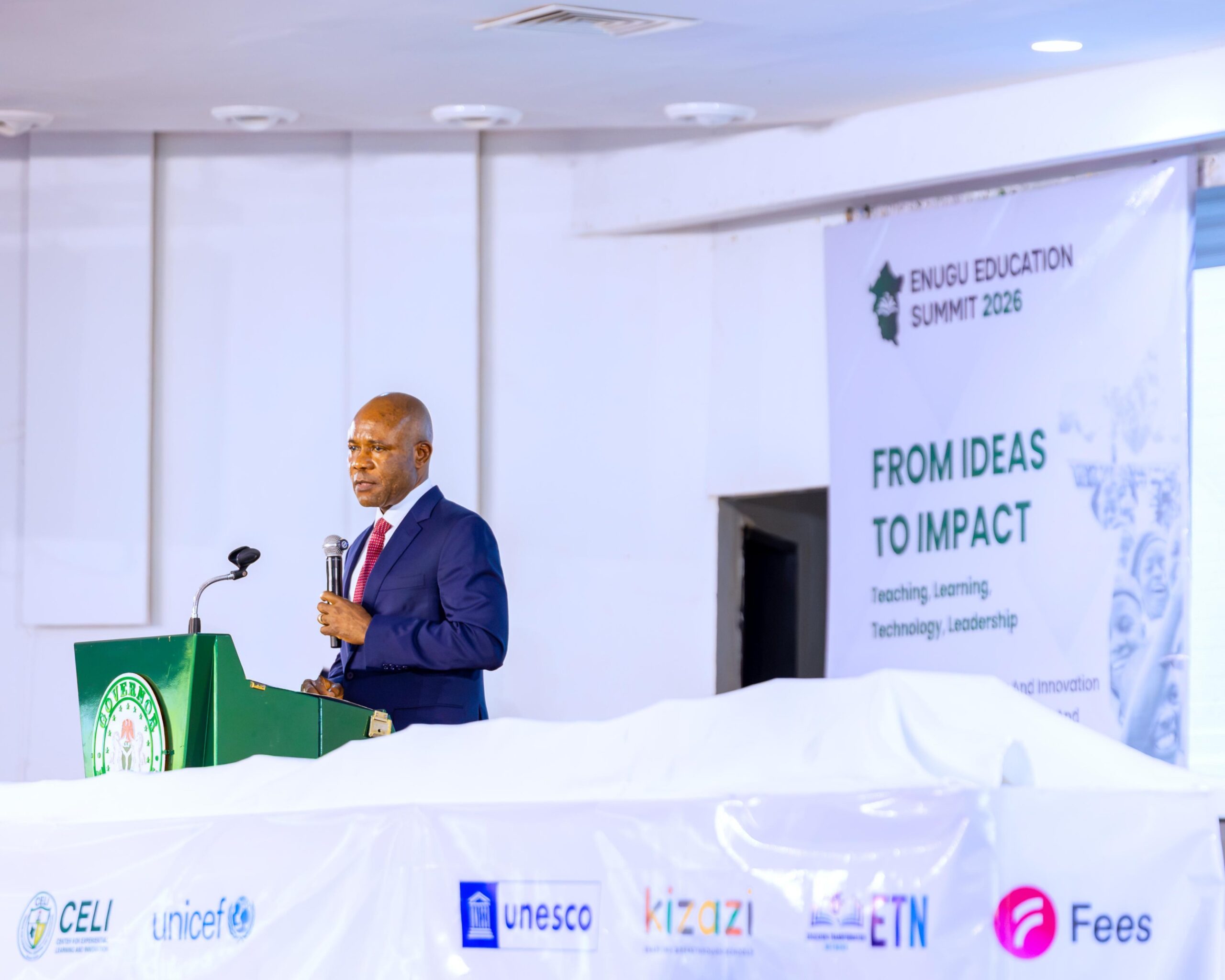
Mbah spoke on Wednesday at the Enugu Education Summit held at the International Conference Centre, Enugu, where he outlined the rationale behind the government’s education reforms.
The governor said renovating classrooms, providing desks and installing computers would not adequately prepare children for the demands of a rapidly changing world.
According to him, the administration considered whether conventional school infrastructure, designed for an earlier generation, could equip children with the knowledge and skills needed for the future.
“We could have repaired the existing system. We could have renovated some classrooms, supplied some desks, put computers into a few schools and called it reform.
“But we had to ask ourselves a more difficult question: Would it be enough?
“Would an education system essentially designed for the world of 40 years ago prepare our children in Enugu for the world we are in now, or the world 20 years from now? Our answer was a resounding no,” Mbah said.
He explained that the decision was intended to move the state beyond incremental improvements towards a modern education system built around technology, practical learning and critical thinking.
Mbah said the administration initially committed to building 260 Smart Green Schools, with at least one planned for every electoral ward in the state.
He said the schools were deliberately extended beyond urban centres to communities where geographical and socioeconomic disadvantages had historically limited children’s access to quality education.
According to the governor, the programme has delivered more than 7,000 classrooms, providing infrastructure for a different approach to teaching and learning.
The state government’s October 7 report on the education summit cited 268 Smart Green Schools, alongside more than 7,000 classrooms equipped with modern learning facilities.
The Smart Green Schools initiative combines digital learning infrastructure with facilities designed to support practical and experiential education.
Mbah said the programme was intended to move pupils away from an overreliance on memorisation towards understanding problems, collaborating with others, developing critical-thinking skills and applying knowledge to real-life situations.
He maintained that the objective was not simply to build new classrooms but to prepare children to participate meaningfully in a knowledge-driven economy.
The governor said his administration had allocated approximately 33 per cent of the state’s annual budget to education for three consecutive budget cycles.
He described the investment as a reflection of the government’s belief that education was central to reducing poverty, expanding economic opportunities and developing the skills citizens need to create wealth.
Mbah argued that inadequate access to knowledge and practical skills remained a major obstacle to personal and economic development.
“If we’re serious about ending poverty, we have to get to its roots. For us, one of those roots is lack of knowledge.
“Whatever education costs us today, ignorance will cost us far more tomorrow,” he said.
The governor said the state’s education reforms were being supported by development partners, including the United Nations Educational, Scientific and Cultural Organization (UNESCO) and the United Nations Children’s Fund (UNICEF).
He said the partnerships had contributed to the development of education policies, sector plans, operational frameworks and implementation guidelines intended to align the reforms with international best practices.
The UNESCO Representative to Nigeria, Dr. Isaias Barreto da Rosa, commended the Enugu State Government for investing in modern school infrastructure and experiential learning.
Barreto da Rosa, represented by the Head of the Education Sector at UNESCO Abuja, Oladeji Adeyemi, said the Smart Green Schools demonstrated how education facilities could incorporate digital technology while remaining environmentally responsible.
He also welcomed the state’s efforts to digitise experiential learning and expand access to quality education.
The UNESCO representative further commended the government’s plan to recruit more than 6,000 additional teachers.
He noted that the world faces a projected shortage of about four million teachers by 2030, while sub-Saharan Africa would require approximately 15 million teachers.
The planned recruitment is part of the state’s broader effort to strengthen the teaching workforce alongside its investments in school infrastructure and digital learning.
The UNICEF Representative to Nigeria, Wafaa Abdelatef, represented by the agency’s Enugu Field Office representative, Juliet Chiluwe, congratulated the state government on its education reform agenda.
Abdelatef said education transformation must ultimately ensure that every child is enrolled in school, learning effectively, safe, healthy and prepared for the future.
She disclosed that UNICEF had supported the development of Enugu State’s education policy, Education Sector Plan and State and Local Education Sector Operational Plans for 2026–2028, as stated during the summit.
She urged the state government, development partners, local governments, school leaders and communities to remain committed to translating the policy commitments into measurable improvements in learning outcomes.
The Commissioner for Education, Prof. Ndubueze Mbah, said the summit brought together development partners, including the British Council, UNICEF and UNESCO, alongside technical and business partners, to validate and support the state’s education reforms.
He said the policy documents were designed to provide a framework for sustaining the reforms beyond the tenure of the current administration and preventing policy reversals under future governments.
The summit provided an opportunity for education stakeholders to examine the state’s approach to infrastructure development, funding, teacher recruitment and modern learning methods.
The governor’s position is that new school infrastructure must be accompanied by changes in teaching methods, stronger teacher capacity and sustained investment to deliver meaningful educational outcomes.
While the government has outlined its reasons for prioritising new Smart Green Schools, the long-term impact of the programme will depend on how effectively the facilities are maintained, teachers are deployed and pupils’ learning outcomes are improved across the state.
Visit GMTNewsng for more news stories.