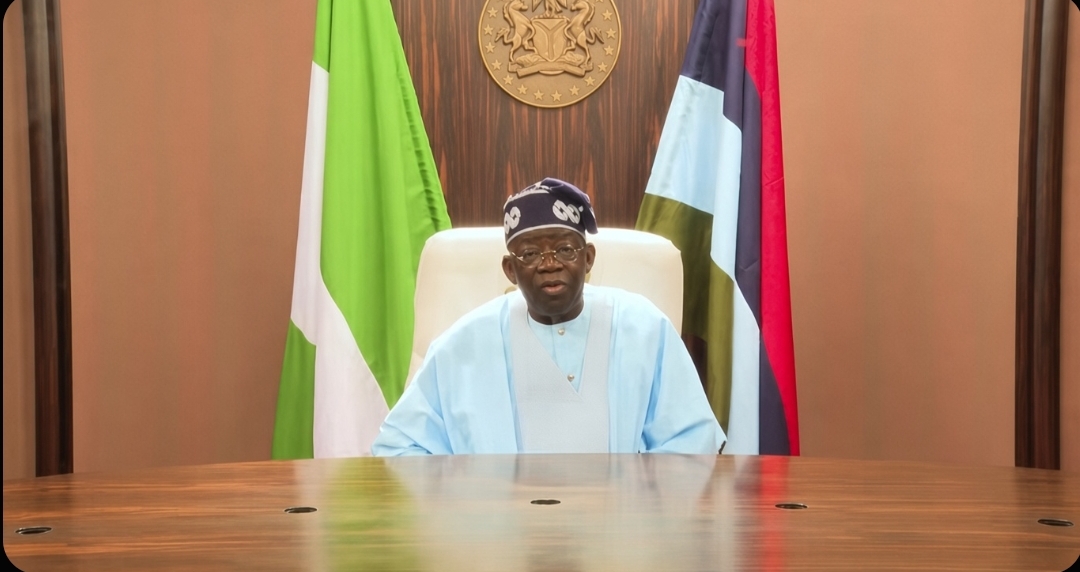
President Bola Tinubu says Nigeria has completed the emergency phase of economic reforms, pledging to focus on lower living costs, job creation and shared prosperity.
President Bola Ahmed Tinubu has declared an end to what he described as Nigeria’s economic emergency, announcing a shift from economic reforms to a new phase focused on shared prosperity, lower living costs and job creation.
Tinubu made the declaration on Thursday in his national broadcast to mark Nigeria’s 66th Independence Anniversary, saying his administration’s economic reforms had laid the foundation for improved economic stability.
The President defended the difficult economic decisions taken since he assumed office in May 2023, arguing that they were necessary to address longstanding structural weaknesses in the economy.
He compared the country’s previous economic situation to that of a seriously ill patient who needed surgery rather than temporary pain relief.
“For too long, Nigeria’s leaders chose morphine while praying for a miracle that never came,” he said.
“Our reforms did not create the weaknesses in our economy. They confronted them.”
Tinubu maintained that the economic difficulties experienced during the reform process were consequences of addressing longstanding distortions rather than the reforms themselves.
He also rejected calls to abandon the policies, particularly those advocating a return to what he described as unsustainable subsidies.
The President cited several economic indicators to support his assertion that Nigeria had made progress in stabilising its economy.
He said the economy had grown by more than four per cent in 2026, with contributions from both the oil and non-oil sectors.
Tinubu also listed declining oil theft, improved foreign reserves, a more stable foreign exchange market and falling inflation among the developments recorded under his administration.
He further disclosed that Nigeria’s non-oil exports generated more than $6 billion in 2025, describing the figure as the highest revenue recorded in the sector’s history.
According to him, foreign direct investment was also increasing, while international observers and multilateral institutions had acknowledged improvements in the country’s economic outlook.
The President said these developments marked a turning point for the economy, allowing the government to shift its attention from stabilisation to improving living standards.
President Tinubu identified reducing the cost of living as a major priority in the next phase of his administration’s economic programme.
He said the government would focus on lowering the cost of producing and transporting goods, particularly food, by investing in agriculture and critical infrastructure.
The President said the administration planned to expand mechanised irrigation, dry-season farming, access to fertilisers, agricultural mechanisation and storage facilities.
He also highlighted investments in roads, railways and ports to improve connections between farms, factories and markets.
According to him, reducing production costs, transportation expenses and post-harvest losses would help lower the prices of goods for consumers.
Tinubu said the objective was to ensure that economic growth translated into tangible benefits for households, farmers and businesses.
The President also placed job creation, enterprise development and industrial expansion at the centre of his administration’s next phase of economic policy.
He said Nigeria’s youthful population presented an opportunity to accelerate economic growth if young people were provided with the skills, infrastructure and financing needed to succeed.
Tinubu pledged to harness the country’s natural gas resources to support manufacturing, revive industrial centres and improve electricity supply to businesses.
He also promised to expand digital connectivity in underserved communities and strengthen access to financing for Nigerian entrepreneurs.
The President said his administration wanted to create an environment where more Nigerians could establish businesses, manufacture products and compete in international markets.
He specifically expressed his ambition to see young Nigerians establish successful technology companies and create employment opportunities within the country.
Acknowledging the economic difficulties still facing millions of Nigerians, Tinubu said social welfare programmes would remain an important part of his administration’s response.
He noted that many households continued to struggle with the cost of food, education, healthcare and transportation.
The President attributed these challenges to decades of low productivity, inadequate infrastructure and limited economic opportunities, saying they could not be resolved immediately.
He said the government was strengthening direct support for vulnerable households through the National Social Register to ensure that assistance reached those who needed it.
Tinubu also highlighted the Nigerian Education Loan Fund (NELFUND), which provides financing for eligible students pursuing tertiary education, and the Nigerian Consumer Credit Corporation (CREDICORP), which facilitates access to consumer credit.
He said these initiatives were intended to help Nigerians access education, acquire essential household assets and improve their economic opportunities.
The President added that his administration would continue working with state and local governments to strengthen primary healthcare, basic education and other essential public services.
He described social welfare programmes as a bridge for vulnerable citizens while the economy continued to develop.
“Our objective is not to manage poverty more efficiently. We will defeat it,” he declared.
Tinubu acknowledged that the economic reforms would require sustained implementation and that poverty reduction would take time.
However, he maintained that the country was now better positioned to pursue economic growth following the reforms introduced since 2023.
He said the government’s next task was to ensure that economic growth generated productive employment, improved household incomes and expanded opportunities across the country.
“The age of reform has done its work. Now begins the age of prosperity,” he said.
The President called on Nigerians to remain united and confident as the country pursued its development objectives.
He concluded his broadcast by urging citizens not to lose hope, saying the country had corrected its economic course and must continue working towards a future of greater opportunity.
“Nigeria has corrected its course. We have passed through our own Red Sea. This is not the time to look back. Let us go forward together,” he said.
Tinubu wished Nigerians a happy 66th Independence Anniversary and called for continued faith in the country’s future.
Visit GMTNewsng for more news stories.