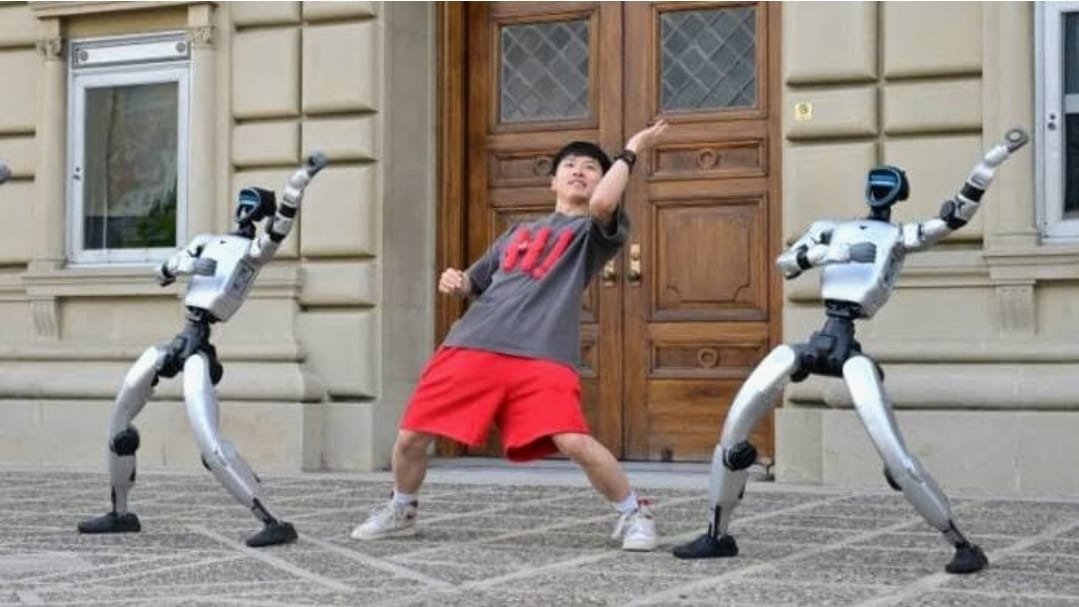
Chinese robot dancers led by Wu Yufei have reached the America’s Got Talent final, combining street dance, kung fu-inspired choreography and humanoid robotics.
Chinese robot dancers led by street dancer Wu Yufei have reached the final of the popular American television talent show America’s Got Talent, combining human choreography with humanoid robots in a performance featuring synchronised dance, acrobatics and kung fu-inspired moves.
Wu, a 27-year-old dancer from Sichuan, has spent about 13 years performing street dance, mostly as a solo performer. His partnership with the humanoid robots, developed by Chinese robotics company Unitree, has now taken the group, known as Homies, to the America’s Got Talent finale in Pasadena, California.
For Wu, the experience has been unlike his previous performances. The longtime science-fiction fan described dancing alongside the machines as a “very magical feeling”, adding that months of rehearsals had changed his perception of the robots.
“It almost feels as if there’s a kind of team spirit there,” Wu told AFP, as the robot dancers prepared for the final. He said the machines had evolved in his eyes from “cold, lifeless machines” into something resembling members of a performance team.
Behind the seemingly effortless routines is an intensive process involving human dancers, engineers, motion capture and computer simulations. Industry experts say even a 30-second routine can take days or weeks to perfect, while engineers must repeatedly fine-tune the robots to reproduce the required movements accurately.
The robot dancers also have clear limitations. They are particularly effective at precise rotating and power movements, but flexibility and musical improvisation remain difficult. Most routines are scripted, meaning the robots cannot respond as naturally as human dancers when music or choreography changes unexpectedly.
Wu, however, sees another striking advantage in the technology — the speed at which a learned routine can be reproduced across multiple machines. “Their knowledge can be replicated extremely quickly,” he said, adding that the ability for several robots to learn the same movements simultaneously is “quite terrifying.”
The appearance of the robot dancers has also highlighted China’s rapidly expanding humanoid robotics industry, where entertainment is increasingly being used to demonstrate balance, coordination, motor control and reliability. While experts say the industry still faces challenges in finding wider commercial applications, Wu and his robotic partners have placed the technology before a global television audience at the America’s Got Talent final.
Visit GMTNewsng for more news stories.