
Enugu Health Commissioner Prof. George Ugwu has warned residents against unhealthy diets, self-medication and herbal concoctions while clarifying concerns over kidney and cardiovascular diseases.
The Enugu State Commissioner for Health, Prof. George Ugwu, has urged residents not to panic over a perceived increase in kidney and cardiovascular diseases, attributing the apparent rise partly to greater health awareness, improved access to medical information and increased testing.
Ugwu said more residents were becoming conscious of their health and presenting themselves for medical examinations, leading to the detection of cases that might previously have remained undiagnosed.
The commissioner spoke during a live interactive programme, The Conversation, aired on 100.3 Udoka FM, Enugu, where he addressed concerns about kidney and cardiovascular health and outlined measures residents could take to reduce their risk.
He, however, warned that unhealthy diets, obesity, physical inactivity, excessive alcohol consumption and indiscriminate use of medicines remained important risk factors for lifestyle-related health complications.
Ugwu advised residents to pay closer attention to their diets, particularly reducing excessive consumption of sugary, salty, oily, highly processed and packaged foods.
He encouraged greater consumption of locally produced foods, noting that several traditional Nigerian meals can provide important nutrients when properly prepared.
The commissioner cited Ayaraaya oka, a traditional maize-based meal associated with the Nsukka area of Enugu State, as an example of a local food that can form part of a nutritious diet.
He expressed concern that some people increasingly associate expensive and heavily processed foods with affluence, warning that excessive consumption can contribute to obesity and other health problems.
Ugwu particularly advised residents aged 40 and above to pay greater attention to calorie intake and body weight, noting that people can consume significantly more food than their bodies require.
He also raised concerns about the eating habits of young people and students who frequently rely on noodles and other convenience foods without adequately incorporating vegetables, proteins and other nutrient-rich foods into their diets.
According to him, poor nutrition is not always driven by poverty, as some people spend substantial amounts on snacks and junk food while overlooking healthier and more affordable alternatives.
The commissioner also urged residents to engage in regular physical activity, describing exercise as an important component of preventing lifestyle-related diseases.
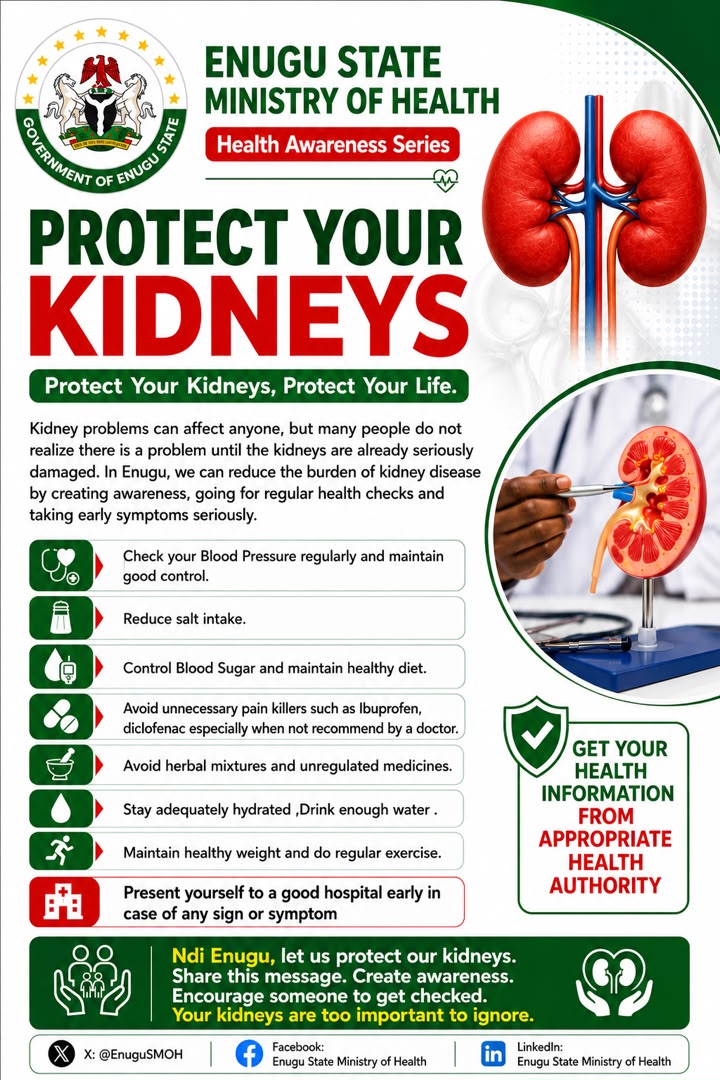
Ugwu identified self-medication and the indiscriminate use of painkillers as significant risks to kidney health.
He advised residents against purchasing and taking medicines without appropriate medical guidance, urging them to obtain orthodox medicines from credible sources and use them strictly according to professional advice.
Addressing concerns over the abuse of herbal medicines amid reports of counterfeit pharmaceutical products, the commissioner cautioned residents against viewing herbal and orthodox medicines as interchangeable alternatives.
He said the Enugu State Government was working to strengthen the regulation of medical products and facilities while developing a system that would allow medical supplies to be sourced directly from manufacturers.
Ugwu said the state was “driving towards ensuring that all medical supplies are gotten directly from the manufacturers”, describing the approach as part of efforts to improve the quality and safety of medicines available to residents.
He acknowledged that regulation remained a major challenge in the health sector but said the Ministry of Health was intensifying efforts to ensure that health facilities and medical products meet established standards.
The commissioner also highlighted the role of the National Agency for Food and Drug Administration and Control (NAFDAC) in combating counterfeit medicines, including the use of verification systems on pharmaceutical products.
He urged residents to patronise authorised medicine outlets and seek professional guidance before taking medication.
Ugwu specifically warned against routinely visiting pharmacies or medicine shops for over-the-counter drugs without consulting a medical professional, noting that some commonly used painkillers can damage the kidneys when taken indiscriminately or for prolonged periods.
He further cautioned against assuming that herbal preparations are automatically safer than regulated pharmaceutical products, stressing that the ingredients, dosage and safety profiles of some herbal products may not have been sufficiently established.
The commissioner also reaffirmed Governor Peter Mbah’s commitment to expanding access to quality and affordable healthcare across Enugu State.
Ugwu said the administration’s investment in the sector was deliberate and designed to ensure that residents could access healthcare at the primary, secondary and tertiary levels.
“The Peter Mbah administration is very intentional about health because he’s a leader that cares. The governor understands that for every other sector of the economy to grow, you must have a healthy population of both old and young residents,” he said.
According to the commissioner, ultramodern Type-2 hospitals are being constructed across the state’s 260 political wards, while major tertiary institutions are also receiving significant investment.
He listed the ESUT Teaching Hospital, Park Lane and the SUMAS Teaching Hospital, Igbo Eno, among the institutions receiving attention under the administration.
Ugwu added that the World-Class Enugu International Hospital would soon be commissioned, while various general hospitals across the state were also undergoing interventions.
“You can see that health is only second to education in Enugu’s consecutive annual budget,” he said.
The commissioner said the government’s objective extends beyond reducing medical tourism, stressing that the broader goal is to make quality healthcare accessible and affordable to residents.
“What the Mbah administration is trying to achieve is not only to end medical tourism or to make Enugu the medical hub for Africa, but also to ensure affordable access to healthcare,” he said.
Ugwu consequently urged residents not to panic over the perceived increase in kidney and cardiovascular diseases but to take advantage of the healthcare facilities being provided by the government.
Responding to concerns about the ability of low-income residents to afford medical consultations, Ugwu said ignorance remained a major challenge alongside financial constraints.
He acknowledged that some patients might struggle to afford subsequent treatment after consultation but advised residents to make qualified medical practitioners their first point of contact whenever they experience health concerns.
The commissioner said even an initial consultation could provide valuable medical guidance for a patient who could not immediately afford further treatment.
He therefore cautioned residents against beginning treatment with self-prescribed medicines or ordering laboratory tests without appropriate professional guidance.
Also speaking during the programme, Dr. Okoro Chizaram, a medical doctor and public health advocate, challenged the perception that kidney and cardiovascular diseases are exclusively associated with adults.
Chizaram explained that children can also develop kidney and cardiovascular conditions, with some cases linked to inherited conditions or other illnesses.
He identified certain infections, including skin infections and sore throat, as possible triggers of kidney complications in children, alongside malaria, malnutrition and severe dehydration.
According to him, kidney disease in children can sometimes follow untreated or poorly managed illnesses, making early recognition and appropriate medical intervention important.
He urged parents and caregivers to take unusual symptoms in children seriously rather than assuming that kidney and cardiovascular diseases only become relevant later in life.
Chizaram also advocated preventive health practices, including balanced nutrition, adequate hydration, regular physical activity, appropriate treatment of infections and medical checks when necessary.
The programme also attracted reactions from listeners, with several callers commending the guests and the station for providing health education while calling for more regular public health engagements.
Some callers raised concerns about food safety, drawing attention to the alleged circulation of adulterated palm oil and artificially ripened fruits in markets.
They called for stronger monitoring and regulation of food products and urged consumers to exercise greater caution when purchasing food items.
The concerns reinforced the broader message of the programme on the relationship between everyday dietary choices, lifestyle habits and long-term health outcomes.
The experts consequently urged residents to become more deliberate about their diets, medication practices and physical activity while seeking professional medical advice instead of relying on self-diagnosis and self-medication.
The discussion also highlighted the importance of sustained public health education, early detection and stronger regulation of medicines and food products in reducing preventable kidney and cardiovascular complications across Enugu State.
Visit GMTNewsng for more news stories.