The Federal Government and key stakeholders have called for greater investment in climate-resilient WASH systems, stronger collaboration and sustainable financing to protect water security, sanitation and public health in Nigeria.
ABUJA – The Federal Government and stakeholders in Nigeria’s Water, Sanitation and Hygiene (WASH) sector have called for increased investment, stronger collaboration and climate-resilient infrastructure to safeguard water security, sanitation services and public health against the growing impacts of climate change.
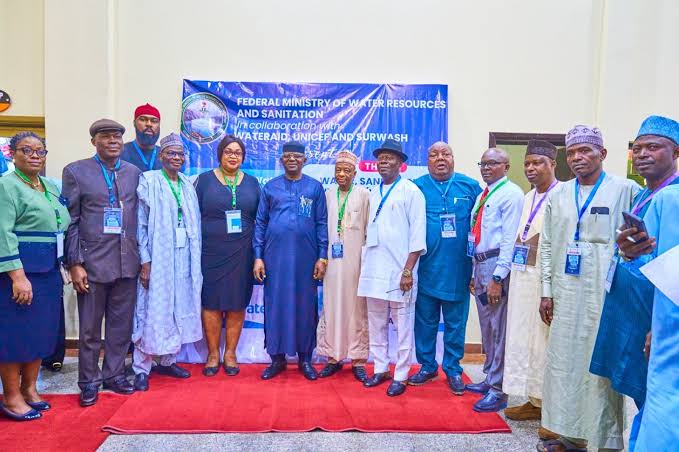
The call was made on Monday at the opening of the 3rd Annual National Climate Change and WASH Conference in Abuja.
The conference, themed “Water, Sanitation and Hygiene (WASH) Systems at the Frontline of Climate Change: Aligning NDC 3.0 with National Adaptation Priorities,” brought together government officials, development partners, civil society organisations, academics and private-sector stakeholders.
Speaking at the event, the Minister of Water Resources and Sanitation, Prof. Joseph Utsev, described climate change as a major threat to water resources, sanitation services and public health, stressing the need to build resilient WASH systems.
According to him, climate change has evolved into a water crisis, with floods, droughts, changing rainfall patterns and declining water quality increasingly affecting access to safe water and sanitation.
Utsev said the conference offered an opportunity to move beyond policy discussions by aligning WASH interventions with Nigeria’s updated Nationally Determined Contribution (NDC 3.0).
“Without water security, there can be no climate resilience. Without sanitation, there can be no public health resilience. Without resilient WASH systems, adaptation efforts remain incomplete,” he said.
The minister reaffirmed the Federal Government’s commitment to integrating climate resilience into water resources management and WASH service delivery through policy reforms, strategic investments and partnerships.
He identified key priority areas, including strengthening climate-resilient water infrastructure, improving integrated water resources management, expanding climate-smart sanitation systems, enhancing hydrological monitoring and early warning systems, and mobilising climate finance.
Utsev also stressed the importance of community participation, gender inclusion and local ownership in implementing climate adaptation programmes.
He said the ministry would continue collaborating with the National Council on Climate Change (NCCC), state governments, River Basin Development Authorities, development partners, academia and civil society organisations to mainstream WASH into Nigeria’s national adaptation plans.
Representing the Minister of Environment, Chika Opara said climate change continues to exert pressure on water resources, sanitation infrastructure, food security and ecosystems.
According to Opara, increasing incidents of flooding, drought, erosion and desertification are weakening community resilience, while the ministry remains committed to promoting environmental sanitation, pollution control, integrated waste management and the One Health approach.
Representing the Minister of Budget and Economic Planning, Maria Yuazake said climate-resilient WASH programmes would remain a priority in national planning and budgeting through strategic investments and sustainable financing.
The Director-General of the National Council on Climate Change (NCCC), Temi Majekodunmi, represented by Amudi Felistas, said the conference would help translate Nigeria’s climate commitments into practical actions.
She noted that climate-resilient WASH initiatives would create green jobs, improve livelihoods, strengthen environmental protection and support the implementation of NDC 3.0.
Speaking on behalf of WaterAid, Mr. Kolawole Banwo commended the Federal Ministry of Water Resources and Sanitation and the National Technical Working Group on Climate-Resilient WASH for sustaining the annual conference.
Banwo said effective climate action requires a government-led, sector-wide approach involving development partners, civil society, academia, the private sector and the media.
He called for stronger institutions, reliable data, sustainable financing and enhanced collaboration to bridge funding gaps affecting climate-resilient WASH infrastructure.
Also speaking, the National Coordinator of the Network of Water and Sanitation (NEWSAN), Mr. Benson Attah, said WASH must be fully integrated into Nigeria’s planning and financing frameworks to achieve long-term climate resilience.
Attah emphasised that deliberate investment in adaptive infrastructure capable of withstanding extreme weather events is essential for protecting vulnerable communities.
“We must move from alignment in principle to alignment in practice. Policies must translate into reinforced boreholes, secure sanitation facilities and community-led management systems that can withstand climate extremes,” he said.
He also advocated innovative financing mechanisms, including stronger public-private partnerships, to mobilise resources for climate-resilient WASH projects, while reaffirming NEWSAN’s commitment to ensuring that vulnerable communities have sustainable access to safe water and sanitation services.
Visit GMTNewsng for more news stories.