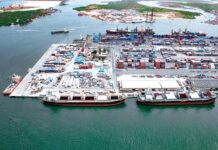
Nigeria’s trade surplus skyrocketed by 341% to N7.55 trillion in the first quarter of 2026, driven by a sharp drop in foreign fuel dependencies and resilient crude oil exports.
Nigeria’s international trade profile recorded a massive structural improvement in the first quarter of 2026, securing a colossal merchandise trade surplus of N7,549.94 billion ($7.55 trillion). The performance represents a staggering 340.88 percent surge compared to the preceding quarter, driven primarily by a sharp reduction in refined petroleum imports and robust crude outflows.
According to the official Foreign Trade in Goods Statistics Report for Q1 2026, released by the National Bureau of Statistics (NBS) on Monday in Abuja, the nation’s total aggregate trade hit N34,788.59 billion. While this marks a minor contraction from the N37.24 trillion and N36.21 trillion recorded in Q1 2025 and Q4 2025 respectively, the underlying trade architecture moved heavily in Nigeria’s favor.
The data reveals that total outbound trade dominated the balance sheet, with exports reaching N21,169.27 billion, representing 60.85 percent of all external transactions. This export value indicates an 11.63 percent growth over Q4 2025 and a 2.77 percent increase year-on-year.
Crude oil remained the undisputed anchor of Nigeria’s export portfolio, generating N11,202.35 billion to account for 52.92 percent of overall shipments. Concurrently, the aggregate value of non-crude oil exports stood strong at N9,966.92 billion (47.08 percent of exports), within which pure non-oil commodities contributed N3,186.74 billion.
Nigeria’s primary global export partners for the quarter included India, France, the Netherlands, Spain, and the United States. Beyond crude, top exported products featured natural gas, urea fertilizer, specialized petroleum gases, and aviation-grade jet fuel.
Conversely, total national imports plummeted to N13,619.33 billion, making up just 39.15 percent of total trade. This represents a significant 21.05 percent contraction from the final quarter of 2025 and an 18.17 percent decline year-on-year from Q1 2025.
On the inbound ledger, China maintained its position as Nigeria’s primary source of imports, followed closely by the United States, India, Germany, and the United Arab Emirates. The bulk of inbound capital flight was driven by machinery and heavy transport equipment at N5,011.21 billion, followed by mineral fuels at N2,648.28 billion and industrial chemical lines at N2,020.71 billion.
NBS analysts noted that the positive balance of trade points to a highly favorable correction in macroeconomics. By suppressing the structural appetite for foreign refined fuels and expanding the volume of liquid gas and agro-related exports, the nation has successfully built a solid liquidity cushion that will fortify external reserves and ease prevailing foreign exchange volatility.
Visit GMTNewsng for more news stories.