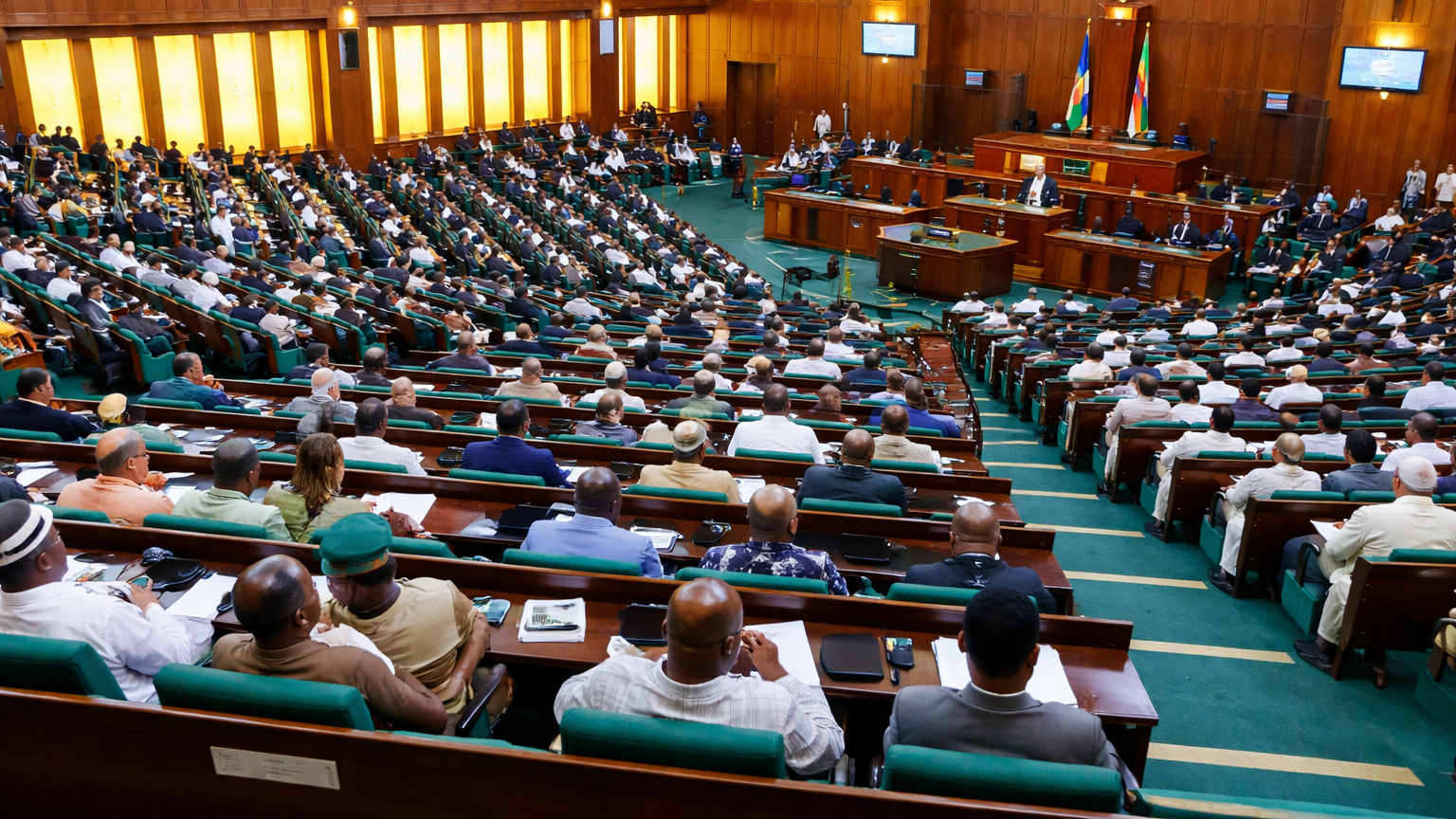
Nigeria’s House of Representatives passes the Electoral Act Amendment Bill 2025, rejecting a two-year jail term for vote-buying at party primaries amid sharp divisions. Electoral Act Bill.
The Electoral Act Amendment Bill 2025 has been passed by the House of Representatives, with lawmakers rejecting a controversial proposal seeking to criminalise vote-buying at party primaries.
The electoral act bill was approved after clause-by-clause consideration, but a provision proposing a two-year jail term without the option of a fine for the inducement of delegates during party primaries was overwhelmingly voted down.
The rejected clause, Clause 89(4), sought to penalise any person who financially or materially induced a delegate to influence the outcome of party primaries, congresses, or conventions.
Despite its strong wording, lawmakers voted against the clause during deliberations at the Committee of the Whole, presided over by the Deputy Speaker, Benjamin Kalu.
Its rejection effectively removes criminal sanctions for inducement at party primaries from the amended law, leaving issues of financial influence and delegate inducement to be addressed outside the scope of the revised Electoral Act.
The decision highlighted deep divisions within the House over the extent to which electoral laws should regulate internal party processes, particularly during primaries, where allegations of vote-buying have remained persistent in Nigeria’s electoral history.
Briefing National Assembly correspondents after the bill’s passage, Chairman of the House Committee on Electoral Matters, Adebayo Balogun, said the House deliberately opted for targeted amendments rather than a wholesale repeal of the Electoral Act 2022.
Balogun explained that several far-reaching proposals failed to secure a broad legislative consensus, despite being aimed at consolidating gains from recent elections and addressing emerging electoral challenges.
He disclosed that the bill was initially introduced to repeal the 2022 Act and enact a new electoral law but was later revised following committee-level scrutiny.
According to him, major proposals such as early voting, inmate voting, replacement of the Permanent Voters’ Card with alternative accreditation mechanisms, and adjustments to electoral timelines did not enjoy sufficient support.
“In legislative practice, a repeal of an existing law and enactment of a new one is appropriate only where the proposed changes fundamentally transform the identity of the principal Act,” Balogun said.
He added that the House instead introduced additional amendments aimed at strengthening the existing framework, addressing observed gaps, and improving implementation without undermining the stability of the current law.
Balogun further assured Nigerians that the committee conducted its work transparently, engaging stakeholders including the Independent National Electoral Commission, security agencies, political parties, civil society organisations, professional bodies, and development partners.
While acknowledging that some innovative proposals, including punitive measures against vote-buying at party primaries, were not adopted, he said such ideas remained part of the national conversation and could be revisited as consensus evolves.
The passage of the Electoral Act (Amendment) Bill 2025 marks another step in Nigeria’s ongoing electoral reform process, even as debates continue over how best to curb electoral malpractices and strengthen democratic accountability within political parties.
Visit GMTNewsng for more news stories.