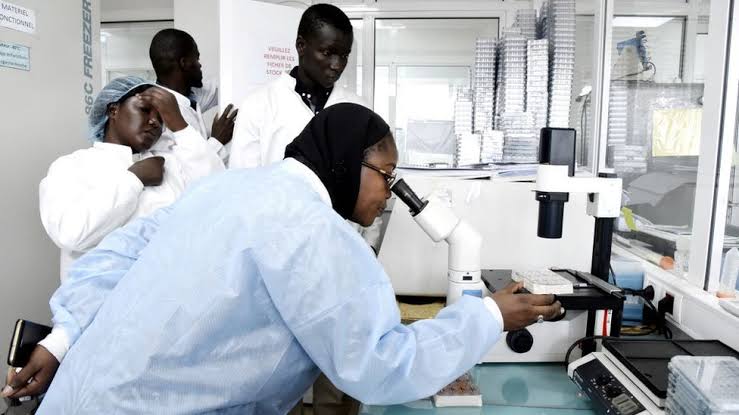
The National Agency for the Control of AIDS (NACA), in collaboration with the Medical Laboratory Science Council of Nigeria (MLSCN), has upgraded and handed over the National External Quality Assessment Laboratory (NEQAL) in Zaria, Kaduna State, as part of efforts to strengthen Nigeria’s laboratory diagnostics and quality assurance systems.
The handover ceremony took place on Monday in Zaria.
Speaking at the event, the Director-General of NACA, Dr Temitope Ilori, said the upgrade was delivered with support from the Global Fund and was aimed at improving disease prevention, diagnosis and healthcare outcomes across the country.
Ilori, who was represented by Malam Mustapha Ya’u, Acting Director of Finance and Accounts at NACA, said the facility would significantly enhance diagnostic services nationwide.
“We are happy to deliver this project to the MLSCN to boost diagnostic services and improve health outcomes in Nigeria,” he said.
Also speaking, the Speaker of the House of Representatives, Dr Abbas Tajudeen, described the upgrade of the national quality laboratory as a critical investment in strengthening healthcare delivery and advancing Nigeria’s commitment to the Sustainable Development Goals (SDGs).
Tajudeen, who was represented by the Chairman of Zaria Local Government Area, Jamil Mohammed, commended Ilori for driving the project and noted that it reflected the Federal Government’s resolve to improve the health and wellbeing of Nigerians through stronger healthcare infrastructure.
The Speaker acknowledged the support of development partners, particularly the Global Fund, for enhancing Nigeria’s laboratory systems and diagnostic capacity for HIV, tuberculosis and malaria.
He said the upgrade had repositioned the laboratory to deliver more accurate, reliable and efficient testing, thereby improving patient safety and the overall quality of healthcare services.
Tajudeen noted that while Nigeria had made significant progress in combating HIV/AIDS through NACA’s coordinated response, rising new infections in some demographics could threaten the goal of ending the epidemic by 2030.
He called for intensified awareness campaigns, stronger prevention strategies and expanded access to antiretroviral therapy, especially to address gaps in preventing mother-to-child transmission of HIV.
The Speaker described the upgraded NEQAL as a milestone that would eliminate delays associated with producing External Quality Assessment (EQA) panels outside the country, improve sustainability and enhance the credibility of laboratory results nationwide.
He urged MLSCN to ensure the professional and ethical management of the facility by certified personnel, warning that poor staffing had undermined many public health investments in the past.
In his remarks, the Acting Registrar and Chief Executive Officer of MLSCN, Dr Donald Ibe Ofili, described the upgraded national quality laboratory as a game changer for diagnostic accuracy, patient safety and laboratory excellence in Nigeria.
Ofili said the project went beyond infrastructure development, representing a decisive step toward improving the reliability, accuracy and consistency of medical laboratory services nationwide.
He commended NACA for its effective management of the Global Fund RSSH2 and C19RM grants that supported the upgrade, while also acknowledging the United States Centres for Disease Control and Prevention (US CDC) for supporting the initial establishment of NEQAL in 2009 and the Institute of Human Virology Nigeria (IHVN) for sustained technical assistance.
Ofili added that the investment would reduce the cost of EQA panels, boost local production and strengthen the sustainability of laboratory quality assurance in Nigeria.
He said the upgraded facility positioned Nigeria as a regional hub for laboratory quality assurance in West Africa, contributing to regional health security.
Ofili reiterated that participation in External Quality Assessment remained mandatory for all public and private medical laboratories in Nigeria, describing EQA as the gold standard for ensuring accurate and reliable test results that support sound clinical decisions and public confidence.
He called for stronger collaboration among government agencies, development partners and stakeholders to build a resilient and sustainable laboratory system nationwide.
Visit GMTNewsng for more news.