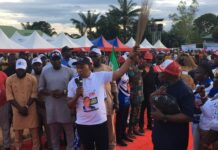
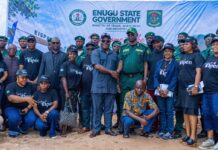
MBURUBU, ENUGU STATE – It was more than a festive gathering in Mburubu community, Nkanu East Local Government Area, on Sunday, April 27, 2025. As families celebrated Easter in familiar warmth and communion, the atmosphere transformed into one of profound gratitude and hope – thanks to a multimillion-naira empowerment initiative championed by one of their own, Prince Engr. Lawrence Ezeh, PhD, the Commissioner for Innovation, Science and Technology in Enugu State.
The Commissioner, a Fellow of the Nigerian Society of Engineers (FNSE), chose to mark the season not just with prayers and pleasantries but with purposeful giving. Over ₦30 million in cash grants were distributed among individuals, youth groups, and the seven villages that make up Mburubu. The individual grants were disbursed in three categories: ₦500,000, ₦300,000, and ₦200,000 respectively, while each of the seven villages received ₦1 million. The youth body was empowered with a substantial ₦3 million.
“I came home this Easter to say thank you to my people,” said Prince Ezeh, speaking to newsmen at his residence. “Their support, love, and prayers have brought me this far. It is only natural that I give back – not just in words, but with resources that can uplift homes, ignite businesses, and plant seeds of independence.”
One of the most resonant aspects of the initiative is its human face. Cecilia Okafor, a petty trader and one of the beneficiaries of the ₦300,000 grant, described it as “a miracle.” According to her, “This money will help me expand my provisions shop. Before now, I was borrowing to restock. Now, I can finally breathe.”
At the Commission’s residence, where hundreds gathered to witness the event, joy was etched on the faces of youth leaders, elders, and market women. The chairman of the youth body, Boniface Okeke – himself a recipient of a commuter bus in last December’s phase of the programme – described the empowerment model as “practical and deeply impactful.” He said, “When we received those 10 buses last year, many of us didn’t believe it would transform our lives so fast. Today, most of those buses are already generating income for our members. That’s real empowerment.”

This Easter initiative is not the Commissioner’s first intervention. In December 2024, Engr. Ezeh donated millions in cash, over 200 bags of rice, and the aforementioned commuter buses to boost local mobility and youth entrepreneurship. The consistent roll-out of support indicates a deliberate strategy, not a seasonal gesture.
To development experts, this aligns with global best practices. The United Nations Development Programme (UNDP) emphasizes that true empowerment is not handout-based but rather “an enabler of economic participation, social inclusion, and civic engagement.” Prince Ezeh’s effort dovetails with this view – merging philanthropy with measurable community impact.
Each of the seven villages – Umudara, Uhuegbe, Uhuagu, Obinagu, Umunafor, Amanator, and Amachi – received ₦1 million each to invest in projects of communal benefit. For village leaders like Chief Joseph Onu, who received ₦500,000 personally, the gesture is not just about money. “This is restoration of dignity,” he said. “When a son of the soil remembers home, not to show power but to lift his people, it is something generations will not forget.”
Beyond the financial figures, the initiative exemplifies the broader vision of Governor Peter Ndubuisi Mbah’s administration in Enugu State. The state government’s “Tomorrow is Here” agenda has consistently emphasized innovation-led development, rural inclusion, and people-centered governance.
“Governor Mbah has always urged us to be the bridge between policy and people,” noted Prince Ezeh. “This empowerment is a reflection of that charge – bringing development to the doorsteps of our communities and restoring hope in governance.”


From a governance standpoint, what is unfolding in Mburubu mirrors the principles behind the World Bank’s Human Capital Project, which advocates that community-based investments in health, education, and economic capacity are the fastest way to break the cycle of poverty. The deliberate targeting of youths, women, and traditional structures reflects this evidence-based approach.
A sense of inclusiveness and equity was palpable. “This is not just for one group or age bracket,” explained Angela Nnaji, another beneficiary representing the women. “I am speaking for hundreds of women who now have a new sense of belonging. Some will go into poultry farming, some tailoring, others trading. Our destinies just took a turn.”
Indeed, what makes the event so compelling is its symbolism. It represents a break from extractive politics to one that rewards social investment. It underscores that leaders can use their platforms not for showmanship but for transformation.
For many in Mburubu, the Easter celebration will be remembered not just for its spiritual significance, but as the moment their collective fortunes began to shift. “We feel seen, we feel valued,” said Chief Onu. “This is not politics; this is progress.”
As dusk settled over the community and residents returned to their homes, voices of children and elders alike echoed one sentiment: “May God bless our son, the Five-Star Prince.”

In Enugu State today, empowerment is not a slogan – it is a lived experience. GMTNewsng