EU, Enugu Government to Partner on Power and Infrastructure
The European Union (EU) and the Enugu State Government have reaffirmed their commitment to exploring potential partnerships in the power and infrastructure sectors to drive economic growth and development in the state.
This was disclosed on Tuesday by the Head of Cooperation at the European Union Delegation to Nigeria and ECOWAS, Mr. Massimo De Luca, during his working visit to Governor Peter Mbah at Government House, Enugu.
Mr. De Luca emphasized Enugu State’s strategic importance to the EU, noting that it had emerged as a key partner in several areas, particularly in renewable energy. He highlighted ongoing projects such as solar-to-health and small hydro-power generation, which are expected to provide uninterrupted electricity to industrial clusters.
“A specific focus, which has emerged over the last couple of years, is renewable energy, and Enugu is one of the selected number of states partnering with us on a number of renewable energy initiatives. One of them is solar-to-health.
“We are working for the electrification of primary health centres in the state, and the model we are adopting is one that will ensure sustainability,” he stated.
Discussing infrastructure development, the EU official lamented that some past projects had suffered neglect due to poor maintenance culture and a lack of sustained interest. He, however, stressed the importance of local authorities’ involvement in ensuring the success of these initiatives.
“This time, we are involving the local authorities fully in the primary health sector, and even the private sector, so that infrastructure, which we will deploy in partnership with the state authority, will be taken over by a management structure that ensures the long-term sustainability of the infrastructure. That also means that the solar installations that we are building should not only serve the health centres but also the ecosystem,” he said.
Mr. De Luca expressed optimism that the partnership would result in projects that enhance the efficiency and sustainability of the primary healthcare system while providing better services to citizens.
“We are also looking at different types of renewable energy operations, and more of them to be connected to agriculture. It is a small hydro, which is a technology where the European Union is particularly advanced and can be deployed without upsetting the environment. It can contribute to the electrification of the area with its own hydro-generation plants,” he added.
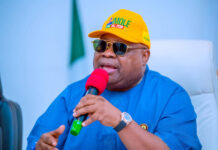
Governor Peter Mbah, on his part, reiterated the state’s keen interest in forging a development partnership with the EU, noting that many of its initiatives align with his administration’s vision of eradicating poverty and fostering exponential economic growth.
“Our vision is to eradicate poverty—to achieve a zero percent rate in our poverty headcount. We have, in pursuit of that objective, invested hugely in our social sector, building 260 smart schools and 260 Type-2 primary healthcare centres.
“We can see a major alignment when you talk of investment because beyond eradicating poverty in our state, we have the vision to grow our economy exponentially, and we see that coming from outside investment—private sector investments from multilateral and bilateral relationships.
“Given our private sector backgrounds, we know how we can structure investment in a manner that is a win-win for all parties, whether with the private sector or the EU investments.
“We are also interested in other areas that you have mentioned. Grassroots for us is particularly of interest because we believe that we cannot grow at the expense of our downtrodden – those in the rural areas.
“If you look at our budget tagline, you will get things like exponential growth and inclusive prosperity. This means that you have to grow even the weakest among us. So, we are investing hugely in basic amenities and expanding economic opportunities for those in the rural areas,” he said.
Mbah further called for the strengthening of the existing relationship to expand new areas of interest in renewable energy, particularly initiatives such as solar-for-health and solar-for-education. These, he noted, would power smart screens, ICT centres, robotics, and artificial intelligence laboratories in the smart green schools across the state’s 260 electoral wards. GMTNewsng