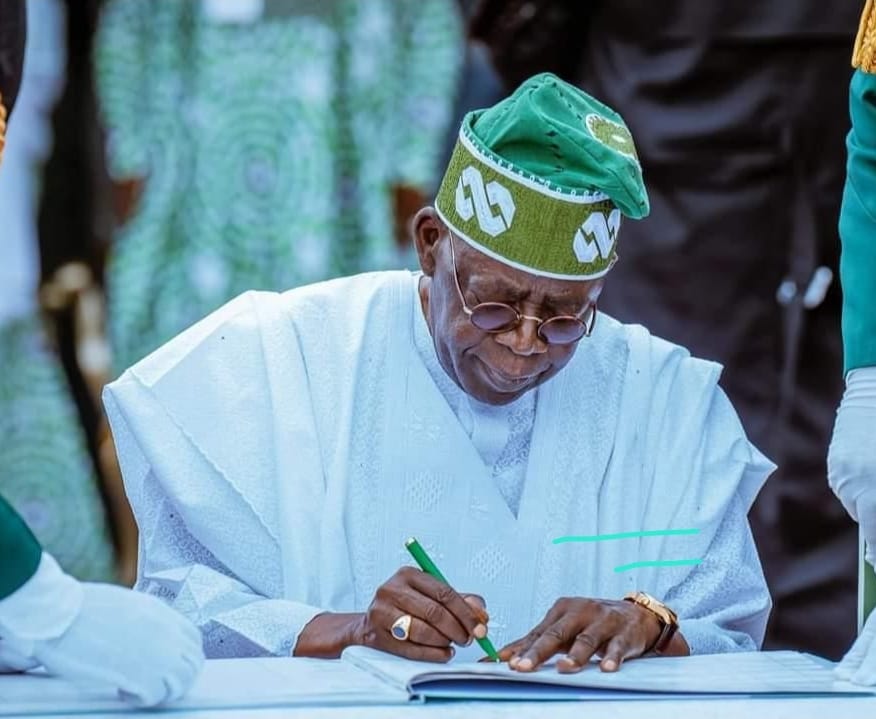
Tinubu signs the 2027 peace accord and pledges peaceful elections as fresh concerns over INEC neutrality and public confidence emerge ahead of the presidential poll.
President Bola Ahmed Tinubu has pledged his commitment to a peaceful and credible 2027 general election as political parties and presidential contenders signed a peace accord in Abuja ahead of the campaign season.
The President, who was represented at the ceremony by the Secretary to the Government of the Federation, Senator George Akume, urged political actors to place Nigeria’s interests above personal and partisan ambitions.
The accord was convened by the National Peace Committee (NPC), led by former Head of State General Abdulsalami Abubakar, alongside prominent members including the Sultan of Sokoto and Bishop Matthew Hassan Kukah.
Tinubu commended the committee for its efforts since 2014 to promote non-violent and issue-based political campaigns during Nigeria’s elections.
He said the country had made progress in election management since the return to democratic rule in 1999, particularly through the use of technology by the Independent National Electoral Commission (INEC).
According to the President, the Permanent Voter’s Card (PVC) and the Bimodal Voter Accreditation System (BVAS) have strengthened the electoral process and reduced manipulation at polling units.
He also cited the recent off-cycle governorship elections in Anambra, Ekiti and Osun as evidence of Nigeria’s growing electoral maturity, saying different political parties won the respective contests and observers described the polls as free, credible and transparent.
INEC’s official election calendar confirms that the 2027 presidential and National Assembly elections are scheduled for January 16, 2027, while governorship and State House of Assembly elections are scheduled for February 6, 2027.
The President called on political parties to focus their campaigns on policies and competing ideas rather than ethnic and religious divisions.
“Let us campaign on superior ideas. Let us debate issues and promote the best policies to expand opportunities for our people,” Tinubu said.
He also pledged that the All Progressives Congress (APC) would abide by the peace accord and reject violence, hate speech, misinformation, artificial intelligence-generated disinformation and incitement, particularly on social media.
Tinubu urged other political parties and candidates to make similar commitments, stressing that elections should not be treated as a do-or-die contest.
“Win or lose, our country, Nigeria, must be the ultimate winner,” he said.
Despite Tinubu’s positive assessment of Nigeria’s electoral progress, concerns over the neutrality and credibility of INEC remain part of the political conversation ahead of the 2027 election.
The issue has become particularly sensitive because the incumbent President is also seeking re-election under the APC banner, placing greater scrutiny on the electoral commission’s independence.
In July, President Tinubu himself declared that INEC was neutral while dismissing concerns raised about the commission’s impartiality. His position was subsequently challenged by opposition figures, including African Democratic Congress (ADC) chieftain Kenneth Okonkwo, who argued that the electoral body had not done enough to convince Nigerians of its neutrality.
Other political actors have also questioned INEC’s credibility, while reports have highlighted concerns over conflicting court decisions, political-party disputes and public distrust ahead of the 2027 polls.
A March 2026 analysis by the Policy and Legal Advocacy Centre (PLAC) also noted that even legally valid electoral timelines can create perceptions of bias when they significantly affect the competitive environment. It stressed that electoral management bodies must maintain both actual neutrality and the perception of neutrality to sustain public confidence.
INEC has repeatedly maintained that it is an independent and neutral electoral management body.
At a consultative meeting with political parties in February, INEC Chairman, Professor Joash Amupitan, said the commission remained committed to openness, accountability and compliance with the Constitution and electoral laws.
The commission has also been undertaking reforms ahead of the 2027 election, including a review of its regulations for political parties following the enactment of the Electoral Act 2026. INEC says the review is aimed at improving party compliance, reducing pre-election disputes and strengthening confidence in the electoral process.
For the peace accord to translate into public confidence, however, political observers and opposition parties will be watching not only the conduct of candidates but also the actions of INEC, security agencies, political parties and other institutions involved in the electoral process.
The signing of the accord therefore marks an important commitment to peaceful politics, but its credibility will ultimately depend on whether all political actors and state institutions demonstrate restraint, transparency and impartiality throughout the election cycle.
Tinubu urged Nigerians, civil society organisations, the media and international partners to participate actively in strengthening the country’s democratic institutions.
Visit GMTNewsng for more news stories.