From childhood as a war refugee to a career as a Holy See diplomat, Archbishop Fortunatus Nwachukwu will now take on a new leadership role in one of the most important dicasteries in the Roman Curia.
The Nigerian archbishop was recently appointed by Pope Francis as a secretary for the Vatican’s Dicastery for Evangelization.
The dicastery is tasked with “the work of evangelization, so that Christ, the light of the nations, may be known and witnessed to by word and deed, and the Church, his mystical body, may be built up.”
In an interview with EWTN last week, Nwachukwu, 62, spoke about evangelization and interreligious dialogue, underlining what Jesus said in John 14:6: “I am the way, the truth, and the life. No one can come to the Father except through me.”
“We have to continue to insist and to say that Jesus is the sole way to the Father,” he said, adding that “even going from Scripture, we can also refer to non-Christians as our brothers and sisters if they are walking in the truth in search of God.”
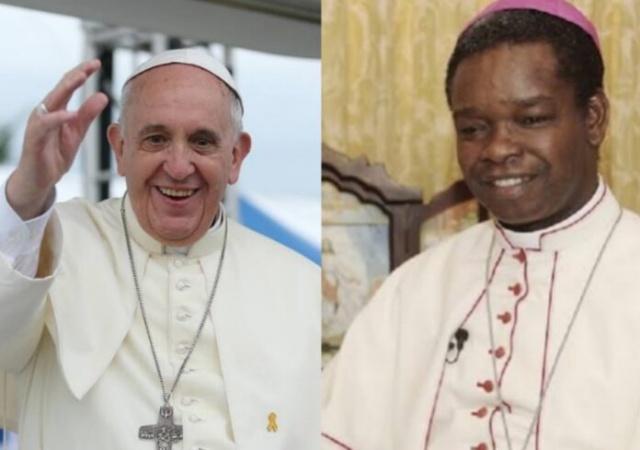 L-R: Pope Francis, Archbishop Nwachukwu
Childhood as a war refugee
Nwachukwu also recalled his childhood as a refugee displaced by the violence of Nigeria’s Civil War, also known as the Biafran War (July 6, 1967 – Jan. 15, 1970), in a previous interview with EWTN.
“I was only 7 years old when I was caught up in the midst of a civil conflict, one of the most horrible, horrendous civil conflicts of the last century. This was in 1967, the outbreak of the Nigeria Biafra Civil War,” the archbishop said.
“I lost many of my peers. I lost two of my own sisters. So, I knew right from a very early age what it means to pass through a situation of war. I know what it means to experience hunger. I know what it means to be an internally displaced person. So, I know the experience of being a refugee.”
An estimated one million people died during the war that lasted less than three years, with the majority dying from starvation, according to Encyclopedia Britannica.
“I know the experience of living away from my home. I lost my father and mother for a long period. We were five and we were under my eldest brother, who was only 13. And we had to survive. So, I know what it means to go through suffering,” Nwachukwu said.
He continued: “I lost years of education, three years from 1967 to 1970. And therefore, when I’m coming to the United Nations, I know what it means to experience war, not at the warfront, but as a victim, a victim that is innocent.”
Nwachukwu noted that he has brought all of these experiences with him to his work as a diplomat, most recently representing the Holy See at the United Nations in Geneva.
“I know what it means to feel one has been abandoned by the rest of humanity. Or what it means to feel one has been discriminated against in one’s own nation,” he said.
“When a person is going to talk to me about discrimination, about violence, about injustice, I think I’ve experienced them all in my own skin.”
Diplomatic service
Nwachukwu began his career in the Holy See diplomatic service in 1994, 10 years after his ordination as a priest in the Diocese of Umuahia in southern Nigeria.
His diplomatic career has brought him to Vatican posts in Ghana, Paraguay, Algeria, Switzerland, and Rome before he became an apostolic nuncio, the Vatican’s equivalent to an ambassador.
In 2012, Pope Benedict XVI appointed Nwachukwu as the apostolic nuncio to Nicaragua and elevated him to the rank of archbishop.