■ GMTNewsng
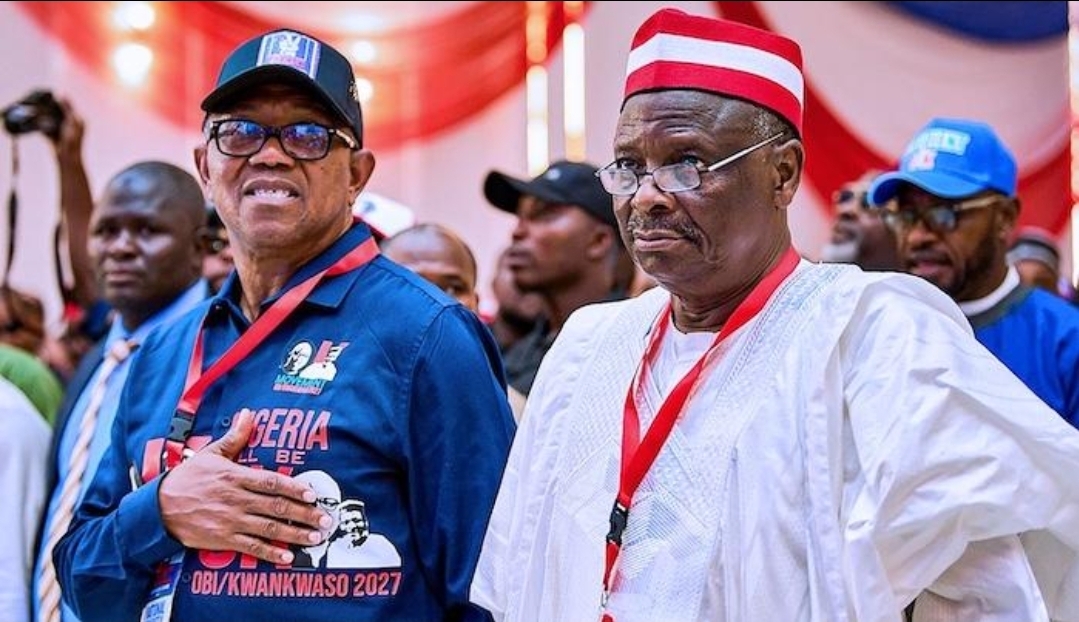
Obi Kwankwaso
PORT HARCOURT — The political atmosphere ahead of Nigeria’s 2027 general election took a dramatic turn in Rivers State as Peter Obi declared his readiness to make the ultimate sacrifice to defend Nigerians’ votes, while his running mate, Senator Rabiu Musa Kwankwaso, warned that control of more than 30 states would not guarantee President Bola Tinubu’s re-election.
Obi Kwankwaso, the two presidential hopefuls made the declarations during a recent town hall engagement in Port Harcourt where they challenged Nigerians to take ownership of the country’s political future and demand accountable leadership.
The gathering, tagged Obi Talks Nigeria: A Town Hall with Peter Obi, was held at the EUI Event Centre, Port Harcourt, and brought together party leaders, traditional rulers, professionals, community stakeholders, youths, women, civil society representatives and other residents for direct engagement with the Nigeria Democratic Congress (NDC) presidential ticket.
It was Obi’s remarks on defending votes, however, that provided one of the most striking moments of the encounter.
‘Nobody will intimidate us again’ — Obi declares
Addressing concerns about electoral manipulation and voter intimidation, the former Anambra State governor insisted that Nigerians must not allow a repeat of the controversies that trailed the 2023 presidential election.
Obi said the numerical strength of voters at polling units should make intimidation difficult, arguing that election officials could not overpower determined voters acting collectively.
“Nobody will intimidate us again at the polling booth,” he declared.
He added: “If you get to any polling booth today, the highest number of officials you see is five. The average number of voters is 40 to 50. There is no way five people will intimidate 50 people.”
The NDC presidential candidate made his much-publicised declaration while responding to a participant who had expressed readiness to die defending the people’s votes.
“This time all of us will rescue our country. Somebody said, ‘We are ready to die.’ Let me tell you, I’m ready to die too,” Obi said.
He subsequently explained that the party would establish coordination mechanisms to prevent intimidation and ensure that citizens freely exercise their electoral rights.
Obi also raised concerns about possible manipulation of the Independent National Electoral Commission’s Result Viewing Portal (IReV), arguing that alternative technological arrangements would be necessary to strengthen transparency in the transmission and collation of results.
“Yes, they will try to manipulate the IReV. But let me tell you, it will not be easy this time,” he said.
“There will be so many IReVs this time. If there is a network glitch, we will give them another one that has no glitch.”
The declaration immediately drew attention to the importance of electoral transparency as political parties begin preparations for the 2027 presidential contest.
Kwankwaso: Having 30 governors cannot save Tinubu
Kwankwaso, a former Kano State governor and the NDC vice-presidential candidate, also delivered a pointed political message, challenging the assumption that the ruling party’s control of a significant number of state governments would make the presidential election an easy contest for the opposition.
Drawing from Nigeria’s political history, he cited former President Goodluck Jonathan’s defeat in the 2015 presidential election despite being an incumbent.
“The sitting president lost the election,” Kwankwaso said.
He continued: “Especially those who think because they have over 30 governors, they cannot lose the election. That is a very big mistake.”
His argument was that political incumbency and the number of governors supporting a presidential candidate should not be mistaken for guaranteed electoral victory.
Kwankwaso also recalled his own political experience, stressing that electoral outcomes could defy expectations when political forces fail to connect effectively with voters.
The message was unmistakable: the opposition believes the 2027 presidential election remains open to a serious challenge, regardless of the ruling party’s current political strength.
From consumption to production: Obi unveils economic direction
Beyond the electoral rhetoric, Obi used the town hall to outline the economic philosophy he and Kwankwaso intend to pursue if elected.
He advocated moving Nigeria away from excessive consumption and import dependence towards a productive economy capable of creating employment, strengthening local businesses and improving food security.
He summarised the proposed economic direction in the phrase: “From Consumption to Production.”
According to Obi, Nigeria must deliberately strengthen agriculture, support small and medium-scale enterprises and create an environment where local producers can thrive.
He argued that a productive agricultural sector would provide employment opportunities, improve food availability and reduce the economic pressures contributing to insecurity.
“With this, insecurity in the country will be a thing of the past,” he said, linking agricultural development and economic opportunity to broader national stability.
The proposal places production, rather than consumption and import dependence, at the centre of the opposition ticket’s economic argument.
Healthcare, education and poverty reduction take centre stage
Obi also identified education, healthcare and lifting Nigerians out of poverty as three critical areas requiring urgent government attention.
He advocated strengthening primary healthcare facilities across Nigeria’s electoral wards to bring basic medical services closer to ordinary citizens.
The proposal, he explained, would reduce the difficulties faced by communities where residents must travel considerable distances to access essential healthcare.
He also emphasised the relationship between healthcare, agricultural productivity and economic development, arguing that a healthier population would be better positioned to contribute to national production.
In his post-event reflection, Obi said the discussions in Port Harcourt covered jobs, healthcare, education, security and economic opportunities.
He also referenced the development experiences of Bangladesh, Indonesia and India, arguing that competent, accountable and purposeful leadership could transform countries confronting difficult economic circumstances.
Dumo Lulu-Briggs: Let Nigerians interrogate those seeking power
The Rivers State NDC governorship candidate, Chief Dumo Lulu-Briggs, described the engagement as an opportunity for citizens to question those seeking the country’s highest political offices.
Welcoming Obi and Kwankwaso, Lulu-Briggs said the town hall was designed to go beyond conventional campaign speeches by creating an avenue for honest conversations about the challenges confronting Nigerians.
“Today, we want to ask honest questions, listen carefully and understand what leadership at the national level means in the everyday lives of our people,” he said.
He stressed that Rivers State and the wider Niger Delta must have their concerns adequately reflected in any national development agenda.
“We want to understand not only the national vision, but how that vision will translate to our people, our state, our communities and our local governments,” Lulu-Briggs stated.
He explained that the engagement was intended to accommodate questions and contributions from traditional rulers, professionals, business leaders, organised groups, the media and ordinary citizens.
“Our objective is not simply to talk. It is to understand. It is to challenge. It is to find solutions. And ultimately, it is to build a shared direction for Nigeria,” he said.
Rivers residents urged to protect their votes in 2027
Following the engagement, Obi expressed satisfaction with what he described as the renewed commitment of Rivers residents to participate in the 2027 elections and ensure that their votes count.
In his post-event statement, he said the people of Rivers State had demonstrated their determination to participate in the electoral process and insist that their mandate be respected.
“Let it be recorded that this time around, the people of Rivers State will vote, and their votes MUST count,” he declared.
He maintained that only leaders who emerge through free, fair and credible elections can legitimately claim the authority associated with public office.
Obi also thanked Kwankwaso, Lulu-Briggs, the NDC national and state leadership, party members and other stakeholders who participated in the engagement.
The gathering was attended by the NDC National Chairman, Senator Cleopas Moses Zuwoghe; Rivers State Chairman, Hon. Success Jack; the party’s deputy governorship candidate, Dr. Mike Nwalele; and other party officials and stakeholders.
Beyond the speeches: The 2027 test
The Port Harcourt engagement represented an attempt by the NDC presidential ticket to connect its national political message with the everyday concerns of Nigerians.
But beyond the strong declarations, electoral warnings and development promises, the real test will be the ability of the party to translate the Obi Kwankwaso proposals into a credible, measurable and implementable programme.
For Obi and Kwankwaso, the challenge is not merely to convince Nigerians that the ruling party can be defeated. It is to demonstrate how their proposed economic transformation, healthcare reforms, education priorities and security interventions would work in practice.
For the people of Rivers State and the wider Niger Delta, the expectations are equally significant: a national development agenda that recognises the region’s economic contribution, infrastructure needs, environmental concerns and demand for inclusive development.
As the 2027 election approaches, the Obi Kwankwaso message from Port Harcourt is clear: the NDC presidential ticket wants Nigerians to demand more from those seeking their mandate, while insisting that the people’s votes must count.
Obi Talks Nigeria. Let’s Build Nigeria.
Visit GMTNewsng for more on Obi Kwankwaso and other news stories.