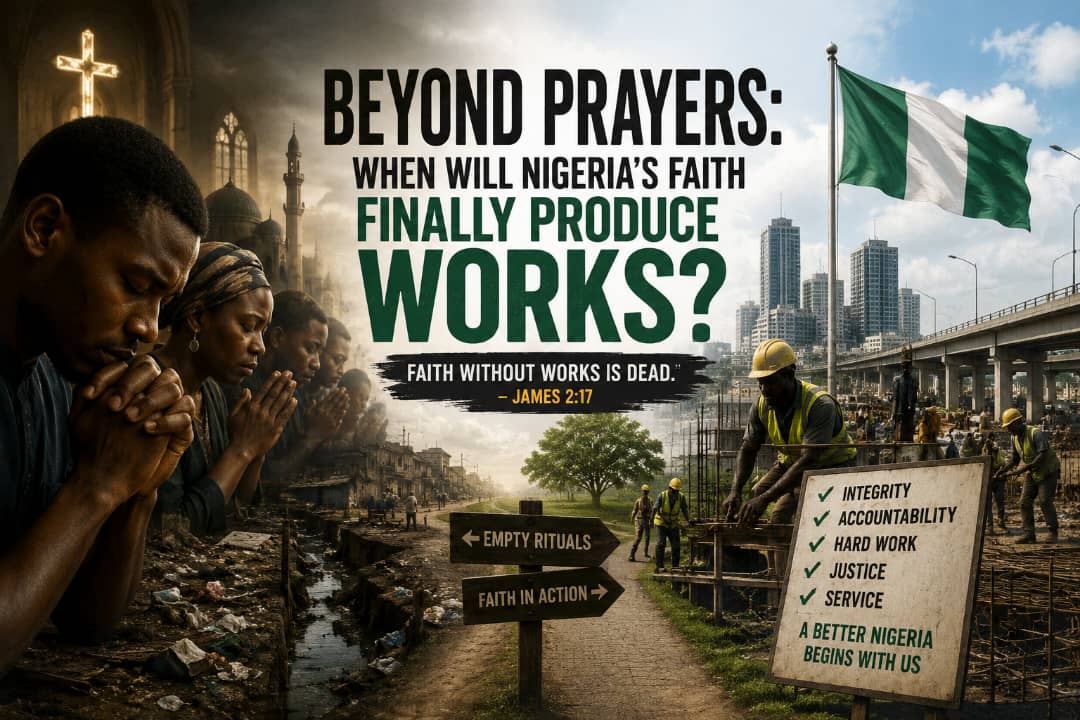
Beyond Prayers: Nigeria Needs the Courage to Act
By Maxwell Menkiti Ngene
Nigeria is arguably one of the most religious nations on earth. Across the country, churches and mosques are filled to capacity. Every public event begins with prayers. Government meetings invoke God’s guidance. Schools open with hymns or Qur’anic recitations. Our National Anthem itself is a prayer: “O God of creation, direct our noble cause.” Governors declare days of fasting whenever crises deepen. Traders dedicate their businesses to God before opening shop, while commercial drivers commit every journey to divine protection. No one can accuse Nigerians of neglecting God. We pray fervently, passionately and relentlessly.
Yet a painful question refuses to go away: Why has so much prayer produced so little national transformation?
The evidence is impossible to ignore. Corruption remains deeply entrenched. Police officers openly demand bribes despite the familiar sign proclaiming, “Bail is Free.” Elections are routinely influenced by vote-buying. Public funds disappear into private pockets. Criminals are protected because they belong to “our people.” Ethnic loyalty often outweighs competence, integrity and justice. We pray against insecurity while harbouring kidnappers and bandits in our communities. We ask God to bless Nigeria, yet many Nigerians actively undermine the very nation they expect God to rescue.
Nigeria’s greatest challenge is not a shortage of prayer. It is the widening gap between faith and responsibility. We have mistaken religious activity for moral character, and loud devotion for national development.
Both Christianity and Islam reject this contradiction. The Bible declares plainly: “Faith without works is dead.” The Holy Qur’an teaches that Allah will not change the condition of a people until they change what is within themselves. Both scriptures place human responsibility alongside divine intervention. God blesses honest labour, discipline and righteousness-not empty rituals divorced from ethical conduct.
Praying for good roads while blocking drainage channels with refuse is hypocrisy. Asking God for uninterrupted electricity while vandalising power infrastructure or refusing to pay electricity bills is self-defeating. Seeking divine protection while shielding criminals because they are members of one’s ethnic group is not faith; it is complicity. Prayer without corresponding action becomes an excuse for avoiding responsibility.
If Nigeria truly seeks transformation, the change must begin with everyday conduct. Corruption will not disappear because millions gather for prayer vigils. It will decline when citizens refuse to sell their votes, reject bribery, insist on transparent governance and demand accountability from public officials. Merit must replace ethnicity in public appointments. Justice must be blind to tribe, religion and political influence. The law must pursue the official awarding phantom contracts with the same determination it pursues the petty thief.
The same principle applies to insecurity. No amount of fasting can substitute for effective policing, properly motivated security personnel, functional intelligence gathering and communities willing to expose criminals instead of protecting them. Security is strengthened not only by government action but also by citizens who refuse to celebrate lawlessness simply because it benefits their own community.
Perhaps the most dangerous phrase in Nigeria’s public life is, “God will do it.” Properly understood, it expresses confidence in God’s providence after human effort has been exhausted. Sadly, it has increasingly become an excuse for inaction. Too often, Nigerians expect heaven to solve problems that require earthly discipline, planning and sacrifice.
History tells a different story. The biblical Israelites prayed, but they also organised, marched, fought and obeyed. Nations celebrated today for remarkable development-such as Singapore, Rwanda and the United Arab Emirates-did not rise through prayer alone. They advanced because leadership was matched by planning, discipline, accountability and sustained execution. Faith inspired values, but hard work built institutions.
Nigeria’s recovery will demand the same commitment. We cannot repair education without parents holding schools accountable. We cannot improve electricity while tolerating vandalism and power theft. We cannot build world-class infrastructure if citizens destroy public property that belongs to everyone. Development is not simply a government responsibility; it is a national culture.
Equally troubling is the normalisation of dishonesty. Inflated contracts, fake academic qualifications, ghost workers, forged documents and abandoned projects have become so common that integrity is often treated as foolishness. Yet no nation has ever achieved greatness on a foundation of lies. A society that rewards deception cannot expect lasting prosperity.
This is not an argument against prayer. On the contrary, prayer remains indispensable. It builds hope, shapes character and reminds humanity of standards higher than selfish ambition. Nigeria does not need fewer churches or fewer mosques. It needs more citizens whose conduct reflects the values they profess inside those places of worship.
The true measure of a God-fearing nation is not how loudly it prays but how honestly it governs; not how frequently it fasts but how faithfully it administers justice; not how magnificent its cathedrals and mosques appear but how safe its streets are, how transparent its institutions remain and how dignified life is for its poorest citizens.
For decades, Nigerians have prayed for national renewal. Those prayers have not been in vain. But perhaps the answer God awaits is not another prayer meeting—it is a people prepared to become the answer to their own prayers.
We have always had the prayers.
What Nigeria desperately needs now is the works.
Visit GMTNewsng for more news stories.