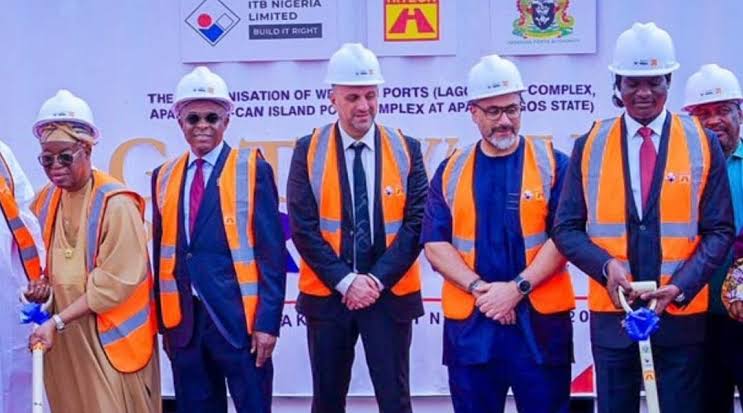
The Federal Government has commenced a ₦1.45 trillion modernisation of Apapa and Tin Can Island ports to reduce logistics costs, improve cargo handling, attract shipping lines and create 20,000 jobs.
The Federal Government has commenced a £746 million (approximately ₦1.45 trillion) modernisation project for the Lagos Port Complex, Apapa, and Tin Can Island Port, aimed at improving port efficiency, reducing logistics costs and strengthening Nigeria’s maritime competitiveness.
The project was officially flagged off on Wednesday, November 25, 2026, at Tin Can Island Port, Lagos, by the Minister of Marine and Blue Economy, Dr. Adegboyega Oyetola, alongside the Minister of Finance, Taiwo Oyedele, and other government officials.
According to a statement issued by the Special Adviser to the Minister of Marine and Blue Economy, Dr. Bolaji Akinola, the initiative is designed to address longstanding infrastructure deficits at the two major ports and reposition Nigeria as a leading maritime hub in Africa.
Oyetola said the modernisation project would reduce logistics costs, attract international shipping lines, stimulate industrial growth and generate at least 20,000 direct and indirect jobs.
He described the initiative as a major step towards advancing President Bola Tinubu’s Renewed Hope Agenda through strategic infrastructure investment and improved economic competitiveness.
The minister noted that Apapa Port, established in 1913, and Tin Can Island Port, commissioned in 1977, had experienced growing pressure from Nigeria’s expanding population, trade volume and cargo traffic.
He said Nigeria’s population had increased from approximately 67.2 million in 1977 to about 240 million, while cargo throughput had risen to 129.3 million metric tonnes, nearly 16 times its 1977 level.
Oyetola said the growing economic activity, coupled with ageing port infrastructure, had made comprehensive modernisation necessary, warning that failure to upgrade the facilities could undermine Nigeria’s competitiveness against neighbouring countries.
He disclosed that cargo dwell time at Nigerian ports currently ranged between 10 and 18 days, compared with three to five days at leading international ports, contributing to congestion, demurrage, storage charges and other logistics expenses estimated at $4 billion annually.
The project will involve the rehabilitation of quay walls and berths, dredging of navigation channels, improvements to port access infrastructure, replacement and upgrading of cargo-handling equipment, as well as modern operational systems to support digitally enabled port services.
To minimise disruptions during construction, Oyetola said an interministerial committee involving the Federal Ministry of Marine and Blue Economy, the Nigerian Ports Authority and relevant regulatory agencies had been established to develop a business continuity and cargo flow management plan.
The Managing Director of the Nigerian Ports Authority, Dr. Abubakar Dantsoho, described the groundbreaking as a landmark development in the agency’s history, assuring stakeholders that the project would be delivered in line with approved designs, standards and timelines.
Dantsoho pledged effective technical supervision, quality assurance and coordination throughout the construction process, with emphasis on safety, environmental standards and uninterrupted port operations.
The ceremony was attended by Poland’s Deputy Foreign Minister, Marcin Bosacki; Polish Ambassador to Nigeria, Michal Cygan; British Deputy High Commissioner in Lagos, Jonny Baxter; contractors and other stakeholders.
Visit GMTNewsng for more news stories.