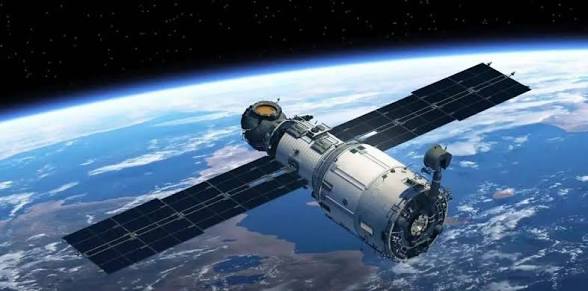
The Federal Government has advanced the procurement of four new satellites approved by President Bola Tinubu, with the project expected to strengthen Nigeria’s space technology capabilities and create opportunities for African partnerships.
The Federal Government has advanced the procurement process for four new satellites approved by President Bola Ahmed Tinubu and the Federal Executive Council (FEC), marking a significant step towards strengthening Nigeria’s space technology capabilities.
Minister of Innovation, Science and Technology, Dr Kingsley Udeh, SAN, disclosed this on Wednesday during a news conference in Abuja ahead of the African Space Economy, Innovation and Communication Conference (ASEICC 2026).
The conference, scheduled to hold from November 24 to November 27, will be hosted by the National Space Research and Development Agency (NASRDA).
Udeh said the procurement process had reached the stage of recommending successful bidders following an international competitive bidding exercise involving companies from China, Israel, Europe, the United States and Nigeria.
He explained that officials from the Federal Ministry of Innovation, Science and Technology, NASRDA and the Bureau of Public Procurement (BPP) had inspected facilities belonging to some satellite manufacturers to verify their claims before making recommendations.
“The next stage is approval to award the contracts, which will also require Federal Executive Council approval because substantial funding is involved,” he said.
According to the minister, ASEICC 2026 will provide a platform for African countries and international partners to explore collaborations and discuss the potential benefits of the proposed satellites.
He noted that the satellites would serve Nigeria and other African countries interested in accessing their services, creating opportunities for international partnerships and revenue generation.
Udeh said the conference would also encourage African countries to move beyond relying on foreign companies for satellite manufacturing and begin developing local expertise and capacity to design and manufacture satellites within the continent.
He estimated the value of Africa’s space economy at more than 25 billion dollars, with an annual growth rate of 7.97 per cent, describing the sector as one of the continent’s rapidly expanding industries.
Speaking on the implementation of recommendations from previous conferences, the minister said the platform had encouraged African countries to view their individual space programmes as interconnected ecosystems capable of generating mutual benefits through collaboration.
He described the conference as a peer-review platform where participating countries assess their progress, exchange experiences and encourage one another to achieve agreed targets, rather than an institution responsible for enforcing compliance.
Udeh further disclosed that one of the major recommendations from the previous conference was for Nigeria to establish its own satellite launch facility.
He said progress had been recorded towards achieving the objective, including the allocation of land by the Lagos State Government in Epe for the establishment of a satellite propulsion and transportation facility.
“This shows that we are not just making recommendations and proposals. We are taking practical steps towards manufacturing satellites and launching them from Nigeria,” he said.
The minister added that the participation of chief executives of space agencies from across Africa and other parts of the world demonstrated growing international interest in the conference and the progress achieved through previous engagements.
Visit GMTNewsng for more news stories.