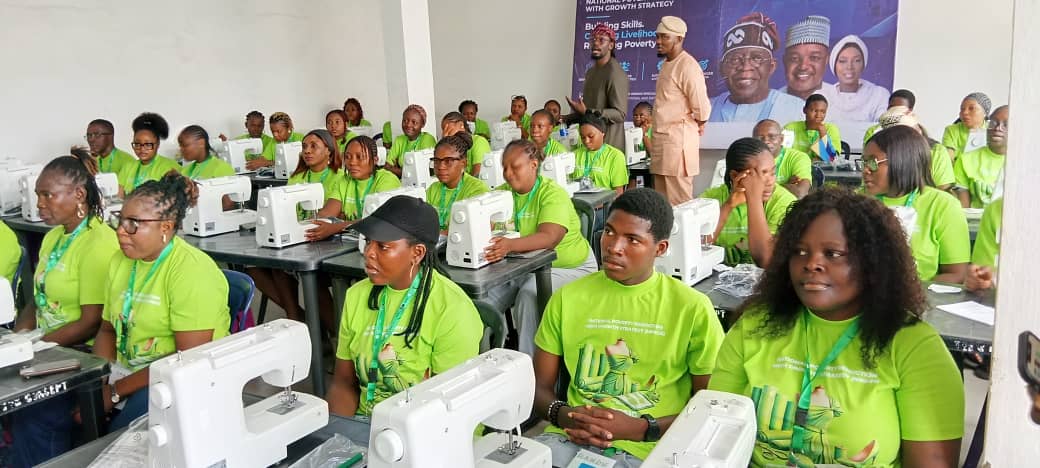
The Federal Government has commenced training for 150 Enugu youths in artificial intelligence, solar installation and fashion design under its National Poverty Reduction with Growth Strategy, an initiative aimed at tackling unemployment and promoting sustainable poverty reduction through vocational skills and entrepreneurship.
The Federal Government has begun a two-week intensive skills acquisition programme for 150 youths in Enugu State, equipping them with practical knowledge in artificial intelligence (AI), solar installation and fashion design to promote self-reliance and economic empowerment.
The programme, implemented through the National Poverty Reduction with Growth Strategy (NPRGS), is powered by the Office of the Senior Special Assistant to the President on Technical, Vocational and Entrepreneurship Education, in collaboration with the Federal Ministry of Budget and Economic Planning.
The training commenced on Wednesday at the Enugu State University of Science and Technology (ESUT) Business School in Enugu.
Addressing participants, the Senior Special Assistant to the President on Technical, Vocational and Entrepreneurship Education, Dr Abiola Arogundade, said the initiative was part of the Federal Government’s broader efforts to lift five million Nigerians out of poverty.
Arogundade described the South-East as an important region in the programme, noting that the selection of Enugu for the training reflected the government’s commitment to expanding youth empowerment opportunities across the country.
She urged participants to attend the training consistently and make effective use of the opportunity to acquire skills that would improve their livelihoods.
“Our expectation is that the beneficiaries will attend the training every day, learn as much as possible and gradually begin to lift themselves out of poverty,” she said.
On the sustainability of the intervention, Arogundade disclosed that the Federal Ministry of Budget and Economic Planning had established a monitoring and evaluation mechanism to assess beneficiaries’ progress.
According to her, assessments would be conducted after six months and one year to determine how participants were applying their skills and utilising the equipment provided to them.
Also speaking, the Director of the Macroeconomic Analysis Department in the Federal Ministry of Budget and Economic Planning, Mr Felix Okonkwo, said the initiative aligned with President Bola Tinubu’s Renewed Hope Agenda, particularly its commitment to reducing poverty through sustainable economic empowerment.
Okonkwo noted that Nigeria’s high level of multidimensional poverty required interventions that would provide lasting economic opportunities rather than temporary relief.
He explained that the programme was designed to help beneficiaries establish businesses, generate multiple income streams and transfer their newly acquired skills to other members of their communities.
According to him, the government is shifting its focus from short-term cash assistance to vocational training, entrepreneurship and the provision of equipment that can support sustainable livelihoods.
“Instead of giving people N5,000, N8,000 or N10,000 as cash transfers, we believe that equipping them with skills and supporting small-scale businesses will provide a more sustainable means of reducing poverty,” Okonkwo said.
He disclosed that beneficiaries undergoing fashion design training would receive electric sewing machines, while those learning artificial intelligence would be provided with laptops. Participants in solar installation would also receive complete solar installation toolkits.
Okonkwo said the starter packs would enable beneficiaries to establish small businesses, earn income and become economically independent after completing the programme.
He added that the initiative had already been implemented in the South-West and North-Central geopolitical zones, with plans to extend it to other parts of the country.
According to him, another phase of the training would be organised in the South-East before the programme moves to state-level implementation across the federation.
He explained that the 150 participants in Enugu were selected through an open application process advertised on social media and radio stations.
Okonkwo encouraged applicants who were not selected for the current phase to remain hopeful, assuring them that subsequent rounds would provide opportunities for more beneficiaries.
In his remarks, the Enugu State Commissioner for Budget and Planning, Mr Chris-Roberts Ozongwu, commended President Tinubu for the intervention, describing it as a significant contribution to youth empowerment and poverty reduction.
Ozongwu said the Federal Government’s programme complemented the efforts of Governor Peter Mbah’s administration to promote entrepreneurship, skills acquisition and economic development in Enugu State.
He added that the state government had continued to support small and medium-sized enterprises through various empowerment initiatives aimed at strengthening economic activities and creating opportunities for residents.
One of the beneficiaries, Anthony Edeh, who is participating in the solar installation training, expressed appreciation to the Federal Government for the opportunity.
Edeh described solar technology as a rapidly growing sector with considerable employment and business prospects, expressing confidence that the training would improve his economic prospects.
“I believe the benefits I will gain from this training will be beyond my expectations. I thank President Bola Tinubu for this wonderful initiative to empower youths through solar installation training,” he said.
The programme is expected to equip beneficiaries with marketable vocational and technical skills, alongside essential tools, to support entrepreneurship, improve household incomes and contribute to the Federal Government’s poverty reduction objectives.
Visit GMTNewsng for more news stories.