
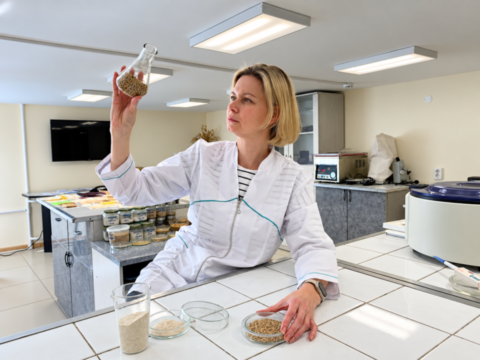
Scientists at South Ural State University have developed experimental yoghurt products containing ten times more beneficial microorganisms, with antioxidant activity reaching 84 per cent.
Russian researchers at South Ural State University (SUSU) have developed experimental yoghurt products containing up to ten times more beneficial microorganisms than conventional yoghurt, using enriched yeast biomass and plant-based ingredients.
The development was carried out by scientists at the university’s Higher Medical and Biological School to improve the survival of beneficial bacteria while incorporating bioactive compounds into fermented milk products.
The researchers used baker’s yeast, known scientifically as Saccharomyces cerevisiae, as a carrier for bioactive substances that can be vulnerable to degradation in acidic environments.
They incorporated curcumin, a natural antioxidant, into yeast cells after processing it with ultrasound to produce a nanostructured form. They also enriched the yeast with ergosterol, a compound that serves as a precursor to vitamin D₂, during cultivation.
The enriched yeast biomass was then added to milk alongside a conventional yoghurt starter culture.
The team also introduced plant-based ingredients, including sprouted wheat flour and a protein product derived from hemp seed cake.
Sprouted wheat flour contains about 12.5 per cent protein and dietary fibre, while the hemp-derived ingredient contains approximately 57 per cent protein.
According to the researchers, the plant ingredients provide additional nutrients that support the growth of beneficial microorganisms in the fermented milk products.
Rinat Fatkullin, an associate professor in the university’s Department of Food Technology and Biotechnology, said the aim was to develop a combination in which the ingredients complemented one another.
“Our aim was not simply to enrich the yoghurt with biologically active substances but to create a system in which all the components work together,” he said.
The researchers reported that the number of probiotic microorganisms in their experimental samples reached between 16 million and 64 million cells per gram, compared with approximately 4.6 million in the control sample.
Sprouted wheat flour produced the strongest increase in beneficial bacteria, which the team attributed partly to its fibre and starch content.
The experimental yoghurt products also demonstrated increased antioxidant activity.
The researchers recorded antioxidant activity of up to 84 per cent in samples containing enriched yeast biomass, compared with about 62 per cent in the conventional control sample. The reported values indicate results from a laboratory antioxidant assay, rather than a direct measurement of health benefits in people.
The hemp-derived protein ingredient also improved the products’ physical characteristics, increasing protein content to between 33 and 34 per cent on a dry-matter basis, compared with 24 per cent in the control. The researchers additionally observed greater viscosity and reduced separation of whey.
Biotesting using Paramecium caudatum, a single-celled organism used in laboratory assessments, found no detectable toxic effects from the experimental formulations under the conditions tested.
The researchers said the yoghurt products could have potential as functional foods because of their higher probiotic content and antioxidant activity.
They suggested that the formulations may help support a healthy gut microbiota and protect cells against oxidative stress. However, these potential benefits have not been established through clinical trials in humans, and further research would be needed to determine their effects on human health.
The study demonstrates a possible approach to combining beneficial microorganisms, bioactive compounds and plant-derived ingredients in fermented dairy products.
Part of the research was supported by a grant from the Russian Science Foundation focused on the targeted biosynthesis of biologically active compounds using resource-efficient methods.
Visit GMTNewsng for more news stories.

