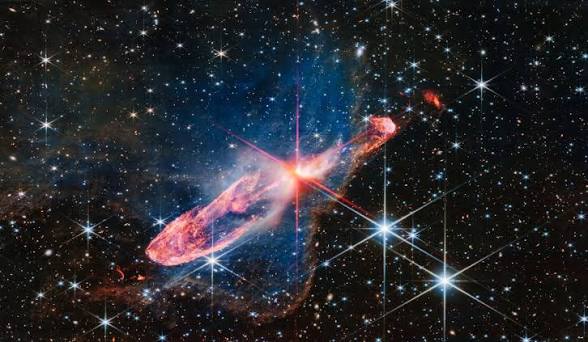
International scientists have discovered that the slowdown in star formation is not caused simply by a shortage of hydrogen, shifting attention to how efficiently gas is converted into star-forming molecular clouds.
An international team of scientists has uncovered new evidence explaining why the universe is producing fewer stars, challenging the long-held belief that star formation is slowing simply because galaxies are running out of gas.
The researchers, led by scientists from the Chinese Academy of Sciences, analysed observations from China’s Five-hundred-meter Aperture Spherical Telescope, known as FAST or the “Chinese Sky Eye,” alongside data from the Dark Energy Spectroscopic Instrument, DESI.
The study examined about 2.5 million galaxies covering nearly one-third of the sky and traced the evolution of neutral atomic hydrogen over the past 4.5 billion years with unprecedented statistical precision. The findings were published in Nature Astronomy on September 1, 2026.
Scientists used a technique known as neutral hydrogen spectral stacking to combine millions of extremely faint 21-centimetre radio signals that would otherwise be too weak to detect individually.
By aligning the signals according to the precise redshifts of the galaxies and combining them, researchers were able to extract the average neutral hydrogen signal from background noise.
The findings revealed a major difference between the decline in star formation and the evolution of the universe’s hydrogen reserves.
About 4.5 billion years ago, the cosmic star formation rate was approximately 2.5 times higher than it is today. However, the density of neutral atomic hydrogen during the same period was only about 1.4 times higher than its current level.
The discovery challenges the simple explanation that the decline in star formation is caused mainly by the depletion of cold gas.
According to the researchers, stars are not formed directly from neutral atomic hydrogen. The gas must first condense and convert into denser molecular hydrogen and molecular clouds, where new stars can form.
The study suggests that the key problem is not a shortage of hydrogen but a decline in the efficiency with which neutral hydrogen is converted into the molecular gas needed for star formation.
As gas supplied through the cosmic web weakens and gas density declines, the conversion of neutral hydrogen into molecular hydrogen may become increasingly difficult, leaving large reserves of atomic hydrogen while the amount of star-forming molecular gas falls.
Guo Hong, the first author of the study and a researcher at the Shanghai Astronomical Observatory of the Chinese Academy of Sciences, explained that the findings point to a change in how efficiently the universe processes gas into stars.
“What we are seeing is not a shortage of gas in the universe, but rather that it is becoming increasingly difficult to ‘process’ the gas into stars,” Guo said.
The discovery shifts scientific attention from the amount of gas available in galaxies to the physical conditions controlling the transition of hydrogen from its atomic state into molecular gas.
Researchers said the findings provide important new clues to understanding the decline of star formation in the modern universe and establish a new observational benchmark for studying galaxy evolution, cosmic gas cycles and the formation of stars.
Visit GMTNewsng for more news stories.