A new Civil War book unveiled in Enugu seeks to help younger Nigerians understand the 1967–1970 conflict while promoting peace, dialogue, national unity and responsible reflection on history.
Three Nigerian authors have unveiled a new book on the Civil War, urging Nigerians, particularly younger generations, to study the country’s painful past and embrace peace, dialogue and national unity.
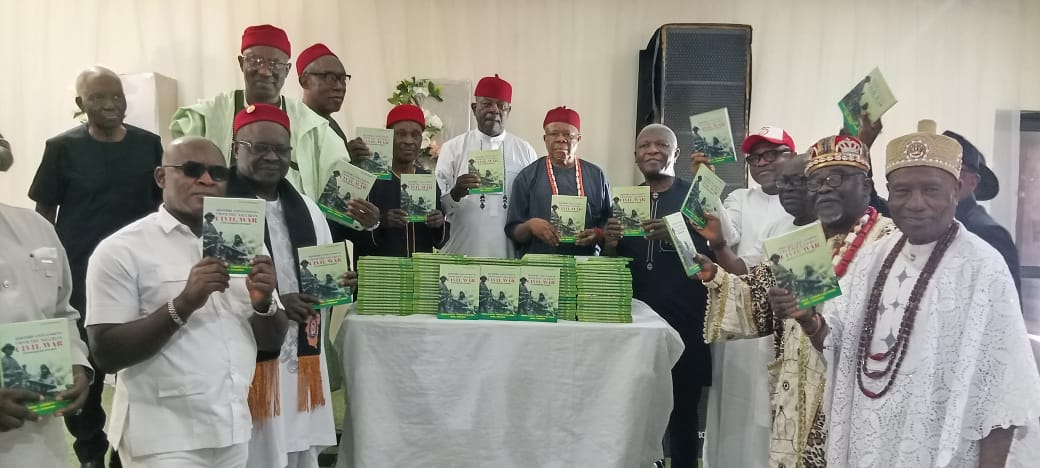
The book, History and Lessons from the Nigerian Civil War (Chronologically Arranged), was presented in Enugu on Thursday, September 3, 2026, by Chief Obioma Ikechi, Dr Uchenna Anioke and Chief James Egwuonwu.
The publication examines the Nigerian Civil War of 1967 to 1970 and seeks to present the events surrounding the conflict in a structured chronological format while drawing lessons for present and future generations.
Nigeria’s Federal Ministry of Education currently includes the 1966 coup and Nigerian Civil War among historical topics for senior secondary learners, with emphasis on the causes, course and effects of the conflict.
Speaking on behalf of the authors at the presentation, Anioke said the book was written to provide what he described as an objective and chronological account of the conflict.
He said the history of the war had frequently been presented in fragments, surrounded by silence or interpreted through partisan perspectives, leaving many younger Nigerians without a comprehensive understanding of the developments that led to the conflict.
“Today, we are not just presenting a book; we are unveiling a mirror for our nation,” Anioke said.
He explained that the authors deliberately adopted a chronological approach to reduce political distortion and give readers a structured account of events from the political crises of 1966 through the end of the war in 1970.
“When three of us — Ikechi, Uchenna and Egwuonwu — sat down to begin this project, we asked ourselves a critical question: How do we tell a painful history objectively so that it heals rather than divides?” he said.
Anioke said the book provides a step-by-step account of the crisis and its underlying developments, stressing that Nigeria could not build a stable future on forgotten or distorted history.
According to him, the central objectives of the publication are to promote national unity, strengthen institutional memory and encourage Nigerians to reflect critically on the country’s past.
He said the book was particularly intended for students, policymakers and Nigerians interested in peace, history and national development.
“The lessons of the Civil War teach us that peace is a deliberate choice. We hope this book inspires you to choose dialogue, empathy and unity every day,” Anioke said.
He added that the publication was not intended to reopen old wounds but to serve as a mirror through which Nigerians could reflect on their shared historical heritage and responsibilities.
Speaking on behalf of Enugu State Governor Peter Mbah, the Commissioner for Environment, Prof. Sam Ugwu, described history as essential to understanding the past and making informed decisions about the future.
Ugwu said the book provided important documentation of the remote and immediate causes of the Civil War, as well as its socio-economic and political implications.
He called for the restoration and strengthening of history education in Nigerian primary and secondary schools, describing inadequate knowledge of the country’s past as a potential danger to future generations.
The Federal Ministry of Education’s current learning resources similarly identify the Nigerian Civil War as a subject requiring students to examine its causes, course and effects.
Ugwu commended the authors for documenting the conflict and encouraged Nigerians to read the publication and draw lessons from its history.
The Chairman of the event and Managing Director of COPEN Group, Mr Ugochukwu Chime, also stressed the importance of historical knowledge in shaping informed decisions about Nigeria’s present and future.
Chime recalled his personal experience during the war, saying he survived a bombing incident in which he was carried and thrown into a ravine. He also said several members of his family were killed during the conflict.
He commended the authors for collaborating to document the history and lessons of the war, describing such efforts as important to development and reconciliation in Igboland and Nigeria.
Reviewing the book, Dr Ambrose Igbokwe, Chairman of the Public Affairs Analysts of Nigeria, Enugu State chapter, said the publication was particularly relevant to younger Nigerians who were born decades after the conflict.
Igbokwe said he had read several books on the Nigerian Civil War but found the chronological arrangement of the new publication particularly useful.
He said the book traced Nigeria’s development from the colonial period through independence, the political crises and coups that preceded the war, and the events that eventually culminated in the conflict.
Igbokwe also warned against romanticising war, particularly among young people who may encounter simplified or sensationalised portrayals of conflict through films and social media.
He stressed that the human consequences of war could not be adequately represented by entertainment or online videos.
The Nigerian Civil War began in 1967 after the Eastern Region declared the independent Republic of Biafra and ended in 1970, leaving deep political, social and economic consequences that remain an important part of Nigeria’s modern history. The Federal Ministry of Education likewise identifies the conflict and its effects as important areas of historical study.
The presentation attracted academics, traditional rulers, public officials, journalists and other stakeholders who gathered to examine the significance of documenting the Civil War and preserving its lessons for future generations.
The new publication, according to its authors, is ultimately intended to turn the memory of one of Nigeria’s most painful periods into an opportunity for reflection, dialogue, peace and national unity.
Visit GMTNewsng for more news stories.