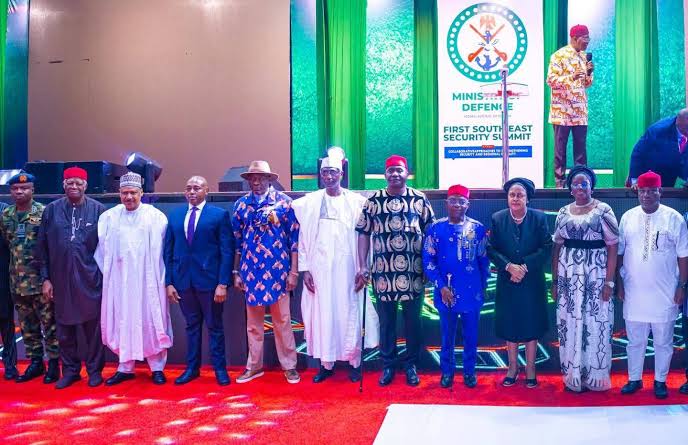
Stakeholders at the maiden South-East Regional Security Summit have called for increased investment in drones, CCTV systems, forensic capabilities and a shared regional database to strengthen the fight against kidnapping, terrorism and other criminal activities across the region.
Stakeholders at the maiden South-East Regional Security Summit have advocated greater investment in advanced technology, including drones, geospatial mapping, CCTV systems, forensic capabilities and digital intelligence platforms, to strengthen efforts against kidnapping, terrorism and other criminal activities across the region.
The recommendations were contained in a communiqué issued at the end of the summit held on Thursday in Umuahia, Abia State. The communiqué was signed by Rear Admiral Olusanya Bankole, Special Adviser to the Minister of Defence on Civil-Military Relations.
The summit, themed “Collaborative Approaches to Strengthen Security and Regional Stability,” was organised by the Federal Ministry of Defence in collaboration with the Office of the Senior Special Assistant to the President on Community Engagement, South-East.
The stakeholders emphasized the need for a shared regional database to improve intelligence gathering and facilitate the tracking of criminals who commit offences in one state while residing in another.
They recommended the creation of a comprehensive database of wanted persons, criminal networks, kidnappers, arms traffickers, drug dealers, stolen vehicle syndicates and other individuals or assets linked to criminal activities.
According to the communiqué, participants agreed that security checkpoints alone are insufficient to tackle increasingly mobile and technologically sophisticated criminal groups.
The summit therefore called for increased investment in drones, geospatial mapping, CCTV surveillance, forensic technology, automated vehicle identification systems, digital databases, emergency communication platforms and professionally managed surveillance infrastructure.
Participants acknowledged that although the security situation in the South-East has improved considerably, the region continues to face threats from kidnapping, armed robbery, politically motivated violence, attacks on security personnel and public infrastructure, illicit arms proliferation, cultism, drug abuse, misinformation, criminal activities within forests and the violent enforcement of illegal sit-at-home orders.
The communiqué noted that insecurity in the South-East transcends state boundaries, making isolated responses by individual states inadequate. It stressed that sustained regional collaboration, coordinated operations and intelligence sharing are essential to addressing the security challenges.
The stakeholders also affirmed that security is a shared responsibility requiring active participation from the federal, state and local governments, security agencies, traditional rulers, religious leaders, town unions, civil society organisations, the private sector, the media, youth and women groups, transport unions, neighbourhood associations and citizens.
The summit observed that peace and security are critical to economic growth, investment, industrialisation, agriculture, commerce, education, tourism and sustainable development across the South-East.
It warned that persistent insecurity continues to disrupt business activities, farming, education, healthcare delivery, transportation and investment, while eroding public confidence and limiting the region’s economic potential.
Participants further identified unemployment, youth frustration, drug abuse, political manipulation, social exclusion, unresolved grievances and inadequate government presence as factors contributing to criminal activities in the region.
The summit featured opening remarks, a security briefing by the Office of the National Security Adviser, and a keynote address by former Chief of Army Staff, Lt.-Gen. Azubuike Ihejirika (Rtd.). It also included interactive panel discussions involving veterans, security consultants and other stakeholders on community policing, intelligence gathering, intelligence sharing and collaborative approaches to enhancing regional security.
Among those in attendance were the Minister of Defence, Gen. Christopher Musa; the Minister of Information and National Orientation, Alhaji Mohammed Idris; the Minister of Technology and Innovation, Dr. Kingsley Udeh; Abia State Governor Alex Otti; representatives of other South-East governors; the Chief of Air Staff, Air Marshal Sunday Aneke; the Chief of Naval Staff, Vice Admiral Idi Abbas; and representatives of the Inspector General of Police, the President of the Senate, Sen. Godswill Akpabio, alongside other key stakeholders.
Visit GMTNewsng for more news stories.