STABILITY – In politics, moments of instability often reveal more about a society than periods of calm. The turbulence surrounding Nigeria’s 2023 elections was one of those moments. Across much of the country — particularly in the South-East — elections became emotional referendums on frustration, identity, distrust and the desire for political disruption. In Enugu State, the search for Enugu stability suddenly collided with one of the most unpredictable electoral climates in the state’s modern political history.
The emotional energy of the Obidient movement reshaped political assumptions across the region. Traditional party structures that once appeared untouchable suddenly looked vulnerable. The ruling People’s Democratic Party faced a wave of anti-establishment sentiment that altered the rhythm of political engagement. For many politically conscious citizens, the 2023 elections were no longer simply about party loyalty. They became symbolic battles over the future direction of governance itself.
It was within that atmosphere that Peter Mbah emerged as the PDP governorship candidate.
Outside business and political circles, Mbah was still relatively unfamiliar to many ordinary voters despite his previous role during the administration of Chimaroke Nnamani between 1999 and 2007. He was not the loudest populist voice in the race, nor did he initially command the kind of emotional enthusiasm that defined much of the political climate at the time. Indeed, even within segments of the PDP, there were visible anxieties about the scale of the political headwinds confronting the party.
The election outcome reflected that uncertainty.
Though Mbah secured victory in the governorship election, the broader electoral map revealed a deeply fragmented political environment. In Enugu East Senatorial District — one of the most politically strategic zones in the state — the Labour Party won the senatorial seat, two of the three House of Representatives seats, and six of the eight State House of Assembly seats. Across the state more broadly, the PDP also suffered significant electoral setbacks as Labour Party candidates rode the wave of protest politics and anti-establishment sentiment.
The message from the electorate was unmistakable: political dominance could no longer be taken for granted.
For Mbah, therefore, the real challenge began after the election. He inherited not only a government, but also a politically polarized environment shaped by lingering distrust, elite rivalries and primordial tensions that had historically complicated parts of politics within Enugu East Senatorial District, particularly in Nkanu land.
Those tensions were not always dramatic in public form, but they existed beneath the surface. Questions of identity, political inclusion and inherited loyalties often shaped alignments in subtle but powerful ways. The emotionally charged atmosphere of 2023 merely intensified many of those anxieties.
What has become politically significant since then is the extent to which governance itself appears to have been deployed as an instrument of stabilization.
Rather than governing from a position of vengeance — a temptation common in polarized political environments — the Peter Mbah administration gradually adopted a broader inclusion strategy. Appointments cut across divides. Political actors who once stood on opposing sides of the 2023 electoral battle increasingly found themselves operating within a less confrontational atmosphere. Several individuals who emerged victorious on opposition platforms eventually aligned politically with the governor, while some later re-emerged as consensus figures with his backing.
That development deserves closer examination.
In deeply divided political environments, stability is rarely sustained through domination alone. More often, it emerges through strategic accommodation, institutional inclusion and the gradual reduction of existential political hostility. What appears to be unfolding in Enugu is not the disappearance of political competition, but the softening of the kind of fragmentation that can make governance perpetually unstable.
Infrastructure became central to that process.
In societies where distrust of government is widespread, visible development often becomes a language of political reassurance. Citizens may not immediately trust rhetoric, but they notice movement, construction, rehabilitation and execution. One of the earliest signals from the Mbah administration toward Enugu stability was therefore its aggressive emphasis on projects — particularly abandoned or neglected assets that had become symbols of governmental stagnation.
The long-delayed International Conference Centre returned to public use after years of abandonment. The 300-bed international hospital project moved steadily toward completion. State-owned assets such as NigerGas and Hotel Presidential for instance, once associated with dormancy, began re-entering conversations about economic revitalization and institutional recovery.
Road construction, however, became perhaps the administration’s most visible political signature.
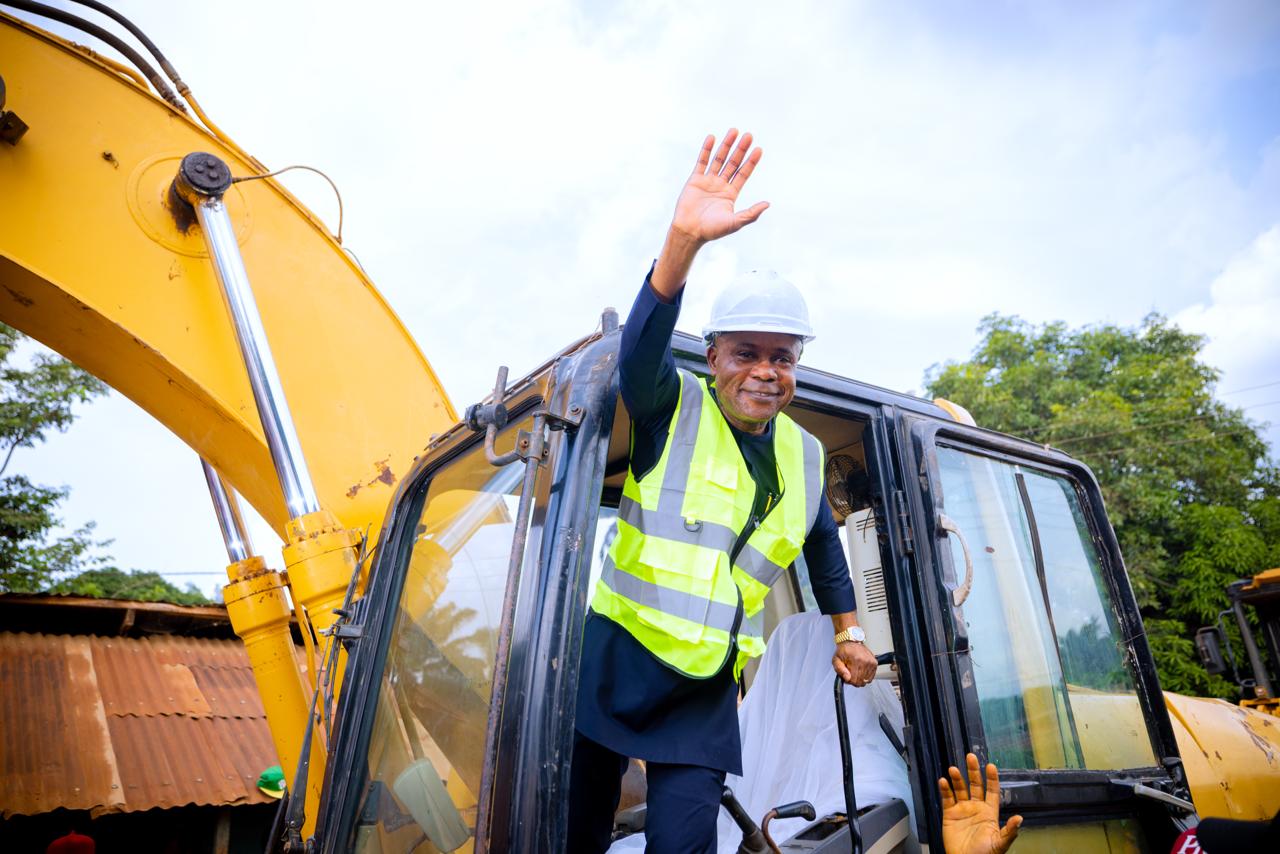
Across different parts of the state, interconnecting road projects altered both movement and public perception. The Penoks–Ugwogo–Opi Nsukka dual carriage road project became one of several visible indicators of infrastructural ambition, while the recent flag-off of 151 kilometres of roads in Enugu North Senatorial District reinforced the image of a government attempting to establish statewide developmental reach rather than governing through narrow political comfort zones.
Beyond roads and physical reconstruction, the administration has also attempted to project a broader economic vision for Enugu State through initiatives such as Enugu Air, a project designed not merely as an aviation venture, but as a symbolic statement about connectivity, investment ambition and the state’s evolving economic identity aimed to further strengthen Enugu stability.
In a region where many governments often think within narrow political cycles, the pursuit of projects with long-term commercial and strategic implications signals an administration attempting to position Enugu beyond traditional civil service politics and toward a more competitive regional economic future. Whether Enugu Air ultimately fulfills its full promise will depend on execution and sustainability, but its conception alone reflects a government increasingly conscious of the relationship between infrastructure, perception and economic confidence.
Importantly, these projects also shifted public discourse.
Political conversations once dominated almost entirely by election grievances increasingly began revolving around governance outcomes, infrastructure and economic expectations. Among traders and small business operators, the abolition of daily taxes imposed on traders without shops across the state further strengthened perceptions of an administration attempting to respond to grassroots frustrations rather than merely preserve elite political structures.
This does not mean universal consensus suddenly emerged.
There are still criticisms of the administration, and some remain entirely legitimate. Complaints persist regarding water supply challenges in parts of the state. Questions have also been raised about project supervision standards and the quality of certain contractors handling aspects of the government’s infrastructure drive. Political dissatisfaction equally remains among some individuals who expected appointments or strategic inclusion but found themselves outside the administration’s power structure.
Those criticisms should not be dismissed because democratic accountability matters.
Yet perhaps one of the more politically revealing developments is that even among critics, there is an increasing reluctance to dismiss the administration outright. In polarized political environments, the first sign of emerging stability is rarely unanimous praise. More often, it is the gradual weakening of absolute hostility.
That shift appears increasingly visible in Enugu.
Compared to the emotionally combustible atmosphere immediately following the 2023 elections, tensions between rival political camps no longer dominate public life with the same intensity. Elite relationships once considered irreparably strained have, in several cases, become more cooperative. Governance, in effect, has partially displaced permanent electioneering.
That may ultimately become one of the defining political stories of the Mbah era.
For some observers, including this writer, the transformation has also required an intellectual reassessment. Like many politically engaged citizens during the turbulence of 2023, I approached the emergence of Peter Mbah with skepticism shaped by the wider mood of the time. The distrust of established political structures was genuine. The appetite for disruption was real. In that emotionally charged climate, skepticism felt both politically and morally justified.
But governance has a way of confronting assumptions with reality.
What gradually altered my own perception was not political theatre, but administrative pattern: the visible consistency of project execution, the refusal to govern vindictively despite a fractured political environment, the strategic inclusion of former opponents, and the broader attempt to shift governance away from symbolic performance toward measurable activity.
That distinction matters enormously.
Across many developing democracies, governments often excel at rhetoric while struggling with institutional delivery. What appears to be emerging in Enugu is an administration attempting — however imperfectly — to construct legitimacy through governance performance rather than emotional political spectacle alone.
That broader shift carries implications beyond immediate politics.
Enugu East Senatorial District occupies a sensitive political position within the wider structure of Enugu State. Political instability within the zone rarely remains isolated because of its historical and strategic importance. Conversely, when political cooperation deepens within the area, broader statewide stability becomes easier to sustain.
This partly explains why the evolving political atmosphere deserves careful attention as another electoral cycle gradually approaches in 2027.
The deeper question confronting Enugu may no longer be simply who can generate the loudest emotional momentum, but whether the state is prepared to preserve an emerging political culture in which governance performance increasingly moderates old divisions. Several political actors who once stood firmly on the opposition side of the 2023 elections now operate within a less antagonistic political environment, suggesting that pragmatic stability may gradually be replacing perpetual confrontation.
That transition remains fragile. But it is significant.
Nkanu land itself still carries traces of primordial political sentiment and inherited anxieties that cannot disappear overnight. No administration possesses such power. Yet divisions that were once amplified primarily through grievance politics can gradually weaken when governance creates broader shared interests around development, infrastructure and institutional stability and progress.
Stability, after all, is not merely political calm. It is the institutional environment that allows development to survive beyond electoral emotions.
That may be the most important lesson emerging from Enugu after the storm of 2023.
Not that politics has suddenly become perfect. Not that disagreements have disappeared. Not that criticism should cease. Democratic societies do not function that way. But there is growing evidence that governance, when pursued through restraint, inclusion and visible performance, can soften divisions that once appeared politically immovable.
For Enugu, that possibility matters.
Because societies trapped permanently in cycles of fragmentation rarely sustain meaningful development or stability. Roads, hospitals, investments, educational reforms and institutional rebuilding all require something often underestimated in political discourse: stability.
And as the state gradually moves toward another decisive electoral season, the challenge may ultimately be whether Enugu chooses to deepen that stability — or risk returning to the fragmentation from which it is only just beginning to emerge.
Visit GMTNewsng for more on Enugu Stability and other news stories.

Enugu stability.
Chijioke Ogbodo writes from Enugu.