December 9, 2025
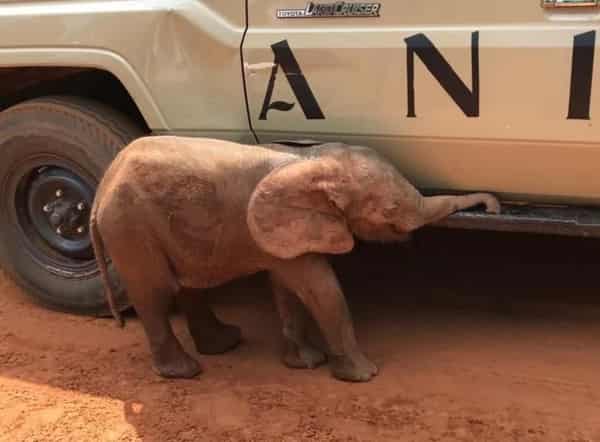
A baby elephant discovered wandering inside an oil palm plantation in Edo State is currently undergoing intensive rehabilitation at Okomu National Park, officials confirmed on Monday.
The male calf, estimated to be about two months old, was found alone inside the Okomu Oil Palm Company plantation on November 30. According to Conservator of the Park, Mr. Osaze Lawrence, workers in the area stabilized the animal before alerting park authorities.
“It was a very young elephant less than two months old; they gave it water, tried to revive it and immediately called us,” he said.
Park rangers, working with the Africa Nature Investors (ANI) Foundation, retrieved the calf and attempted to reunite it with its herd inside the elephant home range. However, the situation quickly changed.
“It walked some metres into the wild on its own and we thought it had returned to the family.
But a commercial motorcyclist later reported seeing the disoriented calf alone by the roadside.
At that point, it became clear it could not find its herd; the best option was for us to rescue, rehabilitate and stabilise it,” Lawrence explained.
The baby elephant, which slipped into a health crisis after losing contact with its herd, is receiving 24-hour veterinary attention at an ANI camp within the park.
“We are feeding it with the recommended milk, giving medication and monitoring its strength; it is stabilising and doing very well,” he added.
He praised the collaboration among national authorities, ANI Foundation, Okomu Oil Palm Company, veterinarians, and international conservation specialists.
One of those experts, UK-born wildlife rescue specialist Liz O’Brien, travelled from Zambia to support the rescue effort, describing the case as historic.
“In Nigeria, they have never rescued an elephant like this before; this is the first of its kind,” she said.
O’Brien, who has spent 15 years rescuing elephants across Africa, emphasized the importance of building local capacity.
“My main reason for coming was to train people here, so the knowledge stays in the country.
You cannot always rely on people flying in; we must develop the next generation of wildlife rescuers,” she said.
On the calf’s long-term prospects, O’Brien advised that it would require at least two years of milk feeding and additional years of supervised rewilding before release.
“Wild animals belong in the wild; the aim should be to return him to the area he came from when he is strong enough,” she stated, adding that elephants need vast landscapes and zoos are not suitable.
ANI’s Project Manager at Okomu, Peter Abanyam, noted that the rescue demonstrated increasing conservation awareness among local communities.
“When the calf wandered to the main road, community members immediately alerted our gate; this shows how much the awareness has grown,” he said.
He highlighted that the calf is an African rainforest elephant, a species currently threatened with extinction. Abanyam also warned that rising elephant movement could heighten human-wildlife conflict without clear park boundaries.
“We will soon grow into a crisis if boundaries are not marked, especially in the southern part where farms are expanding.
Communities must know where the park begins,” he said.
The successful intervention has drawn national and international attention, marking a significant moment for conservation efforts involving the rescued baby elephant in Nigeria.
Visit GMTNewsng for more news.