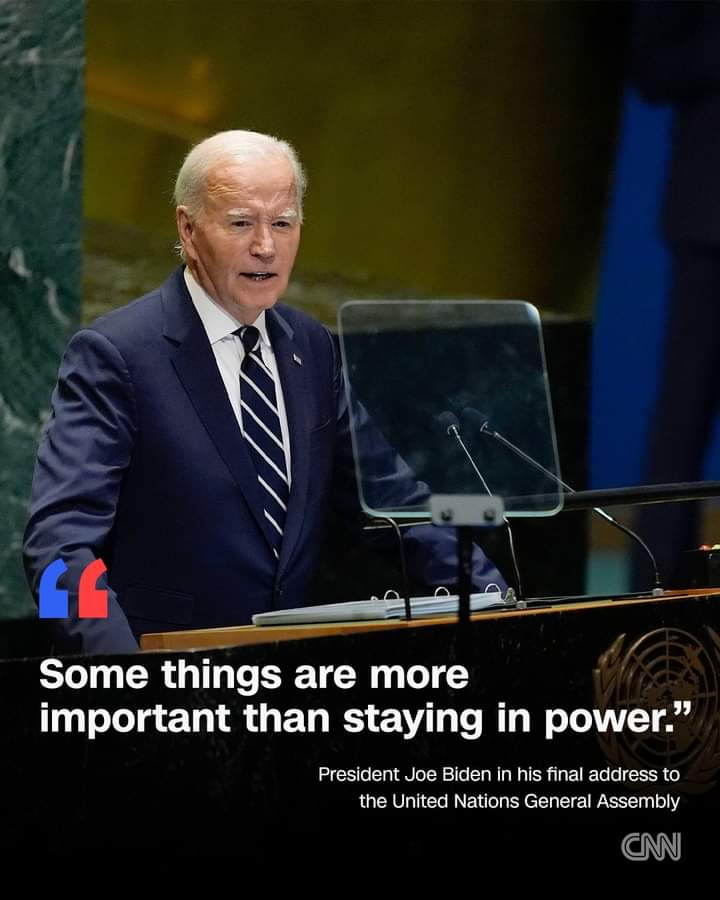
U.S. President Joe Biden addresses the United Nations General Assembly in what is expected to be his final speech before stepping down from the Democratic ticket, urging global leaders to prioritize diplomacy and democracy amid mounting global crises.
In his last speech before the United Nations General Assembly, U.S. President Joe Biden delivered a call to uphold democratic values while reflecting on his decision to step down from the Democratic ticket earlier this year. Without offering concrete solutions to the intensifying crisis in the Middle East, he focused instead on the long-term principles of governance and leadership.
“Some Things Are More Important Than Staying in Power“
Speaking to over 100 world leaders, Biden referenced his voluntary relinquishment of power, stating, “some things are more important than staying in power. It’s your people that matter the most.” This sentiment echoed throughout a speech that ranged from global conflicts to the challenges of emerging technologies. He also touched on his decision to pass the mantle of leadership, stating, “Being president has been the honor of my life. There’s so much more I want to get done. As much as I love the job, I love my country more.”
He emphasized the need for a “new generation of leadership” to continue the nation’s progress, signaling his recognition that his presidency will soon conclude, perhaps sooner than anticipated.
Addressing the Middle East Conflict
Despite the expectation for clarity on the unfolding violence between Israel and Hezbollah, Biden provided limited insight. While acknowledging the escalating crisis, he reiterated the importance of diplomacy: “Full scale war is not in anyone’s interest. A diplomatic solution is still possible.” This call for peace came amidst ongoing strikes between the two nations, leaving hundreds dead and communities displaced.
Ahead of the speech, senior U.S. officials admitted that hopes for a ceasefire in the region remain slim. They acknowledged Biden’s strategy to address the Middle East remains a long shot as Israeli forces continue heavy military operations.
“We Cannot Look Away”: Standing with Ukraine
On the subject of Ukraine, Biden reiterated the United States’ commitment to supporting the war-torn nation, urging the world not to grow weary of the conflict. “We will not let up on our support for Ukraine,” he stated firmly, though he stopped short of addressing specific military strategies involving Western-supplied weapons.
Managing Competition with China
Touching on relations with China, Biden signaled his willingness to cooperate on issues like synthetic narcotics, while affirming the U.S. would maintain its core principles in managing competition: “We seek to responsibly manage the competition with China so it does not veer into conflict,” Biden remarked, emphasizing the need for balance in international relations.
Election Looms as Biden Reaches Out to Global Leaders
As the U.S. prepares for an upcoming election, Biden continues to represent the nation on the global stage, with former President Donald Trump and Vice President Kamala Harris also engaging with world leaders in parallel meetings. The convergence of global and domestic concerns plays into Biden’s messaging that diplomacy and leadership must remain steady, even in politically tumultuous times.
“We’re going to do everything we can to keep a wider war from breaking out,” Biden said, reaffirming his administration’s dedication to Middle East peace while remaining hopeful for a ceasefire between Israel and Hamas.
Global Action on Synthetic Drug Trafficking
Biden’s speech also highlighted the growing threat of synthetic drug trafficking, particularly fentanyl. On Tuesday, he will convene the Global Coalition to Address Synthetic Drug Threats, showcasing new international initiatives to curb the crisis, which claims tens of thousands of lives in the U.S. annually.
Prioritizing Ukraine and Southeast Asia
In meetings scheduled later this week, Biden will discuss reconstruction efforts in Ukraine and meet with Vietnam’s president to address shared interests in Southeast Asia. These discussions align with his broader diplomatic strategy, seeking stability in regions where U.S. influence remains significant.
UN Effectiveness and Global Flashpoints
Biden’s speech also addressed the question of the UN’s effectiveness in resolving global conflicts. With Russia’s and the U.S.’s veto powers limiting the Security Council’s ability to intervene in the Israel-Gaza and Ukraine conflicts, Biden acknowledged the limitations but urged member nations to work within the existing framework. U.S. Ambassador Linda Thomas-Greenfield emphasized the administration’s goal to expand the UN Security Council and address the concerns of smaller nations.
“We’re putting all of our efforts behind peace and security, not just in Gaza and Israel, but we’re also focusing on Sudan, Ukraine, and other conflicts,” she said. Despite the challenges, the Biden administration continues to push for reform and revitalization of the UN’s humanitarian systems, reflecting their ambitious agenda for global leadership.
Biden’s speech underscored the urgency of the current moment, as well as the enduring principles of diplomacy and democracy that he hopes will define his legacy. CNN