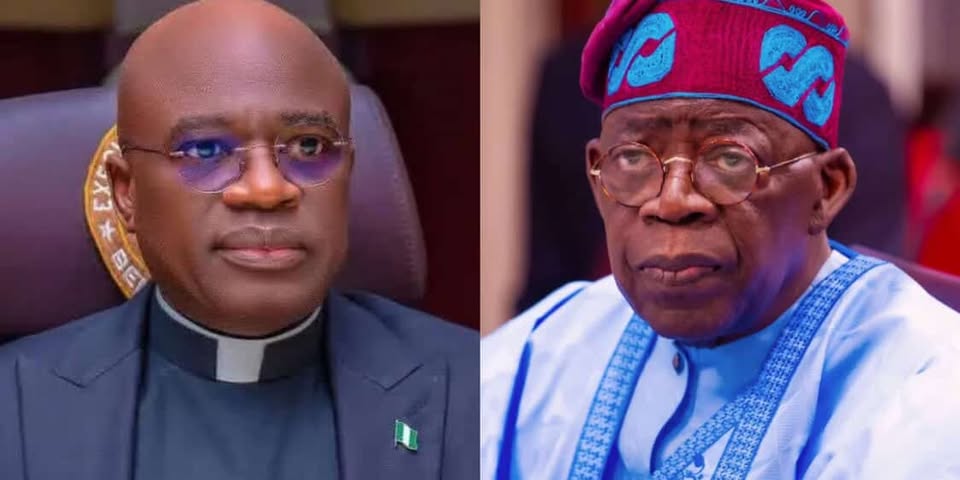
Governor Hyacinth Alia has credited increased federal allocations under President Bola Tinubu with accelerating infrastructure development, reviving industries and strengthening Benue’s economy.
Governor Hyacinth Iormem Alia of Benue State has attributed the renewed pace of infrastructure development and the revival of key economic assets in the state to increased federal allocations under President Bola Ahmed Tinubu’s administration.
Alia made the disclosure as the Renewed Hope Ambassadors National Media Tour, led by the Special Adviser to the President on Information and Strategy, Bayo Onanuga, concluded its inspection of major Federal and Benue State government projects across the state.
The delegation, comprising more than 40 editors and journalists, visited the projects to independently assess, document and showcase their implementation and impact under the Tinubu administration.
Speaking during a media interaction with the delegation, Alia commended President Tinubu for creating what he described as a more favourable fiscal environment for states.
He said the increased federal allocation had enabled Benue to undertake more capital projects, pay salaries and pensions, strengthen critical infrastructure and revive moribund industries.
“The increased Federal Allocation has given us more fiscal space to do some of the things that we could not do before. We are using the resources responsibly to revive industries, build roads and provide infrastructure that will directly impact the lives of our people,” he said.
The governor said the additional resources had strengthened the state’s capacity to tackle its infrastructure deficit while investing in projects designed to create jobs, stimulate economic activity and improve livelihoods.
Alia identified the ongoing rehabilitation of Taraku Mills in Gwer East Local Government Area as a major component of the state’s industrial revival strategy.
Established in 1989 during the administration of the late Governor Aper Aku, Taraku Mills was once a major agro-processing facility producing vegetable oil, animal feeds and other agro-allied products.
The state government has commenced rehabilitation and maintenance work aimed at returning the facility to productive use.
According to Alia, reviving the mill will strengthen Benue’s agricultural value chain by providing a ready market for farmers, particularly soybean producers, while creating jobs and stimulating economic activity in surrounding communities.
He said his administration’s objective was not merely to repair existing infrastructure but to establish an integrated economic system where farmers produce, industries process and markets distribute finished products.
The governor said the strategy would be supported by financial grants to smallholder farmers and other agricultural producers across the state.
Alia also stressed the importance of responsible management of the increased federal resources accruing to the state.
He said the funds should be deployed according to their intended purposes, including the payment of salaries, infrastructure development and security.
“The management skills of those funds is what would be of importance here. So, if the intent for what we receive the money is meant to take care of salaries, infrastructure, security, then it simply means the intention of the donor has to be respected,” he said.
The governor maintained that public resources must ultimately be used for the common good.
The media delegation inspected the ongoing Lafia Bypass and the dualisation of the 250.627-kilometre Section II of the Makurdi–Otukpo–9th Mile (Enugu) Road.
The strategic corridor connects Nasarawa, Benue and Enugu states and is being implemented by the Federal Ministry of Works and executed by China Harbour Engineering Company (CHEC).
Alia described the road as particularly important to Benue because of the state’s position as Nigeria’s food basket.
He said improved connectivity would make it easier to transport agricultural produce to major markets, reduce logistics costs and strengthen regional commerce.
The delegation also inspected the 52-kilometre Awajir–Oju Road, a major state government project cutting across Gwer East, Konshisha and Oju Local Government Areas.
Alia said the state’s road projects were designed to complement Federal Government interventions and demonstrate the benefits of cooperation between the two levels of government.
The governor said his administration had deliberately rebuilt Benue’s relationship with the Federal Government after years of strained relations.
According to him, improved cooperation with the centre has enabled the state to benefit from greater Federal support and infrastructure investments.
“So, we had to renew our relationship with the centre and I thank God, this is why the Federal Government, Mr. President, has been quite good and supportive to us, the sub-nationals. Remember, we’re running a Federation,” he said.
Alia commended President Tinubu for supporting major road projects across the country, describing the Lafia Bypass–9th Mile–Otukpo–Makurdi corridor as transformative infrastructure with implications for agriculture, commerce, mobility and regional integration.
Speaking earlier, the team leader, Bayo Onanuga, commended the Benue State Government for its development efforts, particularly the ongoing Federal and state road projects along the Benue-Enugu corridor.
Onanuga said the road projects had already reduced travel time between Makurdi and Otukpo, even before completion.
He described the improvement as a notable development and said the Federal Government deserved recognition for executing infrastructure projects across different parts of the country.
The Senior Special Assistant to the President on Public Engagement, Fredrick Nwabufo, said the inspection was intended to give Nigerians first-hand information about the pace of development rather than relying solely on official reports and statistics.
The delegation also inspected the Otobi Waterworks in Otukpo Local Government Area.
The Director of Urban Water Supply and Quality Control supervising the Benue State Water Board, Juliet Maka, said the facility supplies water to Otukpo, Otobi and surrounding communities.
She disclosed that the water scheme has a production capacity of 10,000 cubic metres per day and is currently operating at full capacity.
The Benue inspection formed part of the wider Renewed Hope Ambassadors National Media Tour aimed at assessing Federal and state government projects and documenting their impact on citizens.
Visit GMTNewsng for more news stories.