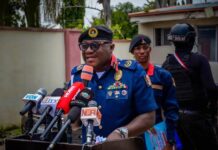
Ex Rivers State Governor Celestine Omehia has urged the National Assembly to halt the swift passage of the State Police Bill, warning that state police could undermine democracy, fuel ethnic tensions and be abused by governors for political purposes.
Former Rivers State Governor Celestine Omehia has cautioned the Senate President, Godswill Akpabio, and the National Assembly (NASS) against rushing the passage of the State Police Bill, warning that the proposed security framework could pose serious threats to democracy across Nigeria.
Speaking in an interview with journalists in Abuja on Monday, Omehia argued that establishing state police would create opportunities for abuse by state governments and weaken democratic institutions at both the state and local government levels.
According to him, state police could encourage ethnic dominance, allowing majority groups to use security agencies to intimidate and oppress minority communities.
He called for extensive public consultations and a national public hearing on the proposed legislation instead of allowing state assemblies alone to determine its fate.
“Nigeria is not yet ripe for state police because state governors are likely to convert the personnel into personal militias to hunt down and suppress political opponents.
“He who pays the piper dictates the tune; the governors will fund, equip and ultimately weaponise these police forces, and in the long run it will result in tribal wars and become an albatross to our democracy,” he said.
Omehia maintained that the Nigeria Police Force (NPF) and the Nigeria Security and Civil Defence Corps (NSCDC) could effectively address the country’s security challenges if adequately funded and properly managed.
Rather than creating state police, he urged the Federal Government to recruit more personnel into the Nigeria Police Force to improve its operational capacity.
Drawing from his experience as governor of Rivers State in 2007, Omehia said his administration successfully tackled cultism and insurgency by working closely with the Nigeria Police Force.
“We trained 50 special personnel of the NPF who wore red caps and restored absolute peace to Rivers within six months,” he said.
He explained that his administration also adopted a “carrot and stick” strategy alongside the C4I model-Command, Control, Communication, Computer and Intelligence—to dismantle criminal networks and combat insecurity.
Concerns Over Abuse and Infiltration
The former governor warned that local militias already exist in many communities under the influence of politicians and council chairmen, arguing that formal state police structures could further worsen the situation.
He also expressed concern that bandits and criminal elements could infiltrate state police formations, particularly in parts of northern Nigeria, thereby compromising security operations.
According to Omehia, creating state police without adequate safeguards could lead to widespread human rights abuses and undermine democratic governance at the grassroots.
He appealed to President Bola Tinubu, Senate President Godswill Akpabio and members of the National Assembly to carefully consider the long-term implications of the proposed legislation before taking further action on the bill.
Visit GMTNewsng for more news stories.