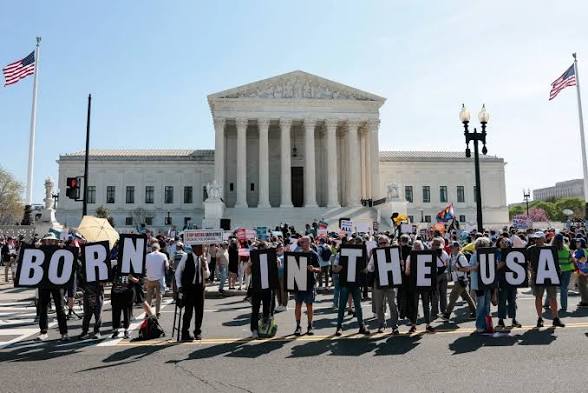
The U.S. Supreme Court has rejected President Donald Trump’s executive order restricting birthright citizenship, affirming that children born in the United States are citizens under the 14th Amendment, with only limited exceptions.
WASHINGTON, D.C. – The U.S. Supreme Court has rejected President Donald Trump’s attempt to limit birthright citizenship, ruling that children born in the United States remain citizens under the 14th Amendment of the Constitution, except in very limited circumstances.
In its decision on Tuesday, the court upheld the long-established interpretation of the Citizenship Clause, affirming that anyone born on U.S. soil is automatically an American citizen unless they fall within narrow constitutional exceptions, such as children of foreign diplomats.
The ruling effectively blocks Trump’s executive order, which sought to deny automatic citizenship to children born in the United States to parents who are in the country illegally or temporarily, including those on student or work visas.
The executive order, signed on Trump’s first day back in office during his second term, had been halted by several lower courts and never took effect anywhere in the country.
The Supreme Court’s decision came after it considered Trump’s appeal of a ruling by a federal court in New Hampshire, which had declared the executive order unconstitutional.
During oral arguments in April, both conservative and liberal justices expressed concerns about the legality of the order, despite the court’s conservative 6–3 majority.
The case marked another significant legal challenge to Trump’s expansive use of executive authority and was closely watched because it addressed one of the administration’s key immigration policies.
It was also notable because Trump became the first sitting U.S. president to attend oral arguments before the Supreme Court.
The justices relied on the long-standing interpretation of the 14th Amendment, adopted after the Civil War, as well as subsequent federal laws recognising birthright citizenship for nearly all children born in the United States.
The amendment states that all persons born or naturalised in the United States, and subject to its jurisdiction, are citizens of the United States.
Trump’s administration had argued that the constitutional phrase “subject to the jurisdiction thereof” should exclude children born to undocumented immigrants and foreign nationals temporarily residing in the country.
However, the Supreme Court rejected that interpretation, reaffirming decades of constitutional precedent.
The ruling represents a significant setback for the administration’s broader immigration agenda, which has focused on tightening immigration rules through executive action.
The birthright citizenship case is the first of Trump’s immigration-related executive actions to receive a final ruling from the nation’s highest court during his second term.
It also follows an earlier Supreme Court decision striking down Trump’s attempt to impose global tariffs under emergency powers, a ruling the president publicly criticised.
Following that tariffs decision earlier this year, Trump accused the justices who ruled against his administration of being unpatriotic and expressed disappointment with the outcome.
Tuesday’s judgment reinforces the constitutional protection of birthright citizenship and leaves intact one of the longest-standing principles of American constitutional law.
Visit GMTNewsng for more news stories.