


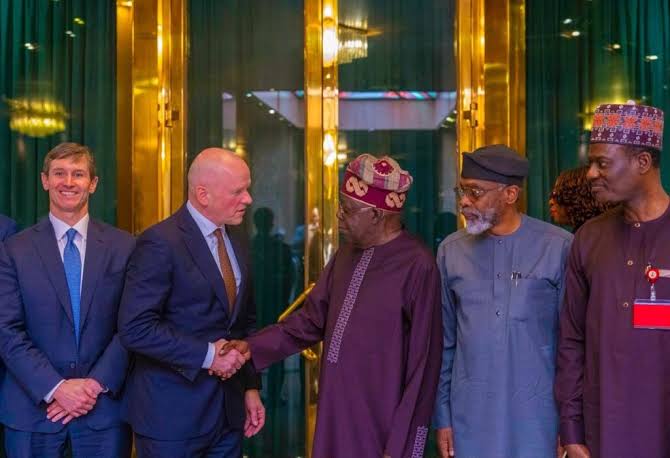
President Bola Tinubu has assured Mastercard of Nigeria’s readiness to participate in the global digital economy, highlighting the country’s tech-savvy youth population while endorsing plans to equip five million businesses with digital skills and financial tools.
President Bola Ahmed Tinubu has reaffirmed Nigeria’s commitment to building a globally competitive digital economy, assuring investors that the country’s youthful and technology-driven population remains well-positioned to integrate into global markets.
The President gave the assurance on Tuesday while receiving a delegation from Mastercard led by its Global Chief Executive Officer, Michael Miebach, at the State House in Abuja.
Tinubu welcomed Mastercard’s proposal to train five million Nigerian businesses and equip them with digital skills, describing the initiative as a significant contribution to economic growth, financial inclusion and youth empowerment.
According to the President, ongoing economic reforms have repositioned and stabilised Nigeria’s economy, creating opportunities for greater participation in the global digital marketplace.
He noted that the government’s efforts to formalise the country’s large informal business sector would unlock new opportunities for investment, job creation, digital transformation and sustainable growth.
“I am glad that you are very familiar with the terrain. I can classify you as a Nigerian. Mastercard has a very big reputation in financial management, and opportunities are spreading in Nigeria,” Tinubu said.
The President observed that more small businesses are embracing technology and registering their operations as government reforms continue to improve the business environment.
He stressed that empowering young Nigerians with digital skills remains a key priority of his administration.
“The most important asset is our youth. Payment platforms and systems are necessary for the inclusion of small and medium-scale enterprises. What you have been doing with our young population is commendable, and we will continue to support it in every form,” he added.
Tinubu also encouraged stronger collaboration between Mastercard and the Bank of Industry (BOI), noting that the institution maintains a comprehensive database of Micro, Small and Medium Enterprises (MSMEs) that could benefit from expanded digital and financial services.
Speaking during the meeting, Minister of Finance and Coordinating Minister of the Economy, Wale Edun, said ongoing economic reforms have created new opportunities for integration within Nigeria’s payment, credit and digital economy sectors.
He noted that government initiatives aimed at digitising public services and formalising informal businesses are producing measurable results.
According to him, more than 10,000 informal businesses have been applying for registration daily in recent months as a result of the administration’s fiscal and tax reforms.
“This speaks to the opportunities that abound in Nigeria for organisations like Mastercard,” he said.
The minister added that reforms in the credit sector, including mortgage financing, consumer credit, auto loans, student loans and small business financing, present significant opportunities for global financial technology firms.
He also highlighted Nigeria’s growing fintech ecosystem, noting that five of Africa’s nine fintech unicorns are based in the country.
In his remarks, Mastercard CEO Michael Miebach pledged the company’s continued support for Nigeria’s economic transformation agenda.
Miebach, who established Mastercard’s operations in Nigeria in 2011, described the country as a strategic market with enormous growth potential.
“We have seen the country grow, and we have seen the country lead. There is significant momentum in Nigeria driven by the alignment of fiscal and monetary policies,” he said.
He disclosed that Mastercard currently helps prevent approximately $200 million in fraud annually in Nigeria while facilitating around $2 billion in foreign exchange inflows.
The company, he added, continues to support the growth of small businesses, financial institutions and digital payment infrastructure across the country.
Miebach said Mastercard aims to unlock the potential of Nigeria’s estimated 40 million small and medium-sized enterprises by providing digital tools, training and market access opportunities.
“We want to connect the diaspora to the homeland and help ensure Nigeria becomes the most thriving and largest economy on the continent. We also want to drive the intra-African digital economy,” he said.
The Mastercard chief further revealed that the company has developed a framework to provide digital skills and business development support to millions of entrepreneurs across Nigeria.
According to him, many small business owners recognise the importance of digitalising their operations but often lack the knowledge and resources needed to do so successfully.
He disclosed that Mastercard has designed a three-year programme focused on capacity building, cyber safety, digital business management and financial inclusion.
The programme will be supported by technical workshops and implementation strategies aimed at delivering measurable impact for participating businesses.
Miebach also reaffirmed Mastercard’s commitment to strengthening cybersecurity and digital resilience through investments in cyber intelligence, artificial intelligence risk management, incident response systems and emerging technology solutions.
Analysts say the partnership aligns with Nigeria’s broader ambition to deepen financial inclusion, accelerate digital adoption and position the country as a leading technology and innovation hub in Africa.
Visit GMTNewsng for more news stories.