


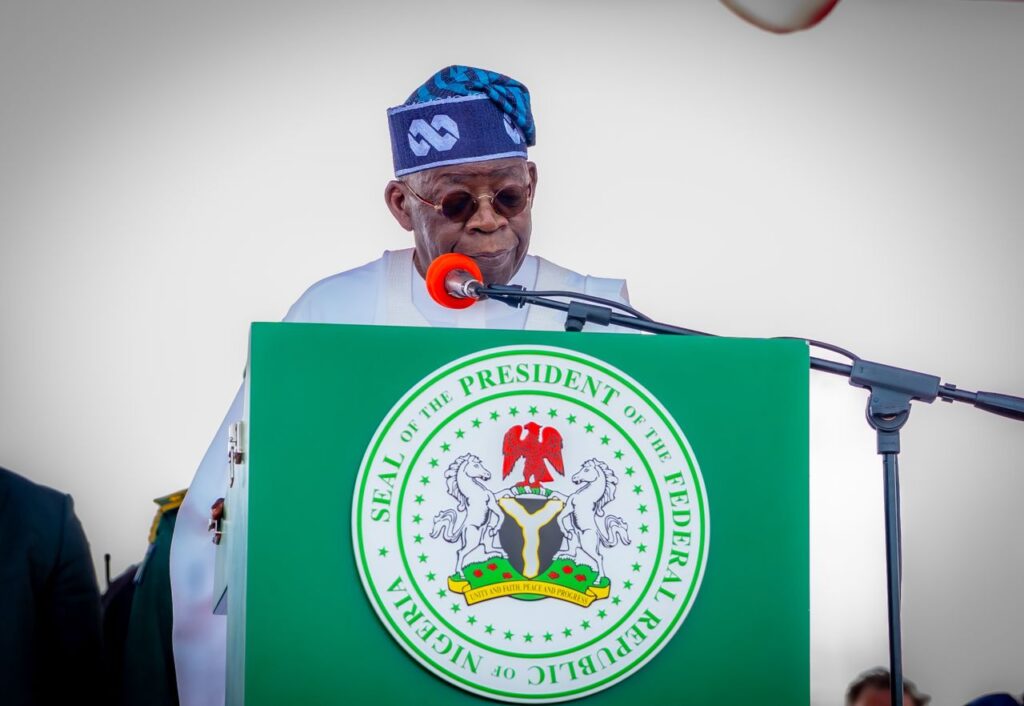
President Bola Tinubu’s Democracy Day 2026 address highlighted security achievements, economic reforms, electricity sector recovery, local government autonomy, and national honours for June 12 heroes as Nigeria marks 27 years of uninterrupted democracy.
ABUJA – President Bola Ahmed Tinubu on Friday used his 2026 Democracy Day address to defend his administration’s economic reforms, highlight gains in the fight against insecurity, honour heroes of the June 12 struggle, and reaffirm his commitment to deepening democratic governance and expanding prosperity across Nigeria.
Addressing Nigerians on the occasion of the nation’s Democracy Day celebration, Tinubu described the country’s 27 years of uninterrupted democratic rule as a significant achievement that must be protected and strengthened.
“Today, we celebrate democracy and the enduring Nigerian spirit,” the President said, noting that since 1999 Nigerians have continued to choose their leaders through the ballot box and resolve political disagreements through democratic institutions rather than violence.
Calls for Credible Elections
With governorship elections approaching in Ekiti and Osun states, the President urged the Independent National Electoral Commission (INEC), security agencies and political actors to uphold the integrity of the electoral process.
“Democracy fails when citizens doubt the process,” Tinubu stated, while calling on political stakeholders to ensure peaceful and credible elections.
He also commended the National Assembly, judiciary, media and civil society organisations for their role in safeguarding democratic governance.
“Criticise me, disagree with me, but never stop believing in Nigeria,” he said.
Message to Nigerian Youth
The President dedicated a portion of his address to young Nigerians, urging them to see the country as a place of opportunity and innovation.
“Build here, code here, work here, and vote here. Every great nation was built by those who stayed to solve problems, not by those who abandoned ship,” he said.
He stressed that the future of the country rests largely on the creativity, entrepreneurship and civic participation of its younger generation.
Security Takes Centre Stage
Tinubu acknowledged that this year’s Democracy Day celebration was overshadowed by recent incidents of insecurity, particularly the abduction of schoolchildren in Oyo and Borno states.
Expressing optimism that the victims would be safely reunited with their families, he reiterated his administration’s commitment to restoring peace and security nationwide.
“Democracy without security is not solid enough,” the President declared.
He disclosed that the Federal Government has approved the recruitment of more than 50,000 additional police officers alongside thousands of military recruits as part of a broader security strategy.
Tinubu further revealed that the 2026 budget earmarked ₦5.41 trillion for defence and security, describing it as the largest allocation ever made to the sector.
Highlighting military achievements, the President said Nigerian forces had successfully degraded an ISWAP command centre in Arege, Borno State, while intensifying precision operations against terrorist groups.
According to him, terror-related deaths have declined significantly over the years, while more than 13,000 terrorists were neutralised within the past year.
He added that over 124,000 insurgents and their dependants have surrendered through Operation Safe Corridor since 2023.
Issuing a stern warning to criminal elements, Tinubu declared: “Surrender or face the full force of the Nigerian State. These windows of surrender will not remain open forever.”
Honouring Heroes of Democracy
The President paid tribute to Nigerians who fought for democratic freedoms during the June 12 struggle, describing their sacrifices as the foundation upon which modern democratic Nigeria was built.
He honoured the memory of Chief M.K.O. Abiola and Alhaja Kudirat Abiola, alongside other prominent figures who played significant roles in resisting military rule and advancing democratic ideals.
Tinubu also acknowledged the contributions of labour leaders, journalists, activists, students, women, professionals, politicians and military officers who endured imprisonment, exile, persecution and other hardships during the pro-democracy struggle.
As part of activities marking Democracy Day, he announced national honours for dozens of pro-democracy advocates and pledged that a comprehensive honours list would be released in the coming days.
The President further disclosed that the Federal Government had approved the renaming of the Institute of Petroleum Studies in Kaduna as the General Shehu Musa Yar’Adua University of Geological Sciences and Engineering Technology in honour of the late statesman.
Defending Economic Reforms
A significant portion of the address focused on the administration’s economic policies and the rationale behind reforms introduced since 2023.
Tinubu maintained that the measures were necessary to stabilise public finances and reposition the economy for long-term growth.
“The reforms we are undertaking were not chosen for ease, but for necessity,” he said.
According to the President, government revenues have improved, enabling increased allocations to states and local governments for infrastructure, healthcare, education and security.
He also pointed to improvements in fiscal transparency and efforts to reduce leakages in public finance management.
Investor confidence, he said, is gradually returning, with increased investments being recorded across agriculture, manufacturing, energy, technology, mining, transportation and the creative economy.
Electricity Sector Reforms
The President identified the electricity sector as one of the most difficult challenges inherited by his administration.
He painted a picture of a sector previously burdened by inadequate generation, weak transmission infrastructure, gas supply constraints, huge metering deficits and unsustainable debts.
To address these challenges, Tinubu highlighted the implementation of the Electricity Act, which gives states greater authority over electricity generation, transmission and distribution.
He also announced efforts to reduce the metering deficit and settle verified legacy debts through a proposed ₦4 trillion bond programme.
“Electricity is a democratic dividend we owe every Nigerian. We intend to deliver it,” the President said.
Tinubu added that rural electrification projects supported by development partners are expanding access to power in underserved communities, markets, hospitals and educational institutions.
Agriculture, Exports and Infrastructure
The President outlined measures aimed at strengthening agriculture and boosting non-oil exports.
He disclosed that the National Agricultural Development Fund is implementing plans to deploy 10,000 tractors over a five-year period to improve productivity and support farmers.
According to him, more than 1,000 small and medium-sized enterprises have been certified for export, while non-oil exports recorded a 21 per cent increase in the past year.
Tinubu also highlighted ongoing infrastructure projects across the country, saying they are improving connectivity, creating jobs and opening new opportunities for businesses and local communities.
Local Government Autonomy
The President reiterated his administration’s commitment to ensuring financial autonomy for Nigeria’s 774 local government councils.
He argued that weak grassroots governance has contributed significantly to insecurity and underdevelopment across many parts of the country.
“Recognising that democracy is undermined when people do not feel its impact, my administration has sought financial autonomy for our 774 local councils,” he said.
According to Tinubu, strengthening local governments is essential to ensuring that the benefits of governance reach communities directly.
Renewing Faith in Nigeria
As he concluded his address, the President urged Nigerians to remain united despite economic and security challenges.
He called on citizens to reject division, despair and cynicism, while embracing hope, unity and national purpose.
“June 12 reminds us: Nigerians do not break. We bend, we bleed, but we do not break,” he declared.
The President said the generation that secured political independence gave Nigeria freedom, while the June 12 generation secured democracy. He argued that the responsibility of the present generation is to secure prosperity and economic freedom for all Nigerians.
Prospects and Implications
The address presents a roadmap focused on three major pillars — security, economic recovery and democratic consolidation.
If the security measures outlined by the administration yield sustained results, Nigeria could witness further reductions in terrorism, banditry and kidnapping, thereby creating a more stable environment for investment and development.
The emphasis on fiscal reforms, infrastructure expansion, agricultural mechanisation and export growth suggests a government seeking to transition the economy from dependence on oil revenues to a more diversified and productive model.
Tinubu’s commitment to electricity reforms and local government autonomy also points to an effort to address long-standing structural challenges that have hindered economic growth and grassroots development.
Perhaps most significantly, the President’s repeated references to youth participation, democratic institutions and national unity indicate an attempt to build public confidence in both governance and the country’s future.
Whether these ambitions translate into measurable improvements in living standards will largely determine how Nigerians assess the impact of the administration’s reforms in the years ahead.
Visit GMTNewsng for more news stories.