


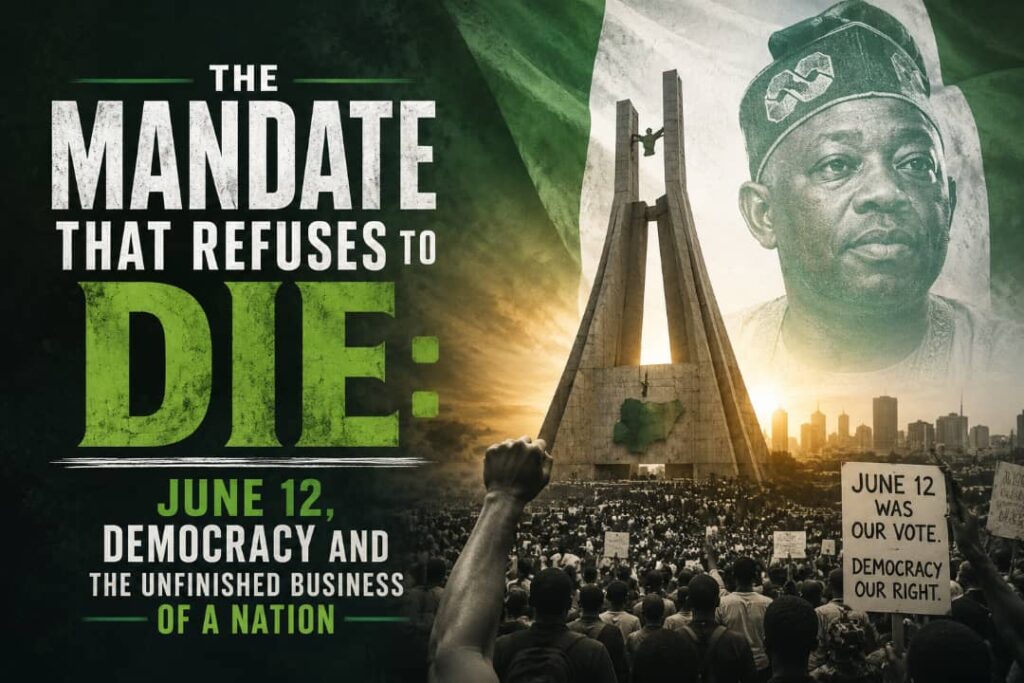
The Mandate That Refuses To Die: June 12, Democracy And The Unfinished Business Of A Nation
By Maxwell Menkiti Ngene
In a profound reflections essay commemorating Democracy Day 2026, media scholar Dr. Maxwell Ngene argues that while Nigeria has built structural democratic continuity, the true socioeconomic and electoral promises of the historic June 12, 1993 mandate remain unfulfilled
There is a particular kind of democratic wound that does not heal. It does not bleed visibly, does not disable the body politic from functioning, but it throbs quietly, and persistently at the centre of the national conscience, reminding the citizenry of what was possible and what was destroyed. For Nigeria, that wound has a date: June 12, 1993. And every year, as the country pauses to observe Democracy Day, that wound opens afresh not to cause despair, but to demand reckoning.
On this day in 1993, the Nigerian people did something remarkable. They queued. They queued under the sun, across ethnic divides, across religious fault lines, across every imaginable boundary of sentiment and suspicion that had historically fragmented their collective will. They queued behind the photograph of a man called Chief Moshood Kashimawo Olawale Abiola, who embodied, improbably and powerfully, the possibility of a truly national Nigerian presidency. They voted. They won. And then, eleven days later, their victory was seized from them by military fiat and political cowardice.
Thirty-three years have now elapsed since that fateful morning. Nigeria has had eight elected presidents, thirty-six elected governors cycling through their constitutional terms, and a National Assembly that has passed landmark legislation, quarrelled with the executive, been accused of corruption, and occasionally risen to moments of genuine institutional courage. By the most basic procedural measure, Nigeria is a democracy. But the deeper question – the one that the spirit of June 12 continues to press upon us is whether Nigeria has become the democracy that the people who queued in 1993 deserved.
The Wound at the Beginning
To understand what June 12 means, you must understand what June 23, 1993 did. When General Ibrahim Babangida, through his Information Minister, Chief Alex Akinyemi announced the annulment of the presidential election results, he did not merely cancel an election. He executed a democratic possibility. He told the Nigerian people, in language more brutal than any formal declaration could express, that their votes were conditional and that the military reserved the right to nullify their choices whenever those choices proved inconvenient to the ruling establishment.
The man whose mandate was annulled, MKO Abiola had won in a manner that astonished even his own supporters. He had secured votes in the deeply Muslim North, running with a northern Muslim running mate, Babagana Kingibe of Borno State. He had built a coalition that crossed the famous divides of Nigerian political imagination. The Option A4 open ballot system, under which voters physically queued behind the photograph of their candidate, had reduced the scope for the manipulation that had characterised previous exercises. Independent observers, domestic and foreign, were near-unanimous: this was the freest and fairest election Nigeria had ever conducted.
And it was annulled. The reasons given were pretextual – 1111111court injunctions obtained by the Association for Better Nigeria, a proxy group widely believed to be a military instrument. The real reason was simpler and uglier: Abiola was too popular, too independently wealthy, too nationally rooted to be controlled. He could not be managed. And in the political economy of military Nigeria, a civilian president who could not be managed was a threat. So his mandate was murdered.
What followed was a trajectory of tragedy. The brief, confusing interlude of the Interim National Government under Ernest Shonekan. The palace coup that installed General Sani Abacha. Abiola’s declaration of himself as President in Epetedo, Lagos on June 11, 1994. His arrest, his detention, his years of confinement under the most deliberately harsh conditions a regime could construct. His death in detention on July 7, 1998 on the very day he was meeting with American diplomats and was, by some accounts, on the verge of release. A death whose circumstances remain, to this day, a wound within a wound.
A Belated Redemption and Its Limits
In June 2018, President Muhammadu Buhari did something unexpected. He designated June 12 as Nigeria’s official Democracy Day, replacing May 29, and conferred on Abiola the posthumous honour of Grand Commander of the Federal Republic, Nigeria’s highest national award. The act was widely applauded, and rightly so. It was an overdue acknowledgement by the Nigerian state that its democratic identity is rooted not in the untroubled foundation of a military handover but in the contested, blood-soaked, morally complex soil of a stolen mandate.
Yet, acknowledgement and atonement are not the same. Renaming Democracy Day in honour of Abiola is meaningful symbolism. But symbolism without structural change is a memorial, not a remedy. The deeper question that the re-designation leaves unanswered is this: have we built the institutions, developed the culture, and generated the political will to ensure that what happened to Abiola’s mandate and to the voters who created it can never happen again?
The honest answer, assessed as at June 12, 2026, is: not yet.
Twenty-Seven Years of Democratic Construction
Let justice be done, however, to what Nigeria has managed to build. The post-1999 democratic era has produced an unbroken continuity of constitutional governance unprecedented in our national history. Seven successive presidential elections have been conducted. The military has stayed in its barracks. A National Assembly has functioned – imperfectly, infuriatingly, but continuously. Courts have delivered judgments, some of which have genuinely constrained executive power.
The landmark of 2015 must never be taken for granted: when President Goodluck Jonathan, facing credible results that showed he had lost to Muhammadu Buhari, telephoned his opponent to concede before the final official announcement, he did something no Nigerian president had ever done. He chose the constitution over his own continuation in power. That telephone call was worth more to Nigerian democracy than a thousand policy speeches, because it demonstrated visibly, nationally, internationally that elections here could produce alternation of power without catastrophe.
The expansion of civic space has been real. The media, for all its challenges, has remained broadly free. Civil society has grown in depth and sophistication. Social media has opened a public square that cannot be closed by any government that does not wish to rule by total coercion. The #EndSARS protests of 2020 showed that young Nigerians, armed with smartphones and organised across platforms, could mobilise millions in days a democratic energy that no wise government should ignore, dismiss or suppress.
Legislative progress has been made. The Freedom of Information Act. The Not Too Young to Run Act. The Violence Against Persons Prohibition Act. The Electoral Act of 2022, with its Bimodal Voter Accreditation System (BVAS) and the result viewing portal (IReV). These are not nothing. They are the slow accretion of democratic architecture, brick by contested brick.
The Unfinished Business: Where Democracy Still Fails Its People
And yet Nigeria has the largest number of extremely poor people on earth, a statistic that coexists with its democracy as a reproach, not a coincidence. Approximately 133 million Nigerians nearly 63% of the population live in multidimensional poverty. The fuel subsidy removal of May 29, 2023, whatever its economic justification, detonated an inflationary crisis that has compressed the purchasing power of ordinary Nigerians to a point of genuine humanitarian distress. Food inflation exceeded 40% at its peak in 2024. These are not abstract figures. They are the lived experience of democracy’s failure to deliver its most basic promise: a better life.
Electoral integrity remains the open ulcer of Nigerian democracy. The 2023 presidential election, despite the promise of BVAS and IreV. These are technologies that generated genuine public optimism, produced a result so contested that the courts were seized of it for months. Whatever the judiciary’s final determinations, the public cynicism generated by that process, the allegations of manipulation, the irregularities cited, the sense among millions of voters that the technology meant to protect their votes had been circumvented was a democratic wound of the first order.
Insecurity has eaten into the territorial and civic fabric of the nation in ways that directly suppress democratic participation. A population that cannot move freely cannot vote freely. The 2023 elections returned a national voter turnout of approximately 29%, the lowest in Nigeria’s democratic history. Behind that number lies a universe of citizens intimidated, displaced, or simply disillusioned into civic withdrawal. A democracy with 29% participation is not a healthy democracy; it is a franchise exercised by the minority on behalf of the majority.
Corruption continues to drain the democratic covenant of its content. When public officials steal the resources that should build hospitals, schools, roads, and power infrastructure, they are not merely committing financial crimes. They are breaking the democratic bargain – the implicit agreement between the elected and the electorate that power, once granted, will be used in the public interest. The persistence of impunity for high-level corruption enabled by a judicial system whose process stretches over decades while accused persons remain politically active is among the most corrosive forces in Nigerian democratic culture.
What June 12 Demands of Us Now
June 12 is not a day for comfortable speeches. It is a day for difficult accountability. What does the spirit of those who queued in 1993 demand of Nigeria in 2026? It demands, first and foremost, that the electoral process be made genuinely sacrosanct. With 2027 on the horizon, the imperative is urgent. The BVAS and IReV must function as designed, without interference, without selective deployment, without the technical failures that conveniently cluster in certain constituencies on certain results. INEC must be insulated from executive pressure with the same constitutional robustness that protects judicial independence. Electoral violence must be treated as the democratic treason it is, prosecuted aggressively and punished exemplarily.
It demands constitutional restructuring of a federation in which states are too dependent on federal allocations and too constrained in their developmental autonomy to serve their citizens effectively. True fiscal federalism in which sub-national governments retain a significant portion of the resources generated within their territories and are held accountable by their electorates for what they do with those resources is not a Yoruba or Niger Delta demand. It is a democratic demand. It is what the voters of 1993, who voted across ethnic lines, were implicitly voting for: a country that works for everyone.
It demands investment in the human infrastructure of democracy. An educated, economically secure, and civically literate citizenry is the most powerful democratic institution any country can have. Nigeria’s youth over 60% of a population approaching 230 million must be met with educational opportunity, employment, and the genuine prospect of a dignified life. Young Nigerians who feel excluded from the dividends of democracy are vulnerable to the recruitment pitches of insurgents, bandits, and political thugs. Young Nigerians who feel included have everything to protect by keeping democratic institutions strong.
And it demands of the media, this writer’s own estate, a renewal of professional purpose. The broadcast and print media organisations in Nigeria have a democratic function that transcends their commercial interests and their proprietorial loyalties. At its best, the Nigerian media has spoken truth to power, exposed corruption, educated citizens, and held the ring of democratic discourse. At its worst, it has been captured by political patrons, deployed as propaganda, and reduced to a vehicle for elite manipulation. June 12 calls the Nigerian media back to its best self to the investigative courage, editorial independence, and civic commitment that a democracy of about 230 million people desperately needs.
The Mandate That Refuses to Die
MKO Abiola is gone. He died in a detention cell, denied the presidency his people gave him. But the mandate he held, the mandate of the Nigerian voters who defied cynicism, queued in the sun, and made their democratic choice on June 12, 1993, that mandate has refused to die. It survived the annulment. It survived the military transition to Abacha. It survived Abiola’s death. It survived the years of May 29 celebrations that erased it from official memory. It survived even the Buhari re-designation that honoured it in name while the system it indicts has remained substantially unreformed.
The mandate lives in every Nigerian who votes despite having every reason not to. It lives in every journalist who publishes an inconvenient truth despite pressure to suppress it. It lives in every civil society advocate who appears before a government committee and refuses to be sycophantic. It lives in every young Nigerian who refuses to sell their vote for a bag of rice, who insists – against the accumulated evidence of systemic failure – that democracy can be made to work here.
On this Democracy Day, let us not merely celebrate. Let us interrogate. Let us ask, with the brutal honesty that the memory of June 12 demands: are we building the democracy that Abiola’s mandate deserved? Are we creating the institutions, the culture, and the political will that would ensure that no future mandate can be stolen – whether by a military coup, an electoral manipulation, a judicial capitulation, or the slow theft of poverty and despair?
If we ask those questions sincerely, and answer them honestly, and act on those answers with courage – then June 12 will have served its deepest democratic purpose. Not as a memorial to what was lost, but as the foundation of what we are still building.
The mandate has not died. The question is whether we are worthy of it.
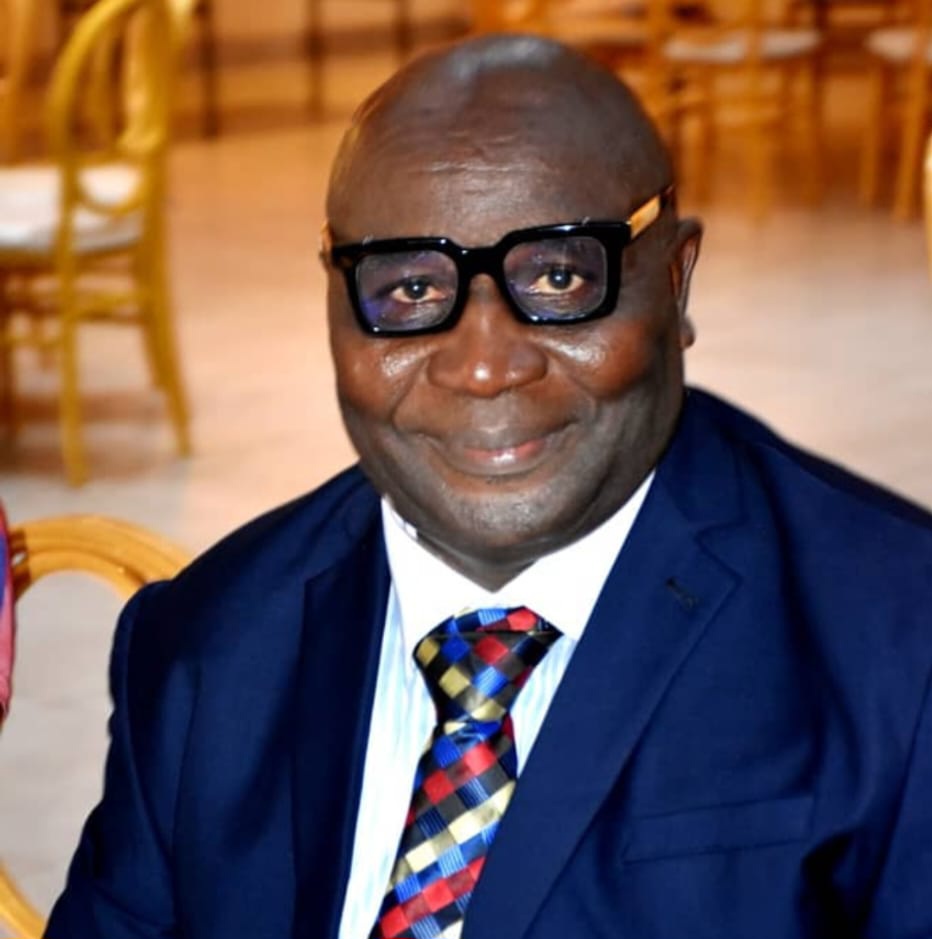

Dr. Ngene, PhD, is a Senior Lecturer and Postgraduate Programmes Coordinator in the Department of Mass Communication, Enugu State University of Science and Technology (ESUT), Agbani. He is a broadcaster, public affairs analyst, and member of the Guild of Public Affairs Analysts of Nigeria (GPAAN), Enugu State Chapter.
Visit GMTNewsng for more news stories.