


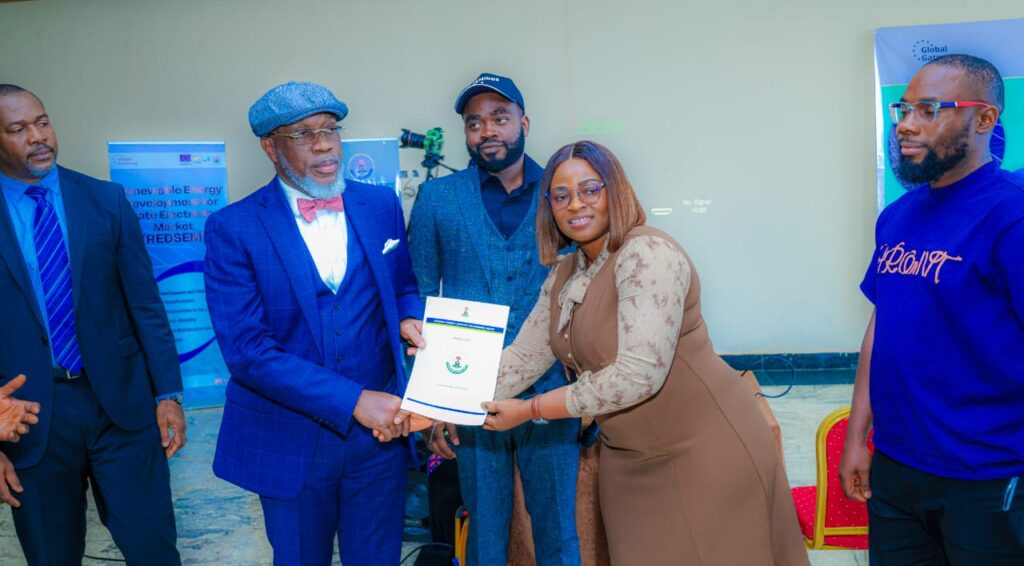
The Enugu State Government has sealed a partnership with four renewable energy firms to deploy solar mini-grids across four rural communities, scaling up rural development through the EU-GIZ-funded REDSEM initiative.
In a major boost for rural industrialization and off-grid power development, the Enugu State Government has officially signed historic grant agreements with four renewable energy developers to deploy solar mini-grid infrastructure across four underserved rural communities.
The deal was finalized during the Renewable Energy Development for State Electricity Market (REDSEM) Grant Agreement Signing Ceremony, a landmark initiative spearheaded by the Enugu State Government. The program is heavily supported by the Nigerian Energy Support Programme (NESP), the European Union (EU), and the German Development Agency (GIZ).
The project is targeting four key rural communities distributed across Enugu’s three senatorial districts: Okpatu, Ugbawka, Agwunta, and Ijabe. Among the selected clean energy developers executing the project are Darway Coast Nigeria Ltd and Sea Solar Energy Limited.
Fast-Tracking Rural Power with 80% Capital Subsidy
Speaking at the event, the Chairman of the Enugu State Electricity Regulatory Commission (EERC), Mr. Chijioke Okonkwo, disclosed that the intervention represents a strategic template to close the energy poverty gap in rural clusters through an in-kind capital grant funded by the German Government and the EU.
The grant completely covers the procurement of essential hard infrastructure, including high-capacity solar panels, deep-cycle battery storage systems, industrial-grade inverters, distribution poles, transmission wires, and related grid equipment. The infrastructure will establish integrated solar mini-grids boasting a minimum generation capacity of 200 kilowatts (kW) in each community.
“In a nutshell, it means that four more communities in Enugu State will have electricity within the shortest possible time, potentially within six months if implementation is fast-tracked,” Okonkwo noted.
Under the financial architecture of the REDSEM framework, 80 percent of the total project costs are entirely absorbed by the international development grant.
The winning private developers will finance the remaining 20 percent balance, which covers civil engineering works, smart metering deployments, day-to-day operations, and downstream utility service delivery. Okonkwo clarified that the electricity will be commercialized at strictly regulated, highly affordable tariffs to safeguard project sustainability and guarantee steady capital recovery.
Driving Enugu’s $30 Billion Economic Vision
The selected sites are part of an ambitious master list of 113 unserved and underserved communities map-coded by the state for systematic electrification. The host communities have already completed land allocation handovers and signed binding community-level pacts welcoming the private operators.
Mr. Joshua Garba, Head of Component for Sustainable Energy Investments at GIZ-NESP, lauded Enugu State’s proactive stance as Africa’s standout subnational government in pioneering an independent state electricity market under the new provisions of Nigeria’s decentralized Electricity Act.
Representing the Executive Governor of Enugu State, Dr. Peter Mbah, the Secretary to the State Government (SSG), Prof. Chidiebere Onyia, stated that the donor alliance fits flawlessly into the administration’s core policy blueprint to position Enugu as Nigeria’s premier investment hub through aggressive structural development.
The Commissioner for Energy and Mineral Resources, Mr. Franklin Enyinna, emphasized the macroeconomic necessity of the solar grids:
“You cannot grow Enugu’s economy from $4.4 billion to $30 billion without a reliable power supply. This project aligns perfectly with the governor’s vision of making Enugu an investment-friendly destination.”
To maintain technical compliance and commercial transparency, the Managing DirectorEnugu State Government, REDSEM, Solar Mini-Grids, GIZ NESP, of the Enugu State Electrification Agency, Mr. Christopher Ezeoha, affirmed that his agency will maintain tight operational oversight, enforcing rigorous engineering standards across the mini-grid lifecycles.
Expressing confidence on behalf of the clean energy operators, the CEO of Sea Solar Energy Limited, Mr. Chibueze Ekeh, described the selection process as highly rigorous and competitive. Ekeh announced that his company alone will directly hook up 600 households, instantly changing the economic realities of about 3,000 residents. Combined across all four installation sites, over 8,000 rural residents will gain immediate access to clean, uninterrupted 24-hour electricity for the very first time.
Visit GMTNewsng for more news stories.