


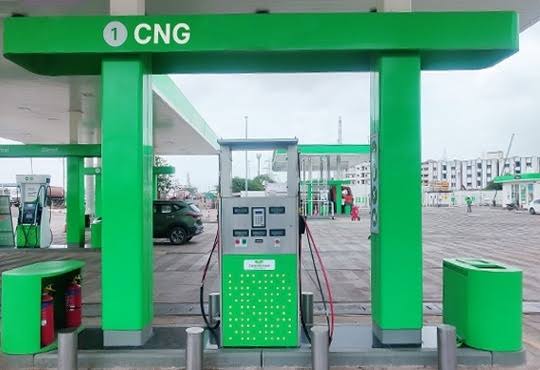
President Bola Tinubu has commissioned four major CNG infrastructure projects across Lagos, Abuja, and Owerri under the MDGIF, marking a major expansion of Nigeria’s clean transport energy transition and domestic gas utilisation strategy.
President Bola Ahmed Tinubu on Friday commissioned four major Compressed Natural Gas (CNG) infrastructure projects across Lagos, Abuja, and Owerri as part of a coordinated push to expand Nigeria’s clean transport energy network.
The projects were delivered under the Midstream and Downstream Gas Infrastructure Fund (MDGIF) and are tied to the federal government’s broader strategy to accelerate gas utilisation, reduce transport costs, and strengthen the shift toward cleaner fuel alternatives following subsidy reforms.
In Lagos, the President flagged off the Portland Gas CNG Mother Station at Ojota, featuring large-scale dispensing capacity, storage systems, and distribution trucks. Also at Ojota, he commissioned the IBILE Oil and Gas Corporation CNG Refuelling Station, which forms part of a wider network of 15 refuelling sites being developed across key areas of Lagos to support cleaner and cheaper transport energy access.
In Abuja, a high-capacity CNG Daughter Booster Station was inaugurated in Jahi District. The facility is equipped with advanced dispensing systems, compressor units, storage infrastructure, and conversion centres capable of serving both private vehicles and commercial fleets at scale.
In Owerri, Imo State, the President commissioned the FEMADEC CNG Daughter Station and Conversion Centre at the Federal University of Technology, Owerri. The project is part of a university-based CNG ecosystem designed to support student mobility, staff transportation, and vehicle conversion services under a national clean energy initiative.
The Federal Government also introduced a structured financing scheme under the Credit Access for Light and Mobility (CALM) Fund, implemented in partnership with financial institutions, to enable vehicle owners and transport operators access CNG conversion through affordable credit repayment plans.
President Tinubu stated that Nigeria’s energy transition will be driven by its domestic gas reserves, describing the newly commissioned facilities as proof of a shift from policy formulation to practical implementation.
He emphasized that Lagos remains central to national transport movement and that expanding gas infrastructure in major cities would significantly reduce fuel dependency and transport costs.
The Minister of State for Petroleum Resources (Gas), Ekperikpe Ekpo, described the projects as a key milestone in Nigeria’s Decade of Gas strategy, noting that the country’s vast gas reserves can transform transportation, industry, and household energy use if fully harnessed.
The Executive Director of MDGIF, Oluwole Adama, highlighted the collaboration between government agencies, investors, and technical partners, stating that the projects demonstrate effective delivery of infrastructure when policy and execution align.
The commissioning forms part of the Federal Government’s ongoing effort to reposition natural gas as a central pillar of Nigeria’s energy transition framework.
Visit GMTNewsng for more news stories.