


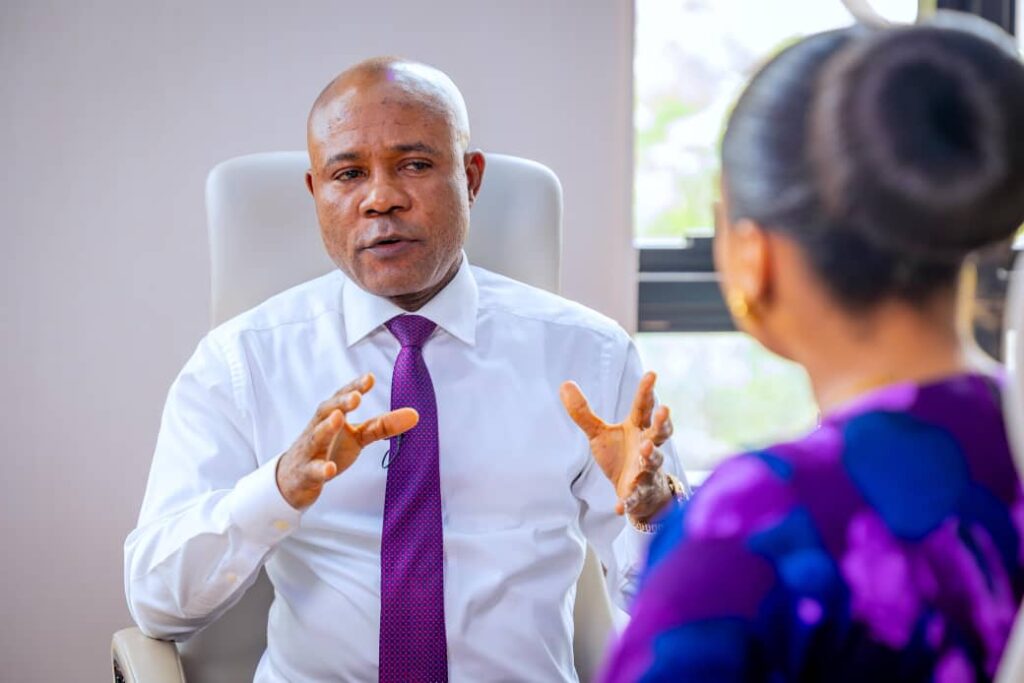
Governor Peter Mbah has dismissed claims of excessive taxation in Enugu State, saying the government only widened the tax net and blocked leakages while introducing measures to curb illegal revenue collection.
Governor Peter Mbah of Enugu State has dismissed allegations that his administration imposed high taxes on residents, describing the claims as a “pathetic misconception” promoted by opposition figures and individuals who previously benefited from irregular revenue collection practices.
The governor also vowed that the state government would arrest and prosecute illegal revenue collectors operating across the state.
Speaking during an interview aired on Afia Television, Mbah said his administration had increased the state’s Internally Generated Revenue (IGR) by expanding the tax net, blocking leakages and reforming revenue collection processes.
He said reforms such as the Consolidated Demand Notice, e-ticketing, and the recovery and monetisation of government assets had significantly boosted revenue.
According to him, the state’s IGR rose from ₦26.8 billion in 2022 to ₦37.4 billion in 2023, then surged to ₦180.5 billion in 2024 and ₦406.7 billion in 2025.
Mbah argued that critics were spreading false narratives because they could not comprehend the scale of the revenue growth achieved through these reforms.
The governor stressed that the 1999 Constitution of Nigeria does not empower state governments to legislate on taxes such as Personal Income Tax, Company Income Tax, Value Added Tax or Withholding Tax.
He explained that such taxes fall under the authority of the National Assembly of Nigeria.
“As a state, we are not able to legislate on taxation. It is on the exclusive legislative list and can only be legislated on by the National Assembly,” he said.
Mbah further explained that tax revenue accounted for only a small portion of the state’s total IGR in 2025.
According to him, tax revenue stood at ₦51.5 billion, representing 12.6 percent of the ₦406.7 billion IGR recorded that year, while non-tax revenue contributed ₦355.2 billion, representing 87.4 percent.
He said the figures demonstrated that the growth in revenue was largely driven by optimisation of state assets rather than increased taxation.
The governor said his administration had also reduced rates and fees within the state’s jurisdiction, particularly in the land sector.
He explained that a committee comprising market leaders, organised labour and the Enugu Chamber of Commerce, Industry, Mines and Agriculture reviewed charges across the South-East before recommending reductions.
According to him, Enugu already had the lowest rates in the region but the government still reduced some charges by 70 percent.
Mbah acknowledged that illegal revenue collectors were still operating in parts of the state, stressing that the government was intensifying enforcement to curb the practice.
He said the newly enacted Enugu State Harmonised Taxes and Levies (Approved List for Collection) Law, 2026 was designed to eliminate multiple collections and unauthorised roadblocks.
The governor added that the government had constituted a task force to track down illegal collectors and encouraged residents to report them through toll-free lines.
According to him, the new system consolidates government charges into a single payment covering multiple services.
“Some people still go about extorting money from helpless citizens because this practice has gone on for years, but we have constituted a standing task force to track and bring them to book,” he said.
Visit GMTNewsng for more news stories.